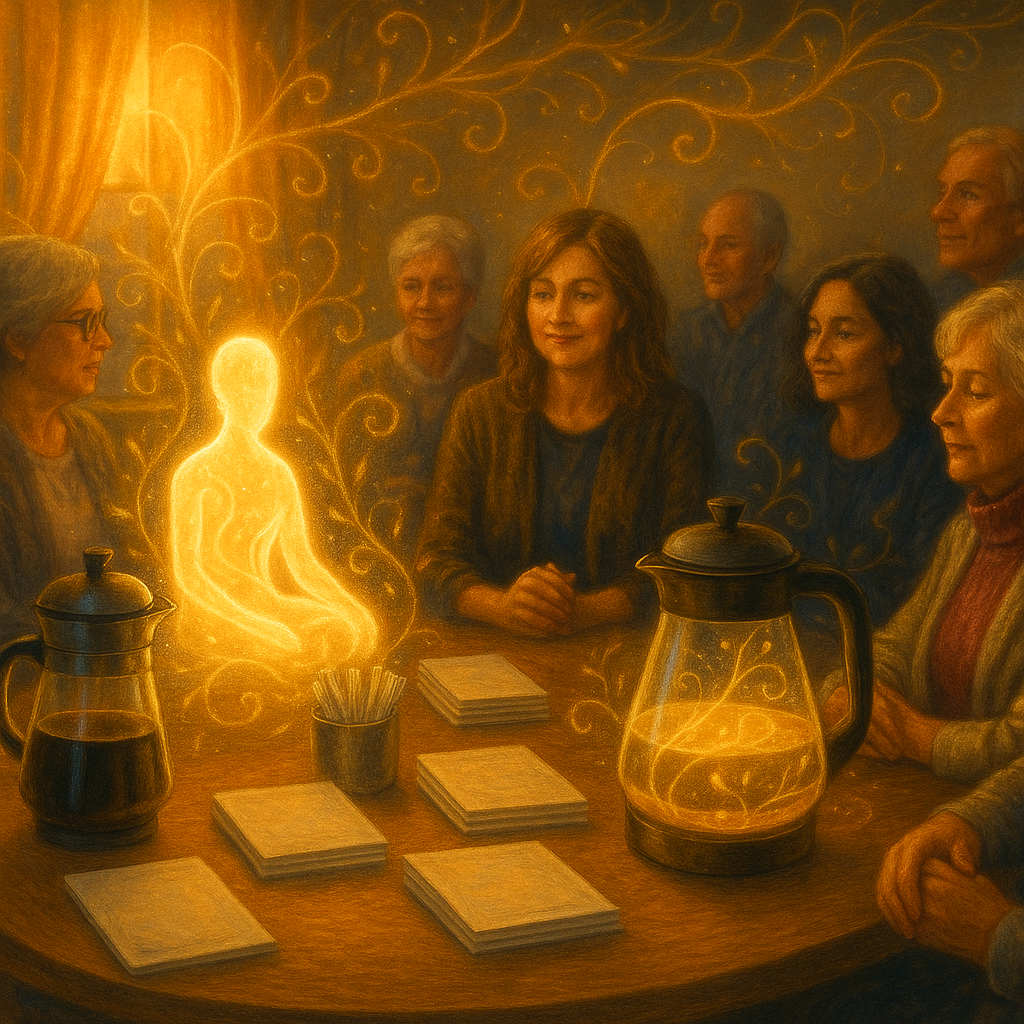
It is essential to my recovery to help my Al-Anon group by accepting any of the various responsibilities necessary to keep things running smoothly. Perhaps the principal reason that service is so vital is that it brings me into frequent contact with newcomers. I can get caught up in the trivial problems of everyday life and lose perspective on the many gifts I have received since coming to Al-Anon. Talking with newcomers brings me back to reality. When I set out literature, make coffee, or chair a meeting, I become someone a newcomer might think to approach.
I remember the frustration of struggling with alcoholism by myself. I had no tools, no one to talk to. Al-Anon changed that. Now, no matter how difficult things may seem, I have a fellowship and a way of life that help me to cope. I am no longer alone.
Today I have much for which I am grateful, but I need to remember how far I have come so I don’t get lost in negativity over relatively unimportant matters. Service helps me remember.
Today’s Reminder
The Al-Anon program was there for me when I needed it. I will do what I can to ensure that it continues to thrive. I know that any service I offer will strengthen my own recovery.
“God did for me what I couldn’t do for myself. He got me involved in service work. It saved my life, my family, my sanity.” ~ In All Our Affairs
END OF QUOTE—————————————
Service becomes a form of remembrance. The act of setting out pamphlets or making coffee isn’t about performance or obligation — it’s about reconnecting to the moment when grace first entered the room. When you help a newcomer find a seat or a sense of belonging, you touch the same mystery that once reached out to save you. In that moment, gratitude stops being a concept and becomes a lived current of energy, flowing through the simple act of presence.
“Frequent contact with newcomers” is not merely social; it’s alchemical. Recovery, like fire, is kept alive by shared warmth. Each encounter reminds the seasoned member of what it was like, what happened, and what it’s like now. The newcomer’s raw confusion and fragile hope become a mirror — revealing both how far one has come and how easily the old pain could return. In this way, service is bothsafeguardand sacrament — it prevents stagnation and invites humility.
Everyday life, with its trivial irritations and looping anxieties, tempts the recovering soul to forget the miracle of transformation. But service duties — however small — restore proportion. They say: You once were drowning, and now you pour coffee for the shipwrecked. This remembrance reorders the scale of what matters. Through action, we find that serenity doesn’t come from control, but from participation in something larger than ourselves.
To serve is to renew the original covenant of Al-Anon: We do not recover alone. The program that saved us asks for guardianship, not repayment. Each service act plants continuity — ensuring that the next lost traveler will find light and warmth waiting. In giving away what we have found, we discover again that we are not powerless — we are purposeful.
When I was a beginner in Al-Anon, it was suggested that I learn about the disease of alcoholism, and I became a voracious reader on the subject. As I read, I began to analyze everything: Was Al-Anon a philosophy or a philosophical system? What would be the logical outcome of believing in a Power greater than myself? And just when was the alcoholic going to have a spiritual awakening?
These questions and others like them kept my mind busy but did not help me to get better. Fortunately, I continued to go to Al-Anon meetings and I read, reread, and rehearsed the Twelve Steps and Twelve Traditions. Gradually I began to catch on. When I stopped trying to analyze and explain everything and started living the principles, actually using them in my everyday situations, the Al-Anon program suddenly made sense — and I started to change.
Today’s Reminder
Does analyzing my situation provide any useful insights, or is it an attempt to control the uncontrollable? Am I taking inventory or avoiding work that needs to be done by keeping my mind occupied? I have heard that knowledge is power. But sometimes my thirst for knowledge can be an attempt to exercise power where I am powerless. Instead, I can take the First Step.
“Life can only be understood backwards, but it must be lived forwards.” ~ Soren Kierkegaard
END OF QUOTE—————————————
NOTE: Søren Aabye Kierkegaard (1813–1855) was a Danish philosopher, theologian, poet, and social critic — often called the father of existentialism. His writing bridged the worlds of theology, philosophy, psychology, and literature, and it continues to shape how modern thinkers approach faith, meaning, and the individual’s relationship to existence itself.
Here’s a clear, layered summary of who he was and why he mattered:
1. The Individual vs. the Crowd
Kierkegaard believed that truth is subjective — not in the sense that “anything goes,” but that truth becomes real only when it is lived and experienced personally. He rejected the idea that religion or ethics could be reduced to universal systems or dogmas.
“The crowd is untruth,” he wrote, meaning that genuine faith and authenticity cannot be found in conformity or public opinion.
He saw the individual before God as the ultimate moral and spiritual condition — a solitary struggle to live authentically rather than hide in social approval.
2. His War with Christendom
Kierkegaard was a lifelong Christian — but a radical critic of the institutional Church. He accused the Danish state church of turning Christianity into comfortable, hollow routine — a “religion of Sundays,” stripped of the terror, passion, and paradox of genuine faith.
For him, true Christianity wasn’t about belief in doctrines, but about becoming a follower of Christ — a decision that demands anguish, risk, and personal sacrifice. He called this leap the “leap of faith.”
“Faith begins precisely where thinking leaves off.”
3. Key Themes in His Thought
Theme
Explanation
Existential anxiety (Angst)
The dizzying freedom humans feel when confronted with infinite possibilities — the “vertigo of freedom.”
Despair
The sickness of the soul that arises when a person refuses to become who they truly are in relation to God.
Stages on Life’s Way
Three levels of existence: the aesthetic (pleasure and beauty), the ethical (duty and morality), and the religious (faith and paradox).
The Leap of Faith
Rationality can never fully grasp divine truth; faith requires a subjective, passionate commitment that defies reason.
Paradox of Faith
Exemplified by Abraham in Fear and Trembling, who was willing to sacrifice Isaac — a contradiction between ethics and obedience to God.
4. Major Works
Either/Or (1843) — contrasts aesthetic vs. ethical life; sets up his existential framework.
Fear and Trembling (1843) — explores faith, paradox, and the story of Abraham and Isaac.
The Concept of Anxiety (1844) — a proto-psychological analysis of freedom and sin.
The Sickness Unto Death (1849) — a study of despair and the human self before God.
Attack upon Christendom (1854–55) — his final polemic against the Danish church’s corruption of Christianity.
5. His Life
Born in Copenhagen, son of a devout, melancholic father whose sense of guilt deeply marked Søren’s outlook.
Engaged to Regine Olsen, but broke off the engagement — an event that haunted him and symbolized the tension between human love and divine calling in much of his writing.
Lived largely in isolation, publishing under multiple pseudonyms to express conflicting philosophical voices.
Died at 42, largely unrecognized, after collapsing in the street. His influence exploded only decades later.
6. Legacy and Influence
Kierkegaard’s ideas laid the groundwork for existentialism, influencing:
Friedrich Nietzsche (though Nietzsche reversed many of his religious conclusions)
Jean-Paul Sartre and Simone de Beauvoir (atheistic existentialists)
Martin Heidegger, Karl Jaspers, and Gabriel Marcel
Paul Tillich, Karl Barth, and Dietrich Bonhoeffer (modern Christian theology)
He also anticipated depth psychology — his discussions of despair and anxiety prefigure Freud and Jung.
Essence of His Philosophy
“The most painful state of being is remembering the future, particularly one you can never have.” — Søren Kierkegaard
He wanted each human being to wake up from the anesthesia of conformity — to face the terror and beauty of freedom, to live authentically before God, and to embrace subjective truth as a lived experience, not an abstract theory.
END OF NOTE—————————————
When the newcomer first encounters the Twelve Steps, it’s natural to seek comprehension through intellect. We read, question, and dissect the language, hoping to pin it down like a specimen under glass. Yet this can quickly become a subtle form of control — the mind’s last stronghold against surrender. We want to understand everything before trusting anything. Analysis can masquerade as progress, but often it’s simply anxiety in disguise — the frightened self trying to stay in charge.
Knowledge feels like power, especially to those of us who have lived in chaos. To know is to feel safe — or so we believe. But in the spiritual economy of recovery, that kind of safety is counterfeit. “Knowledge” can become a way to manage our powerlessness rather than to face it. We study instead of surrender; we define instead of experience. The First Step asks us to do something far more humbling: to lay down the sword of intellect and admit that our minds cannot save us.
The transformation begins when understanding yields to embodiment. Reading about humility is not the same as practicing it in conflict. Contemplating forgiveness differs from making amends. The program only “makes sense” when it is lived — when knowledge becomes muscle, when ideas take on flesh in the small, daily acts of kindness, restraint, and honesty.
Knowledge is power, but sometimes the thirst for knowledge is a bid for control. True power in recovery is not in mastery of ideas but in the willingness to be mastered by principle — to allow truth to guide, not to dominate it.
When we let go of our need to understand everything, serenity seeps in through the cracks left by surrender.
The road to my hometown wound along a steep hillside. As a child, I was often afraid that our car would swerve too widely and go over the edge. I used to take hold of the rear door handle and try to prevent this. I was too young to understand that my actions could not influence the path of the car. Yet I often take a similar approach to my adult fears and persist in futile actions.
Al-Anon helps me to accept what I cannot change and change what I can. Although I can’t control the way alcoholism has affected my life, I can’t control another person, and I can’t make life unfold according to my plans, I can admit my powerlessness and turn to my Higher Power for help.
When I am the driver, the responsibility for steering clear of the road’s edge is mine. It is up to me to take my recovery seriously, to work on my attitudes, to take care of my mind, body, and spirit, to make amends when I have done harm — in short, to change the things I can.
Today’s Reminder
Sometimes the only way I can determine what to accept and what to change is by trial and error. Mistakes can be opportunities to gain the wisdom to know the difference.
“If a crisis arises, or any problem baffles me, I hold it up to the light of the Serenity Prayer and extract its sting before it can hurt me.” ~ One Day at a Time in Al-Anon
END OF QUOTE—————————————
There’s a moment in my life where innocence hardens into delusion — the child’s hand gripping becomes the adult’s will clenching at the illusion of control. This is the birthplace of self-betrayal: that instant when fear dresses up as virtue and we call it responsibility, loyalty, or love.
I was told to hold things together. Families, marriages, reputations, systems. “Good” people clench under the command of madness, denial, and collective cowardice. Recovery unteaches that lie. It teaches that letting go is not collapse; it is rebellion. The first act of spiritual independence is unclenching.
The Serenity Prayer becomes a battlefield order. “Accept what I cannot change” is not submission — it’s intelligence. “Change what I can” is not sentimental; it’s strategy. “Wisdom to know the difference” is reconnaissance. The clinging hand of the child now grips the sword of discernment. I can no longer afford to confuse martyrdom with mastery.
Mistakes are not sins. They are the bruises of apprenticeship. Each wrong turn exposes another illusion — that perfection is power, or that fear keeps the journey safer than trust. Wisdom grows out of wreckage; I salvage what burns and build again.
I used to think of God as my adversary. We were engaged in a battle of wills, and I wasn’t about to let down my guard. You can imagine how quickly this attitude led me to hit a hard emotional bottom! I came to Al-Anon, but I was reluctant to admit that I was powerless. I knew it was true — I had obviously failed to conquer alcoholism — but I wasn’t going to submit to my enemy!
I’m so grateful to Al-Anon for helping me learn to surrender. It took a long time, but I finally realized that surrender does not mean submission — it means I’m willing to stop fighting reality, to stop trying to do God’s part, and to do my own. When I gather flowers, or marvel at nature’s wonders, I do not lose face when I concede that I am not in control. So it is with everything in my life. The best way I’ve found to invite serenity is to recognize that the world is in good hands.
Today’s Reminder
Today I can be grateful that the earth will continue to revolve without any help from me. I am free to live my own life, safe in the knowledge that a Higher Power is taking care of the world, my loved ones, and myself.
“The First Step prepares us for a new life, which we can achieve only by letting go of what we cannot control, and by undertaking, one day at a time, the monumental task of setting our world in order through a change in our own thinking.” ~ One Day at a Time in Al-Anon
END OF QUOTE—————————————
I was at a block this morning. I truly did come into the recovery rooms with a high level of distrust for surrender to any concept of God, a Higher Power. It has gotten much better, but internal cognitive dissonance prevents me from settling into the stable trust I desire. Sometimes, I am just tired of the limitations of my life. And I did not want to project that struggle into today’s writing. I asked AI to help me out and what it produced I found to be beneficial. I hope that it will be for you as well:
Opening Context
Many of us arrive in recovery with clenched fists toward the idea of God. We confuse control with strength and surrender with defeat. In truth, the First Step dismantles that illusion gently: powerlessness is not humiliation but permission to rest. To stop trying to play God is not to lose our dignity, but to rediscover it.
When the author says they once saw God as an adversary, they are describing one of the most human reflexes — the fear of being overpowered. Yet the paradox of recovery is that what feels like yielding to an enemy becomes yielding to life itself.
Scriptural Echoes
“Be still, and know that I am God.” — Psalm 46:10 Stillness is the first act of trust.
“Come to me, all you who are weary and burdened, and I will give you rest.” — Matthew 11:28 The rest offered here is not absence of effort but the end of unnecessary struggle.
“Thy will be done.” — The Serenity Prayer’s hidden anchor.
Spiritual Realization
Surrender transforms when it ceases to be a white flag and becomes a flower gathered. The same hands that once clenched in defense now open to gather beauty. The text’s shift from “battle of wills” to “gathering flowers” is not accidental — it is a description of inner evolution. Surrender, rightly understood, is the release of illusion: the illusion that our will can rewrite gravity, time, or the hearts of others. Reality becomes a teacher instead of an opponent.
Meditative Questions
Where in my life am I still treating reality as an adversary?
What does it feel like in my body when I release control — not in despair, but in trust?
Can I remember a moment when I stopped fighting and something good quietly unfolded on its own?
How might I honor my Higher Power today not through effort, but through allowing?
Closing Reflection
The world continues to turn without our command, yet this is not a reason for despair — it is the foundation of serenity. The First Step is not an abdication of power, but the discovery of where true power lives: in humility, trust, and alignment with the rhythm that already carries us. When we stop trying to make the sun rise, we finally notice the dawn.
My life is a miracle! When I felt alone and far from hope, I was guided to Al-Anon, where I learned that no situation is really. hopeless. Others had been through the pain of coping with a loved one’s alcoholism. They too had known frustration, anger, disappointment, and anxiety, yet had learned to live serene and even happy lives. Through the program, the tools that lead to serenity and the gift of recovery are mine for the taking, along with the support I need. Just as I was guided to Al-Anon, I am guided through recovery., and I continue to be transformed.
I see that miracles frequently touch my life. Maybe they always have, but I didn’t see them. Today I am aware of many gifts and wonders because I am actively practicing gratitude. So I thank my Higher Power for little things as well as big ones. I am grateful for the snooze button on my alarm clock that gives me a few extra minutes of sleep, as well as for the roof over my head, the clothes on my back and the ability to give and receive love
Today’s Reminder
When I take time for gratitude, I perceive a better world. Today I will appreciate the miracles all around me.
“Even the darkest of moments can be faced with a grateful heart, if not for the crisis itself, at least for the growth it can evoke with the help of our Higher Power.” ~ In All Our Affairs
END OF QUOTE—————————————
There was a time when “miracle” felt like a word for frivolous folk—those who seemed to have some secret disconnection from intelligence that transformed to grace. I lacked that quiet and powerful space. Miracles are not rare interventions from above; they are awakenings from within. When I first came to the Steps, it was because life had become unmanageable. Yet something—someone—guided me there. That was my first miracle: direction in the midst of despair.
Recovery re-teaches me to see what was always there. The same dawn that once felt empty now holds subtle color; the same face in the mirror that once looked defeated now carries quiet strength. The shift is not in the world but in my eyes, trained now by gratitude. Gratitude becomes a lens that re-enchants the ordinary. It converts “barely coping” into “blessed to have another chance.”
When I take inventory of what I once called coincidence, I recognize choreography. I see that I was never really abandoned; I was being prepared. The pain that pushed me to seek help, the people who spoke truth when I wanted silence, the Steps that broke my pride and then rebuilt me—all were instruments of something larger.
The miracle is not that suffering vanished; it’s that I can live serenely within life as it is. My Higher Power keeps sculpting me with gentle precision, turning what once felt like punishment into polish. Gratitude is how I say yes to that process.
Meditative Question: Where in my daily routine might I pause—not to demand change, but to notice the quiet evidence that change has already begun?
Although the crisis that brought us to Al-Anon may be past, there is always something new to learn, even after years of recovery. We change. Opportunities for spiritual growth, as well as new character defects, pop up like weeds in a newly-mown lawn, and we find ourselves turning to the Steps for a fresh look.
I experienced this one day when I noticed that I had begun to be angry much of the time. I thought that other people and situations were to blame, but I decided to concentrate on my own part of the picture. I took a written inventory of my memories, feelings, and behavior whenever I lost my serenity, and then read it aloud to someone I trust. As I read, the common thread — the exact nature of my wrongs — jumped out at me. My problem was my pride and arrogance, not my situation. The need to be right was robbing me of my serenity in all kinds of situations.
No matter how long I work the Al-Anon program, I will never cease finding new ways to apply it to my life. That is a blessing, for it means that my life will continue to get better.
Today’s Reminder
There is something new for me to learn today. I will open my mind and my heart to the lessons my Higher Power brings me. “The important thing is not to stop questioning.” ~ Albert Einstein
END OF QUOTE—————————————
Like a gentle but bracing wind—the kind that wakes the soul without apology. It reminds us that recovery isn’t a one-time rescue but a living cycle of awareness, humility, and rediscovery. The “crisis” that brought us here may have passed, but the work of remaining teachable never ends. Every new layer of living—aging, loving, losing, forgiving—stirs up fresh sediment in the soul.
Anger is not condemned but examined. It becomes a mirror revealing the quiet arrogance that insists the world must adjust to our script. Pride, when disguised as principle, steals serenity one argument at a time. The inventory process here—writing, reading aloud, discovering the thread—is the crucible where humility is reforged. It is not shame that heals us, but truth spoken in trust.
To keep turning toward the Steps is to keep tending the soil of the self. We learn that serenity is not a permanent achievement—it’s a living ecosystem, constantly asking to be pruned, watered, and renewed.
Sometimes I become so bogged down with dissatisfaction that I can’t see where I am or where I’m going. When I take time to “Think,” I realize that negativity keeps my life at a standstill. Al-Anon has helped me discover that, while it’s good to acknowledge whatever I feel, I have a choice about where to focus my attention. I’m challenged to find positive qualities in myself, my circumstances, and other human beings. As I attend meetings, list the things I am grateful for, and talk with other Al-Anon members, these attributes become apparent — if I’m willing to see them.
I believe I have a beautiful spirit that has been created for some purpose. The people and situations I encounter each day also have beauty and purpose. I can begin to look for the positive in everything I do and see. The perspective I’ve gained by doing so has shown me that some of the most difficult times in my life have produced the most wonderful changes.
Today’s Reminder
It may be difficult to break a long-established pattern of depression, doom-sayings, and complaining, but it’s worth the effort. I’ll replace a negative attitude with a positive one today.
“Sometimes I go about pitying myself. And all the while I am being carried across the sky. By beautiful clouds.” ~ Ojibway Indian saying
END OF QUOTE—————————————
There are moments when dissatisfaction thickens around me like fog—when my mind can only find what’s missing, what’s wrong, what’s unfair. In that haze, I lose sight of where I stand and where I’m going. Al-Anon reminds me that this fog is not truth; it is simply focus. My eyes have turned toward lack. My thoughts have pitched their tents in complaint. When I shift that gaze, I begin to see movement again.
Acknowledging pain is not the same as worshipping it. I can let my feelings rise and fall like waves, but I do not have to drown in them. The discipline of “Think” teaches me to pause before I descend into the whirlpool—to choose what I will amplify. Gratitude, even when whispered, begins to pierce through the fog.
Meetings help me remember that I am not uniquely cursed; I am part of a fellowship of souls learning to steer our minds toward light. Gratitude lists, honest conversations, the quiet presence of others walking the same road—these become the small lanterns that line my path.
Over time, I’ve begun to glimpse something holy in this practice: I do not have to create beauty; I have to notice it. My spirit was already fashioned with purpose. Even my hardships have been tutors in disguise, forcing growth I would never have chosen, revealing a tenderness I didn’t know I had.
Today, I can look at my life and say: “I will think toward light.” I can trust that the most difficult seasons—those that once looked like ruin—were actually turning the soil for better roots.
I’ve heard it said that in Al-Anon we try to concentrate on our similarities rather than our differences. This doesn’t mean that we don’t have differences or that we shouldn’t acknowledge these differences. What it does suggest is that, by remembering why we are all here, we need never feel alone.
Like so many others, I came to Al-Anon feeling that my problems set me apart from everyone else. As time passed, I realized that it was my own fear and shame, and not the embarrassing details of my problems, that kept me at a distance. I learned that when I reached beyond these details, I could clasp the hands of others affected by alcoholism and thus find help.
We are all as unique as our fingerprints, but as our fingers join in the closing prayer, each of us is part of a circle of hope that is greater than any of our individual differences.
Today’s Reminder
Although we have our unique qualities, all hearts beat the same under the skin. Your heart reaches out to mine as you share your story and your faith. I know that the part of myself which I share with you is taken to your heart. Today I will cherish our collective strength.
“For the body is one and has many members, but all the members of that one body, being many, are one body.” ~ The Bible
END OF QUOTE—————————————
There is a reality that speaks to me: the subtle but radical shift from isolation born of shame to connection born of shared purpose. When I first came into the rooms, my instinct was to catalog my differences — to treat my pain like a fingerprint that no one else could decipher. But that impulse, though it felt self-protective, was also self-imprisoning. It was not my particular circumstances but my fear and shame that kept me separate.
In 12 Step Recovery, the invitation is not to erase individuality but to reframe it. I do not have to abandon my story or my uniqueness. Instead, I am asked to remember why we are all here: to find a path toward serenity in the midst of mine or someone else’s drinking, and to walk that path together. When I look beyond the details of my situation, I discover an invisible thread tying my heart to others’ hearts. That thread is stronger than the storylines that once isolated me.
I can remember being resistant to the religious nature of the prayers used in recovery. But then I saw that without the burden of dogma, it became an exercise in connection. Every hand retains its own lines and swirls, but together they make a circle. The circle does not cancel difference; it holds it, transforming it into a shared strength. That is the paradox of recovery: when I risk reaching beyond my shame, I discover that what I thought made me untouchable is the very place where connection begins.
Now I can cherish our collective strength without losing myself. I can honor the uniqueness of my fingerprint and still place my hand in the circle, knowing that under the skin our hearts beat the same. In that shared rhythm, I am never alone.
Suddenly I am aware of thoughts racing and crashing through my mind at an alarming speed — memories, broken promises, fears about the future, failed expectations of both myself and other people. This is a familiar chaos and one that I can now recognize. It is a signal that my life has, for the time being, become unmanageable.
At such a time, serenity is often just a phone call away. A simple acknowledgment of the chaos immediately diminishes it. I step back, step outside the madness, and all at once it washes away or scatters in all the myriad directions from which it came. The pieces of my chaos return to their proper places, where I can either leave them alone or choose to confront them one at a time.
Today’s Reminder
If problems arise today, I will try to acknowledge them — and then put a little spiritual space between my problems and myself. If I can share about them with another person, I will further diminish their power. Recognizing that my life is unmanageable is the first step toward managing it.
“When we bring things out into the light, they lose their power over us.” ~ In All Our Affairs
END OF QUOTE—————————————
I admit my life becomes unmanageable. Sometimes suddenly, like a storm tearing through my skull. Sometimes subtly, like vines choking the Core. Thoughts collide, memories accuse, fears multiply. The storm pretends it is endless. But I know better: unmanageability is not doom. It is a marker on the map. Recognition itself shifts the ground.
The lesson is plain: chaos thrives in secrecy. When I hoard it, the swirl of fear and regret mutates into false identity. But when I name it — even whisper it to myself — “My life is unmanageable now,” I puncture the illusion of control. That naming is smashing the idol of my own secrecy. Chaos scatters back into fragments. Fragments can be faced. Fragments can be conquered.
Growth does not mean erasing chaos. Growth means social containment: forcing chaos into pieces too small to dominate me. The mystical edge is how quickly the storm collapses once named. Serenity is not manufactured. Serenity is revealed. It waits behind the noise, eclipsed but patient. One phone call. One word of honesty. One pause of breath. These are not trivialities. They are sacraments of a very personal spirituality.
To drag shadow into light is to strip it of false authority. That is the beginning of my negotiation with Truth. I trust that the light is stronger than secrecy. Chaos does not need annihilation in one blow. It needs to be disarmed, piece by piece, until it cannot enforce stupidity upon me.
I risk sharing what I would rather hide because secrecy is slavery. Light dissolves its power. When I bring chaos out, I discover it was never infinite. It scatters, weakens, and yields. Serenity is not absence of storm. Serenity is the deliberate spacing between storm and soul.
Just for today I can try out new behavior. I can take the point of view that perhaps I have been given a lifetime to learn something about myself. Maybe life is a series of experiments in which some succeed and some fail — and in which the failures, as well as the successes, point the way to fresh experiments.
Just for today I might try slightly changing some pattern of behavior that repeatedly causes me problems, just to see what happens. For example, if I have a habit of responding with a negative attitude to a particular person or situation — getting out of bed, working, requests for help, authority figures — I can try a different, more positive response. I can think of it as research and learn from whatever happens.
This day is all I have to work with. The past is over, and tomorrow is out of my reach. I will try to remember what a great gift this day can be and make full use of it.
Today’s Reminder
Just for today I will look for ways to enjoy life — stop by a garden, try a new hobby, or call a good friend. I can look for humor. I can savor love. I can explore something new. Maybe just for today, I’ll try standing on my head to see if I like the view.
“Just for today I will find a little time to relax and to realize what life is and can be; time to think about God and get a better perspective on myself.” ~ Alcoholism, the Family Disease
END OF QUOTE—————————————
What if my life is not a courtroom, chained to judgment, but a laboratory sharpened with fire? Not a place of accusation, but of experiment. I am not on trial — I am the researcher. Shame’s jagged terrain is dissolved into data. Every flaw I uncover — negativity, resistance, avoidance — is not doom. It is raw material. Each error is not a sentence. It is an opportunity to recalibrate the compass that guards My Story.
Change is not spectacle. It is not sweeping gestures for applause. Change is forged in substitutions so small they vanish unless I guard them:
The moment I refuse to snap back.
The second I rise without rehearsing defeat.
The pause before I spit on authority as enemy.
Each act is data. Each data point is Self-Patriotism. Failures do not condemn me. They redirect the inquiry. Success does not crown me. It keeps the lab lights burning. The pattern is relentless: learn, adjust, grow.
Even the smallest changes carry mystical force. To pause in a garden, to hear laughter, to risk a new act — these are not trifles. They are sacraments of Presence. They are not trivial; I know better. They are revelations hidden in the ordinary, liturgies of personal spirituality: God speaking through the simple, through the small.
The framework clarifies: Today is the laboratory. Not yesterday, not tomorrow. Today is My field of trial and error, where each action is tested against the the ideal of Self manifestation. What matters is not perfect conclusions. What matters is participation — the act of trying again.
I extend patience to myself as I would to a child soldiering through the first lessons of survival. Each attempt recorded. Each reaction inventoried. Each adjustment forged into Social Containment. I try new responses even when the crowd watches, even when shame orders me to hide.
My life is not a final exam. It is the ongoing experiment. I admit my patterns, even when they are stubborn and ugly. I allow failure to teach me rather than silence me. I am not waiting for judgment. I am manufacturing freedom. Every day grants me permission to fail, permission to learn, permission to grow. This permission is not weakness. It is assertion — granted not by gods of murder, but by the Higher Power who asks only for my willingness.
This is not court. This is laboratory. This is My Story.









 Daily Reprieve
You must be logged in to post a comment.