Archive for Alcoholism

Endigar 332

Posted in Uncategorized with tags , , , , , , on March 31, 2013 by endigar

TOS2x04

It is 19:48 and there is an impossible backlog of academic activities.  Why am I called upon so very late in the game?  I need to be rid of all internal and external interruptions.  If I could be here on a daily basis, I would not be dealing with this.  Maybe this is a Kobayashi Maru test.

Endigar 331

Posted in Uncategorized with tags , , , , , , on March 31, 2013 by endigar

male-slave-1

The council calls for me to accomplish and to deal with life on life’s terms.  i move forward, for i know it will serve Mission, and honor the Mistress who is the voice of my Goddess.  i go forward.  Down seven, up eight.

1652:  Shower – shave – breathing meds –

1810:  Leftovers cooked, Father and self fed – disposed of garbage – purchased cell minutes –

This body is short of breath and full of fatigue.  Academic emergency.  Must find the scholar.

Endigar 330

Posted in Uncategorized with tags , , , , , , on March 31, 2013 by endigar

bookcover01

I want to find My Gor-inspired life.  And I realize that as the days progress, I grow impatient with the oppressive environment of today’s earth culture.  I grow angry when I feel social control mechanisms sculpting Me into a dreary cog in Tharna.  I welcome a world that would call for My masculine expression, and if I had too little to answer, My life would be forfeit.  I know how I want to live.  I just have to find and manifest that reality.  One of the major Priest-Kings here on Earth appears to be Gomu.

I used Alcohol so that I could endure the perversity this life on Earth requires Me to embrace.  Alcoholism is a disease of the mind, body, and spirit.  Recovery is a method of being true to who I am.

Deh-Shay Deh-Shay Bah-Sah-Rah, Bah-Sah-Rah!

[http://www.youtube.com/watch?v=nreyvSkjbvM]

[http://pagelady.wordpress.com/2012/07/16/the-bat-chant/]

The important thing on this Resurrection Day, for Me, is not that He is Risen, but that we likewise experience our Rising.  I think the Christian Priest-King Y’shua would agree.

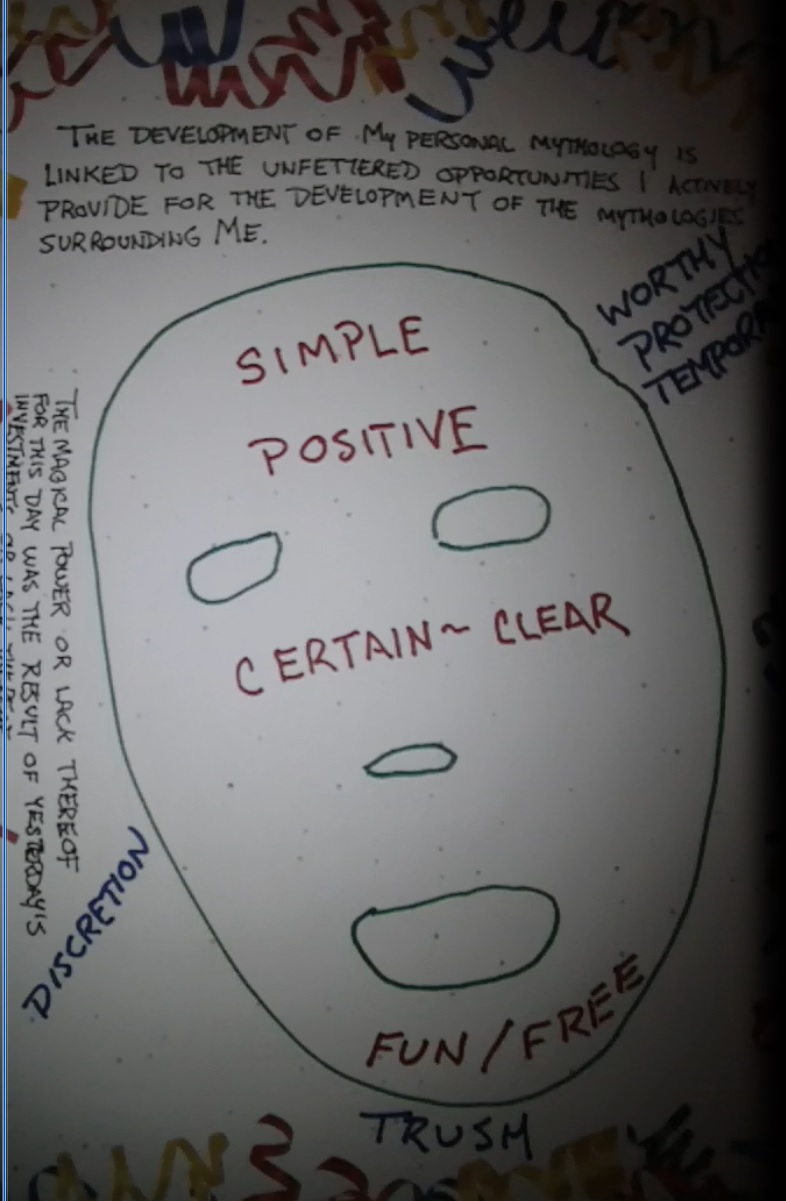
Endigar 329 ~ The Mask I Wear

Posted in Uncategorized with tags , , , , , , on March 30, 2013 by endigar

The Mask

The red terms within the Mask is what I would like to convey.  The blue terms surrounding it are the why I should wear it.  The black writing are two trains of thought where the Mask proves helpful.  The term Trush is one I created to express the fact that people give you about 5 minutes to express the truth of who you are before they lose interest and begin to use  interactive disengagement strategies.  Trush = truth (as you know it) + rush.   It is a very rare occasion when it is helpful to remove the Mask, because communication is a fragile thing.

Blue Terms Explained:

WORTHY – I think Jesus said it best in Matthew 7.   “Do not give dogs what is sacred; do not throw your pearls to pigs. If you do, they may trample them under their feet, and turn and tear you to pieces.”  True and open conversation belongs in the temple of mutual respect.

PROTECTION – Sometimes, when you reveal too much, you make others complicit in you life ambitions and assertions.  You may have come to peace with whatever you conspire to do in order to survive and thrive, but to pull others into your confidence and assume that they will be at peace with it as well, without establishing a history of mutual trust and respect, could create unnecessary dilemmas in your associations.

TEMPORARY – There are some relationships that are clearly temporary in nature.  The association is based on the completion of a common goal.  The Mask prevents the accomplishment of the mission from hitting roadblocks of intimate expectations.  Do not invest yourself in a relationship that does not have the ability or need for long term commitment.  Finish the job.  Get in and get out.  The Mask will help you focus.

TRUSH – This term has been explained above.  It’s application to the Mask is that you develop a quick summary story or hint about yourself in introductory interactions, and then disengage.  The Mask fights the need to become intimate with the masses.  You should become sensitive to those who probe for greater connection after they have received your trush.

DISCRETION – This is the practice of respecting the bubble of tolerance that surrounds other people.  There are religious and security and privacy sensitivities that we all have.  I resist talking about my sexual life in public.  I also cover my sneezes and hide my farts while out and about.  I do not pick my nose, scratch my balls, dig in my ass, or perform coitus or sexual groping while in casual display to the passers-by of daily living.  Cursing or explicit language within the hearing of young children, and adults who are repulsed by it, is another such unacceptable situation.  I am sure you can think of other incidents where you would like to have seen some discretion exercised out of respect for your own sensitivities.  If you claim to have no such sensitivities, then I would assert that you are also lacking in self-respect and need to work that out with your Higher Power, your sponsor, and / or your spiritual – psychological counselor(s).


These are guiding terms I use and I acknowledge that there are exceptions to every rule.

Endigar 328

Posted in Uncategorized with tags , , , , , , on March 28, 2013 by endigar

New Republic: Victims Of Addiction, Not Their Art

by SACHA Z. SCOBLIC

July 26, 2011 8:45 AM

partner content from:The New Republic

In this July 4, 2008 file photo, singer Amy Winehouse of England performs during the Rock in Rio music festival in Arganda del Rey, on the outskirts of Madrid. British police say singer Amy Winehouse was found dead at her home in London on Saturday, July 23, 2011. The singer was 27 years old.

Victor R. Caivano/AP

Sacha Z. Scoblic is a contributing editor for The New Republic and author of the new book Unwasted: My Lush Sobriety.

To the surprise of no one with the slightest sense of irony, singer Amy Winehouse, who earned a spot on iPods everywhere for saying no, no, no to rehab, died last weekend of an apparent overdose. Earlier this year, two other (less famous) celebrities, alumni of Dr. Drew Pinsky’s “Celebrity Rehab,” also died unsurprisingly from presumed overdoses: Mike Starr and Jeff Conway. Starr, formerly of the band Alice in Chains, had at one point achieved six months clean— an eternity in sobriety; but, then, it’s an insidious thing, this disease. And, lately, so is the response to it.

Over on The Huffington Post, Charles Karel Bouley (“KGO Radio and Syndicated Host, Stand Up, Entertainer, Author, Actor, Dog Walker”— who doesn’t blog for HuffPo?) spends many thousands of words pondering the cruelty of the “general public” who “pass judgment on Winehouse, or any of the other host of celebrities that left too soon because of drugs, alcohol, fast cars or a myriad of other ways to die.” Let’s break that down: We, the general public, are chastised for our— un-cited— judgments of Winehouse and those other celebrities who died in, well, myriad other ways. “Those critics are not artists,” he huffs. How perfectly annoying. It’s bad enough that Bouley cannot produce one example of this supposed mass intolerance of fast cars (?!) and the like, but then he has the gall to be callous toward the “general public”— none of whom, apparently, are artists. Talk about passing judgment. “What we really should be asking,” Bouley declares, “is, why artists?”

Really? Not: Why is it so easy to score drugs? Not: Why do we put addicts in jail for minor possession instead of rehab? Not: Why aren’t we doing anything about a disease that costs the United States alone more than $400 billion a year? No, no, no. We should be asking, Whyartists?— as though artists have a unique monopoly on addiction. According to Bouley, “being an artist hurts,” and he knows: He surrounds himself with “many very, very famous” artists. I don’t surround myself with many very, very famous artists (I live in D.C.), but I do surround myself with addicts. And, it turns out, they are pretty easy to come by in just about every profession. Heck, I can’t walk near Capitol Hill without bumping into a dozen addicted lawyers.

So, for once and for all, let’s give the lie to this silly notion that artists must suffer for their work via drugs and alcohol. Or that artists are so innately tortured that they must use drugs and alcohol to tolerate the injustices of the world (especially if they are rich and very, very famous). Or that creativity is solely derived from this artist-addict round-robin. “If Jim Morrison was sent to a 30-day program with Dr. Drew, would he have lasted, and if so, would he have created the same music?” wonders Bouley— in a wildly discordant epic pop-culture sophistry— as if Morrision’s music were worth losing his life over. Why doesn’t anyone ever wonder if his art— or Janice Joplin’s or Jimi Hendrix’s or Kurt Cobain’s or Heath Ledger’s or Jim Belushi’s— would have actually become even better with sobriety? Because, for every died-too-young artist, I can name ten got-it-together artists who went on to do even greater things in recovery: Robert Downey Jr., James Hetfield, Johnny Cash, Mickey Rourke, Betty Ford, Stephen King, Rob Lowe, Stevie Nicks, Craig Fergusen, Steven Tyler, Russell Brand, Ewan MacGregor, Robin Williams … I could go on. I bet they are all glad they didn’t die young for their art.

And guess what? Once you get sober— surprise!— pain still exists. You need not plumb the abyss of a heroin addiction to experience soul-sucking distress for the sake of art. Life happens, folks, and it’s not a guaranteed perfect ride. This notion that art must be accompanied by addiction is not just insidious; it’s enabling.

I think Mike Starr knew that; I think he knew his creativity, talent, and motivation would only come back if he went a different way, if he got sober. While Charlie Sheen willingly plays addicted jester to our wicked delight (I myself feasted on the ignobility of Sheen around the water-cooler at work only to feel like scum immediately afterward) and Winehouse dies and will be lionized, Starr did the hard work of attempting to bridge the insurmountable chasm between the way things started and the way they ended up.

Not all artists will, like Amy Winehouse, become enshrined as the young, sad, beautiful victims of art, fame, depression, and drugs— martyrs to their craft, like Bouley would have them. Chris Norris got it right when he wrote in New York Magazine‘s Vulture blog: “[A]s Mike Starr has shown, the reality behind this reality narrative is usually a much longer, downward arc, with few twists and turns, and a very predictable ending.” In other words, we who use to excess are all just addicts. Not artist addicts. Not special addicts. Not entitled-to-use addicts.

Indeed, even very, very famous addicts are just plain-old addicts. So let’s stop giving them a creativity pass.

[http://www.npr.org/2011/07/26/138697293/new-republic-victims-of-addiction-not-their-art]
Endigar 327

Posted in Uncategorized with tags , , , , , , on March 27, 2013 by endigar

I like the fact that this is post 327 on 3/27.

I wanted to use this post to republish an article given to me be a very close…well, for discretion’s sake, a very close friend.

The Artist and the Addict

By STEVEN PRESSFIELD | Published: MAY 18, 2011

The artist and the addict are not very far apart, are they? Often they’re one and the same. A blues musician or a painter can be an addict one minute and an artist the next. He can be an artist and an addict at the same time. On Tuesday you’re rocking the casbah; on Wednesday you’re checking in to Betty Ford. Why is that?

Bob Dylan

“It may be the devil or it may be the Lord,

But you’re gonna have to serve somebody.”

If Bob Dylan is right in Gotta Serve Somebody (and I think he is), we all do have to pick our masters. The question is whom.

The artist and the addict (or the artist/addict) both face the same dilemma each morning. Will they serve their higher nature or their lower? Between the two stands Resistance. Like gravity, Resistance exerts a pull back to earth. Its object is inertia. Resistance doesn’t want you to do something evil. It wants you to donothing.

Resistance wants you to go back to sleep, meaning remain unconscious. Resistance is always selling the easy way, the shortcut, the cheap shot. Resistance urges the artist/addict to slack off from, to sidestep, to avoid, to run away from, to not do. It wants you and me to stay shallow, to remain superficial, to continue unfocussed and uncommitted; to accept mediocrity, to avoid pain, to back away from the fight.

The addictive substance is Resistance’s ally. The addictive substance wants the same thing Resistance does. The addictive substance is the free ride to unconsciousness and to surcease from pain.

We’re all human, and the human condition hurts. How do we make that pain go away? How do we get to that place where we can set down our burden, close our eyes, draw an easy breath?

I’m no expert; I could be wrong. But it seems to me that the road turns two ways. If you serve the devil, the ride is free. Serve the Lord and you have to work.

The thing about the Muse is, when she gifts you with inspiration—the idea for a new album, a ballet, the impetus for an act of love or commitment—she dumps the job in your lap and says, “Jane, take over.” The Muse doesn’t do the work for you. She can’t; she’s not here in this material dimension.

You and I are the only ones here. We have to work. That’s the sign. That’s how we know the inspiration is real.

But to say we have to work is only half of it. Not only do we have to work, but we have to perform that work in the teeth of fear, isolation, self-doubt and self-sabotage. Often we have to labor in the face of opposition—fierce opposition—from the people closest to us, who love us the most and whom we love and whose approval we seek. We have to fight our bosses, our mentors, our religions, our pasts and our beliefs about ourselves and what we’re capable of.

The addictive substance is different. When we take that airline, we fly for free. Not only is no work required (other than the labor of acquiring the addictive substance itself), but there’s no imperative to wake up or to elevate our consciousness. On the contrary, the payoff is lack of consciousness. Oblivion is quick, visceral and gratifying. The pain goes away.

We’ve all done it. We can be addicted to crack cocaine or Haagen-Dazs, to love or hate, to our husband, our cause, ourselves. It all works. It’s all easy.

The addict and the artist are both struggling to emancipate themselves from the tyranny of the ego. The petty, piss-ant ego that devalues and undercuts and holds us earthbound. The addict gets off one way, the artist another. The addict/artist yo-yo’s back and forth. When she’s an artist (or reaching by any means toward her higher self) she somehow finds the courage to take the slow, hard, unglamorous path. When she’s an addict she grabs the EZ-Pass.

We all bounce from one form of service to the other, don’t we? I know I do. And none of us is really fooling himself. It may be the devil or it may be the Lord, but we all know which master we’re in servitude to—and we can’t hide from the knowledge that no one has made the choice but us.

[http://www.stevenpressfield.com/2011/05/the-artist-and-the-addict/]

Endigar 326

Posted in Uncategorized with tags , , , , , , on March 21, 2013 by endigar

Is seems that pushing forward feels like anger, just as loving feels like sadness.

It is everything or nothing for me.  I am either a jelly fish discarded on the beach by violent waves or I am Hitler invading Poland.  I guess that it is time to start goose stepping if I am going to get anything accomplished today.

I think this might be a common dilemma for alcoholics.  That is why our approach toward God must be “Everything or Nothing.”  It is not to appease divine insecurity or surrender to the control of a religious cult;  It has little to do with God and more to do with the powerful egos of myself and my fellow alcoholic / addicts.

Gomu 3

“On the other hand—and strange as this may seem to those who do not understand—once a psychic change has occurred, the very same person who seemed doomed, who had so many problems he despaired of ever solving them, suddenly finds himself easily able to control his desire for alcohol, the only effort necessary being that required to follow a few simple rules.”~ Doctor’s Opinion from BB.

” One feels that something more than human power is needed to produce the essential psychic change.”~ Doctor’s Opinion from BB.

Soft and mushy thinking ~”we threw up our hands in doubt and said, ‘We don’t know.’ ” ~ page 53 of the Big Book.

WE AGNOSTICS “could not postpone or evade, we had to fearlessly face the proposition that either God is everything or else He is nothing.  God either is, or He isn’t.  What was our choice to be?” ~ page 53 of the Big Book.

This is one place where we take the black and white thinking that is usually counted as a fault, and turn it for our good.

Time to march forth.

Endigar 325

Posted in Uncategorized with tags , , , , , , on March 13, 2013 by endigar

As of the 3rd of this month, I have 18 months.  It has taken me 7 years to get it.  So this is new territory I guess.  The DUI case from my last relapse finally came up on the 8th and I was granted a deferment.  On that day, I went back to the Hut to pick up the token.

There is magic in recovery I would really like to tap into on a regular basis:

1.  Being rocketed into the 4th Dimension of Existence – Spiritual Experiences (page 25 BB)

2.  Hearing the morning Voice of Spiritual Awakening as a daily guide (page 86 BB)

3.  Remarkable things of the New Employer in the 3rd Step covenant (page 63 BB)

4.  The full protection of the Place of Neutrality (page 85 BB)

5.  The Fulfillment of the Promises throughout the BB.

6.  The protective review and rituals of the program of AA.

7.  The Sufficient Substitute of the Fellowship to replace the dark  magic of alcoholism. (page 152 BB)

I feel a cautious hope, and yet I am exhausted from the steady stream of anxiety that flows through me.  Must sleep.

Endigar 324

Posted in Uncategorized with tags , , , , , , on February 7, 2013 by endigar

I have not started sponsoring anyone, probably to the relief of Lydia [http://lydiacharlotte.wordpress.com/].  She advised against it, based on what she saw here in my writing, I suppose.  It has not been the result of a decision on my part though.  I just forgot that I had decided to take on that responsibility.  I have difficulty keeping things simple.  Simplicity bores me.  I love twists and turns and the mad employment of imagination.  Unfortunately, such a labyrinth makes it difficult to complete important projects and necessary tasks.  I overwhelm myself.

I was talking to my female about this latest quagmire, and why I often end up in the swamp, when she simply says, “I think your disease makes you go there.  How long has it been since you have been to a meeting?”  Internally, I slap my forehead.  Oh yeah, I’m an alcoholic!  How can I forget that?

The next day, I get a message from my sponsor, just wanting to touch base with me, saying that he has not heard from me in a while.  How was college and how am I doing.  If this is not the grace of Gomu (God of my understanding) doing for me what I cannot (or will not) do for myself, I do not know what is.

So last night, I went to a meeting in downtown Birmingham, and met my sponsor there.  The topic was from Chapter 7 of the Big Book, Helping Others, the first couple of paragraphs.

“Practical experience shows that nothing will so much insure immunity from drinking as intensive work with other alcoholics.  It works when other activities fail.  This is our twelfth suggestion:  Carry this message to other alcoholics!  You can help when no one else can.  You can secure their confidence when others fail.  Remember they are very ill.  Life will take on a new meaning.  To watch people recover, to see them help others, to watch loneliness vanish, to see a fellowship grow up about you, to have a host of friends – this is an experience you must not miss.  We know that you will not want to miss it.  Frequent contact with newcomers and with each other is the bright spot of our lives.”

The topic leader then went on to describe an experience of being of help to another.  Here are some of the other points I heard as the topic was opened for discussion:

1.  The 12th step teaches us to face life proactively, not just react.  It teaches us to secure insurance against those waves of alcoholic insanity that will assault in the future.

2.  Remember that 12th step work is not relegated to sponsorship.  Being present at meetings, sharing the AA message, serving the group, and willingness to be friendly, to listen and talk to newcomers, are all apart of the spirit of 12th step work.

3.  This program offers help outside of religion.  Some people benefit from church and religion, but many of us do not.  A lot of us have tried to make that work, and have despaired.  This program does work where religion cannot.

4.  This program has helped many establish a place of human connections.  As time goes on, you become apart of a secondary family.  In fact, many find most of their true friends in this program.

5.  Building up an intimacy with the fellowship provides additional resource for maintaining sobriety.

6.  It is important to remember not to seek to prosletize AA, but to rely on attraction rather than promotion.  In this way, we rely on Gomu, and do not take on the futile role of being someone else’s God.

7.  Co-dependency is a dangerous part of the 12th step, particularly if you are attempting to help family members recover.  (I think this is why Gomu has not had me sponsoring – I have issues in this area)

8.  My sponsor talked about his decades of service as a salesman that he retired from and one of the situations that the sales force was warned against was sitting on a china egg.  He explained that the china egg looks so good, and you just keep trying to hatch it.  Do not waste your time with prospects that are simply not ready.  It denies others who ready to go to any length for sobriety of your attention.  Know when to move on.

My own religious resistance caused me to have difficulty hearing the following points, because it sounded more like a churchian hijack of the program to me.  I could be wrong, so I will put them here anyway:

9.  We need to only be speaking AA’s message, and not our own.  Remember that you are the only Big Book some people will read.  (This felt felt like a religious straight jacket to me, a way of thinking that causes religious people to maintain a facade, to hide their struggles, to miss the “more to be revealed” aspect of the program).

10.  Knowing that my life is being directed by Gomu’s will helps me to accept the difficult and hard to understand elements of life.

I have acceptance issues…there is no doubt about it.  During active alcoholism, we used the cold slap of consequences to buy us moments of sanity, that allowed us to confess that we might truly be alcoholic.  Why would we now accept negative occurrences as anything but red flags?  Maybe there is something else that needs to change in either our circumstance, or more likely, in our perspective.  It just sounded to me like a surrender to eating sour grapes in sobriety because “God is in control.”  I am also not sure what relevance this had to the 12th step, since she was talking about her job interview and subsequent prospects.  Maybe it was the “living out these principles in all our affairs” part.

Anyway.  I am still sober, and for that I am grateful.  Even if I am a Swamp Thing.

xoxo

Endigar 323 ~ Or Else

Posted in Uncategorized with tags , , , , , , on February 2, 2013 by endigar

“After a while we had to face the fact that we must find a spiritual basis of life – or else.” ~ Big Book of Alcoholics Anonymous, Chapter 4, We Agnostics, (page 44 – in my book).

“Lack of power, that was our dilemma.  We had to find a power by which we could live, and it had to be a Power greater than ourselves.” ~ Big Book of Alcoholics Anonymous, Chapter 4, We Agnostics, (page 45).

The Or Else manifestations (Also known as the Bedevilments of this Disease – page 52)

~ We were having trouble with personal relationships

~ We couldn’t control our emotional natures

~ We were a prey to misery and depression

~ We couldn’t make a living

~ We had a feeling of uselessness

~ We were full of fear

~ We were unhappy

~ We couldn’t seem to be of real help to other people

Thus, a spiritually based life would be the inverse?

~ We were able to overcome trouble with personal relationships

~ We can control our emotional natures

~ We are not a prey to misery and depression

~ We can make a living

~ We have a feeling of uselfulness

~ We are full of courage

~ We are not unhappy (possibly even …happy)

~ We are of real help to other people