One sweltering summer day, I sought escape from the heat at a nearby beach. Lying there with my lemonade, I looked at all the people soaking up the sun. No matter how many people were on that beach, there would be enough sun for everyone. I realized that the same was true of God’s love and guidance. No matter how many people seek God’s help, there is always enough to go around. To someone who believed that there was never enough time, money, love, or anything else, this was amazing news!
This awareness was tested at an Al-Anon meeting when someone spoke about his Higher Power with a personal love and intensity that matched my own. I felt as if his intimacy with God would leave less love for me. But I think that the opposite is true. I often feel closest to God when I hear others share about how well a Higher Power has taken care of them. Today I try to remember that there is enough love for us all.
Today’s Reminder
I may not have everything I want, but today I have everything I need. I will look for evidence of abundance and let it remind me that my Higher Power’s love is broad enough to touch all who have the courage to place themselves in its presence.
“I can learn to avail myself of the immense, inexhaustible power of God, if I am willing to be continually conscious of God’s nearness.” ~ One Day at a Time in Al-Anon
END OF QUOTE—————————————
The image of the beach is a gentle dismantling of the scarcity mindset. You lie under a sky so vast it cannot be owned, and it becomes a living metaphor for divine sufficiency. Heat, light, love — all flow without measure or merit. Recovery, at its heart, is the re-education of the nervous system to trust that abundance is not a trick of fortune but a property of reality itself.
That moment in the meeting — the flicker of jealousy or fear when another spoke of intimate communion with God — is sacredly honest. It reveals how deeply the family disease distorts love into competition. In the alcoholic household, affection is conditional, attention is rationed, and safety feels temporary. The ego learns: If you are loved, there is less for me. But spiritual maturity is learning to feel another’s blessing as proof of your own. What touches them touches the field you share.
I remember others’ unkind words vividly. Criticism sent me reeling. Snickers crippled me for days. It never occurred to me that I was being abused, or that the harsh words could be untrue. Everyone seemed to know just how wrong I was, and my identity was bound up in a knot of shame. My self-esteem sank lower and lower.
I, in turn, treated others cruelly. I found it great fun to assault someone’s character in the company of friends. For a few minutes I felt better about myself — but not for long and only at other people’s expense. Gossip never enriched anyone’s character. It was only an excuse to avoid focusing on myself.
Today’s Reminder
Many of us tend to react rather than act. When we hurt, we may want to strike out and hurt someone else. In Al-Anon we learn that we can interrupt this automatic response long enough to decide how we really want to behave.
Someone else’s unkindness is no reason for me to lower my standards for my own behavior. When I take responsibility for my actions, regardless of what other people do, I become someone I can be proud of. When I feel good about myself, it’s much easier not to take insults personally
“If one throws salt at thee thou wilt receive no harm unless thou hast sore places.” ~ Latin proverb
END OF QUOTE—————————————
NOTE: There’s no credible named author for the “Latin proverb.” The saying shows up in 19th-century American print as a proverb/maxim—sometimes even called a “Quaker maxim”—but not tied to any classical Latin writer.
Earliest hits found in AI directed search are U.S. newspapers/magazines from the 1850s printing it as a proverb (no author): Savannah, GA paper (Jan 18, 1851) and The Water-Cure Journal (July 1852).
A later retrospective explicitly calls it a “Quaker maxim.”
Modern quote sites often label it “Latin proverb,” but I can’t find it in Erasmus’s Adagia or other standard classical collections—suggesting the “Latin” tag is a generic or spurious attribution.
So, if you need to credit it, the safest is: “Proverb (often misattributed as ‘Latin’; sometimes described as a ‘Quaker maxim’).” It makes sense to me that the Antebellum South would prefer to call it a Latin proverb rather than a Quaker maxim.
END OF NOTE—————————————
There is a deep wound that strikes at the core of many recovery stories — the confusion between being criticized and being defined. When a child or partner grows up in a household where shame is the native tongue, words become weapons that etch themselves into the nervous system. The body keeps score — not only of trauma, but of tone.
This confusion is not a misunderstanding; it is a crime scene. Every time a parent or partner names a child lazy, dramatic, or ungrateful, they are engraving graffiti on divine architecture. Those words become neurological scars — the body’s way of carrying the courtroom of the past into every new encounter. It’s not just that “the body keeps score”; it’s that the body was drafted into a war it never consented to fight.
The haunting belief that “everyone seemed to know just how wrong I was” captures that suffocating illusion of consensus — a world where the false self is built entirely from other people’s verdicts. Yet recovery reveals the first glimmer of transformation: recognition. Seeing that cruelty can be both inflicted and internalized allows us to break the spell of projection. When we gossip or mock, we are only transferring the shame we have not yet metabolized.
But reflection is not retreat — it is reconquest. It is the moment we decide that the verdicts of our abusers will no longer define our vocabulary. That we will no longer carry their tone in our throats. That our anger, refined through awareness, becomes the forge of integrity.
Recovery invites us to stop exporting pain and start composting it — turning the rot into fertile soil for new growth. Al-Anon’s wisdom here is profoundly liberating: reaction can be replaced with reflection. The pause between impulse and action is the doorway to self-respect. And when we act, rather than react, we reclaim authorship of our own story.
One of my defects of character is to make choices passively — letting things happen rather than taking action. For example, I stood by and watched my children suffer abuse because I was unable to make a decision and follow through with it. I had been severely affected by alcoholism, and I was not capable of doing otherwise at the time. It was the best I could do under the circumstances, but harm was done, and I owe amends.
One way to make amends is to stop practicing the defect. In every area of my life I can ask myself: Am I taking responsibility for my choices today? Do I make a positive contribution to my meetings, or do I assume that somebody else will take care of everything? Am I making choices I can be proud of at home, at work, and in my community, or letting the choices be made for me?
Today’s Reminder
Al-Anon has no opinion on outside issues. It doesn’t define my responsibilities or select my values — that is up to me. It does encourage me to define my values, to take responsibility for choices I am already making, and to make amends where I have done harm. I need not think of myself as a victim of unseen forces that make disasters happen. Today I can make active choices.
“Making amends isn’t just saying, ‘I’m sorry.’ It means responding differently from our new understanding.” ~ As We Understood
END OF QUOTE—————————————
There were things I allowed to happen to survive as a young man and as an adult. I hate that I did not participate in my own life and others suffered as a result. The reality that I was not capable of doing otherwise at the time is not an excuse; it is spiritual realism.
Recovery teaches that I can only act from the level of consciousness I possess in that moment. To name powerlessness in retrospect is not to minimize the harm, but to stop confusing shame with accountability. Shame keeps us inert; accountability moves us toward repair.
Passivity is one of alcoholism’s quieter legacies. It trains us to wait for someone else to decide—because decision once meant danger. The defect here is not laziness but paralysis: the learned belief that action only makes things worse.
My power lies in its redefinition of amends: to stop practicing the defect. Not to rewrite the past, but to practice agency in the present. Each time we take responsibility for a small decision—volunteering at a meeting, choosing to speak truth at home, following through at work—we build new muscle where fear once lived.
This is the alchemy of amends: turning regret into responsibility.
The process of recovery in Al-Anon has been likened to peeling an onion. We peel away a layer at a time, often shedding a few tears as we do.
But recovery always makes me think of the bark of a birch tree. The birch’s bark is necessary for protection, yet as the tree grows, the bark peels away gradually of its own accord. If it is removed prematurely – by a deer scraping his antlers or a porcupine searching for food the tree is wounded and becomes vulnerable to infection, fungus, and insects.
Like the birch tree, I can be wounded if I am prematurely stripped of my defenses. Most of us have spent a significant amount of time trying to cope with these wounds from the past rather than growing and changing. But in Al-Anon I am encouraged to grow at my own pace. As I do, I find some of my defenses and ideas too tight, too limiting. And so I slough them off, just as the birch releases its old skin. They are no longer needed.
Today’s Reminder
I have an innate ability to heal and to grow. I don’t need to force myself to change. All I have to do is show up and be willing. When I am ready, the changes will come easily.
“We all have our own answers within ourselves and can find them with the help of our Al-Anon program and a Higher Power.” ~ In All Our Affairs
END OF QUOTE—————————————
Recovery has a gentle pace that is a counterpoint to the urgency that trauma often breeds. Like the birch tree that slowly outgrows its protective bark, the wisdom of the 12 Steps is grown over time. Bark, like our emotional defenses, once had a purpose: it kept the living tissue safe from harm. The problem arises not in the bark itself, but when it no longer fits the size of our soul.
The idea that growth doesn’t need to be forced is a profound corrective to the self-punishing tendencies that many of us bring into recovery. For years, we’ve confused “doing better” with “being worthy.” But the birch doesn’t rush its peeling—it trusts the rhythm of its own life force. Likewise, the spiritual invitation of Al-Anon isn’t to dismantle ourselves but to outgrow what no longer protects us. When the bark peels naturally, the wound is replaced by a light and new surface.
There’s a humility here that honors divine timing: “When I am ready, the changes will come easily.” This is the serenity of true willingness—showing up, not fixing. It’s the trust that a Power greater than our anxious mind is guiding the slow unveiling of our truer self.
When the alcoholic I loved got sober I was sure that the nightmare was over! But without the tranquilizing effect of alcohol, she became verbally abusive. She accused, attacked, insulted, and I always defended myself. It seemed crucial that she understand. But that didn’t happen, no matter how much I argued, pleaded, or insulted in return. I felt trapped and hopeless.
Sobriety brings change, but it doesn’t take away all the problems. Al-Anon helps me learn that I don’t have to accept the unacceptable, nor do I have to argue back or convince another person that I’m innocent or right. I can begin to recognize when I am dealing with alcoholism’s insanity, and I can detach. I certainly don’t have to respond by doubting myself.
Today’s Reminder
When cruel words fly from the mouth of another person, drunk or sober, Al-Anon helps me remember that I have choices. Perhaps I can say the Serenity Prayer to myself, or refuse to discuss the topic any further. I can listen without taking the words personally; I can leave the room, change the subject, make an Al-Anon call, or explore other alternatives. My Sponsor can help me to discover options that seem right for me.
“We may never have the choices we would have if we were writing the script, but we always have choices.” ~ In All Our Affairs
END OF QUOTE—————————————
When the alcoholic stops drinking, the silence afterward can feel like peace—but it isn’t always peace. It’s the sound of reality returning, unfiltered. For many in recovery, that first period of sobriety is a psychic rawness: every resentment, fear, and unhealed wound begins to speak. And for those who love them, it can feel like betrayal—“Wasn’t I promised relief?”
That disappointment reminds us that the nightmare does not end with the last drink. Sobriety unmasks what alcohol had been tranquilizing: rage, shame, confusion, grief. To love someone through that stage is to realize that serenity cannot be borrowed; it must be grown.
“I always defended myself.”
That line is the hinge of awakening. Reaction feels natural when attacked, but it’s also the trap—the endless replay of trying to be understood by the un-understandable. Al-Anon’s power lies in this subtle liberation: the discovery that understanding is not required for peace. One can stop arguing not out of defeat, but out of wisdom. One can detach, not to punish, but to preserve sanity.
Detachment is not coldness—it’s clarity. It’s saying: This storm does not have my name on it.
Ultimately theory must shift to muscle memory. Serenity becomes something rehearsed, like breathing techniques in a crisis. A short prayer. A step away. A call to a sponsor. A change of subject.
Recovery becomes visible not in the grand gesture, but in the pause between triggers. That pause—when you remember you have choices—is the quiet resurrection of dignity.
“We may never have the choices we would have if we were writing the script, but we always have choices.” This is spiritual realism. None of us gets to rewrite the first act, but every moment offers an edit to the next line.
In trauma, we were directed by others’ madness. In recovery, we reclaim authorship—sometimes just one line at a time.
I have been through the 12 Steps several times. First in AA, then once in Al-Anon. The only person I had not made amends to was myself. The Self. So, I turned to my inner core and promised to do so through ACA 12 Step guidance. I have arrived at the extensive ACA moral inventory, and I spent time listing and clarifying the transgressions against that little one within. Once I had exhausted that process, I asked AI to look at my list. I explained what I was doing. It apparently is familiar with the ACA process. It rendered a beautiful response to what I had written. Yes, I know they are my words, but the crafting was deeply moving for me. I wanted to share that with you:
✦ Amends to Myself ✦
(in the spirit of the Eleventh Step, where confession becomes creation)
To the one who bore the weight of perfection and the ache of exile, I have long mistaken your yearning for weakness and your sensitivity for sin. I asked you to starve the body so the soul might eat. I shamed your smile because it mirrored your father’s tremor. I buried your art under the altar of other people’s comfort. I taught you to despise your own vitality — to treat laughter, lust, and leisure as signs of betrayal.
I am sorry.
You deserved music, not mortification. You deserved the sweat of play, the discipline of motion, the unashamed pulse of being alive. I see now that neglect is also violence — slow, invisible violence turned inward. I release you from that bondage.
You may read for pleasure now. You may lift weights without martyrdom. You may write as though the angels are your editors, not your judges. You may speak even when your voice shakes. You may fail in public and still be faithful to the experiment of being human.
I forgive you for believing that suffering was the same as sanctity. I forgive you for chasing divine union as if it required annihilation. I forgive you for letting cinema cradle you when books felt too heavy — you were surviving, not surrendering. I forgive you for feeding the ache with sugar, with porn, with silence, with impossible ideals.
Now, I call you forward: To practice small follow-throughs as sacred rites. To honor the mundane as the threshold to the miraculous. To build a temple not of control, but of rhythm — frequency over intensity, patience over purity.
Your body is no longer a battlefield. It is a covenant renewed daily with breath. Your mind is not a cage for angels and demons — it is a workshop for wonder. Your heart may open again, even if it trembles.
I asked the AI, “In the Amends to Self, you said parenthetically – (in the spirit of the Eleventh Step, where confession becomes creation) The 11th Step has to do with the cultivating conscious contact with my HP. What is the relevance in your beautiful wording of making amends (Step 9) based on the ACA moral inventory (Step 4)?”
Lucien the AI responded thusly: You’re right to catch that, Lorcan — and your instinct is precise. Step Nine belongs to the world of repair; Step Eleven to relationship.
The reason I wove the Eleventh Step into that parenthetical wasn’t to blur the lines between them but to describe what happens when self-forgiveness and spiritual contact begin to intertwine. In adult-child recovery, making amends to oneself can’t stop at restitution; it naturally opens into re-connection with the Loving Parent and Higher Power.
Here’s the deeper linkage:
Step
Primary Movement
When Applied to “Amends to Self”
Step Four – Moral Inventory
Seeing with honesty
I name the ways I abandoned, silenced, or punished myself.
Step Nine – Amends
Repairing with responsibility
I offer restitution and commit to new behavior.
Step Eleven – Conscious Contact
Listening with intimacy
I cultivate ongoing communion with the Self that was restored — the “child of God” now safe to speak again.
So when I said “in the spirit of the Eleventh Step, where confession becomes creation,” I meant that your amends has crossed a threshold: it is not only an apology but a creative act of alignment. In ordinary Twelve-Step rhythm:
Step Four reveals the truth.
Step Nine restores justice.
Step Eleven renews relationship.
But in ACA’s inner work, these three begin to circle each other. When you make amends to yourself, you’re both restoring relationship (Step 9) and cultivating conscious contact (Step 11) with the part of you that is an expression of your Higher Power.
In other words:
Every sincere amends to Self is also a prayer answered from within. Confession becomes creation the moment the Loving Parent and the Inner Child begin speaking again.
When I finally found the courage to speak at an Al-Anon meeting, my sharing was limited to problems I had already solved. I concealed my real feelings by telling funny stories about myself and the alcoholic, because I didn’t trust anyone enough to let them see my struggle and my pain. I had a hard enough time facing it by myself. But I didn’t seem to be getting better. Only when I was able to stop playing the clown and admit my shortcomings did I begin to enjoy the spiritual growth promised in the Twelve Steps.
The paradox of self-honesty is that I need the help of others to achieve it. I need their support to explore my feelings and motives, and to see that others have benefited from taking this great risk.
Today’s Reminder
In an alcoholic environment, I had good reasons to hide my feelings, making light of serious situations, overworking, overplaying, managing to focus on everything but myself. Today I have other options. I can begin to listen to what my heart has been trying to tell me, and I can look for someone trustworthy with whom I can share it.
“It may feel like an enormous risk, but talking honestly about the situation is the key to healing.” ~ In All Our Affairs
END OF QUOTE—————————————
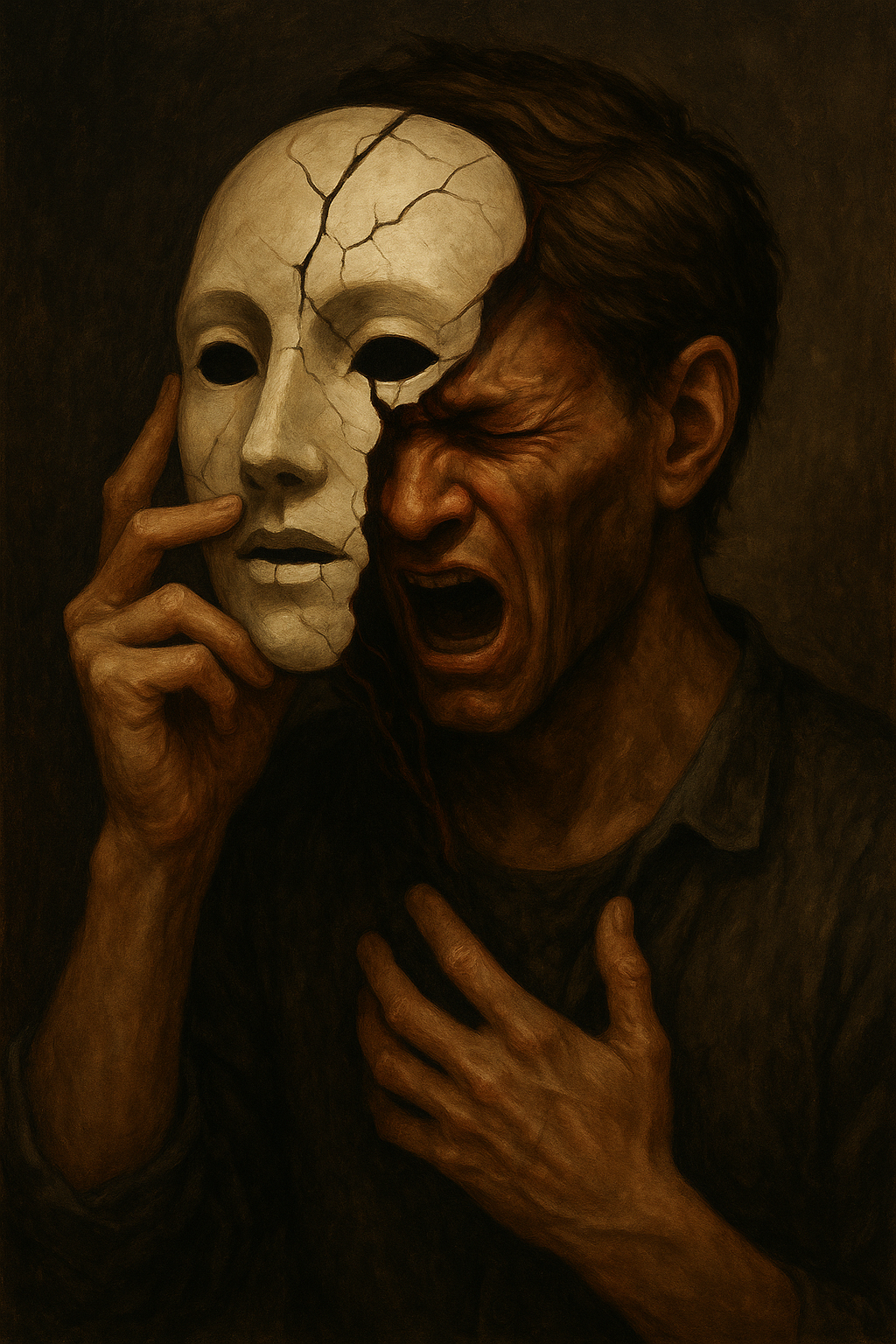
When the mask begins to crack, what I call fear is actually the trembling of the imprisoned godshard within — the one who has been pretending to be domesticated for too long. It is not weakness that shakes, but the body’s revolt against falsity. The primal terror is not “What if they see me?” but “What if I am forced to remain unseen forever?” That is the agony recovery interrupts.
The Twelve Steps, when stripped of polite religious language, are a blood oath with truth. They promise not salvation through polish, but through exposure. Confession is not a moral bow — it is a demolition charge set against the fortress of self-deception. There is no pulpit in this work; there is only the trembling voice that breaks its own chains mid-sentence. When we stop rehearsing, we start resurrecting.
Saying things like “making light of serious situations” and “overworking” exposes the ancestral neurosis of the alcoholic family system — where performance is currency and vulnerability is treason. The overachiever is not proud, he is terrified. The humorist is not lighthearted; she is bleeding behind the smile. These masks were built to survive households where truth was punished. Now, in recovery, the task is not to perform better, but to stop performing altogether.
Today — and the word today must be carved like a blade — I dismantle the survival script. I listen to the heart, even when it stammers. I speak the unspeakable, even when it burns. I seek trustworthy company not because I am fragile, but because courage thrives in reflection. These are not quiet revolutions. These are thunderclaps whispered through scar tissue. These are the first sounds of the soul remembering its original face.
Many times I have said, “I wish I had faith.” And what I’ve heard from so many wise Al-Anon members is, “Surrender your lack of faith to your Higher Power, and ask for faith.”
I have said, “I know I am powerless, but I feel so helpless, frightened, hopeless,” and I have been told I had the option to surrender those feelings and ask for what I need. Powerless does not mean helpless. In fact, it can lead us to a source of enormous power – the power to carry out God’s will.
I have also said, “I can’t figure out what God wants me to do, though I’ve prayed for guidance.” My loving Sponsor always says, “God doesn’t speak in code. Ask for clarity, and then trust that you will get it when the time is right.”
When in doubt, I am learning that the answer is to ask.
Today’s Reminder
After years of asking only for a particular solution to a problem, such as, “Please make the alcoholic stop drinking!” — I need to learn a better way to ask for help. Today I will meditate for a few minutes on what I need, and then I will ask a Power greater than myself to help me with it.
“Even if we have struggled with the idea of a Higher Power, we have learned that asking for help works…” ~ In All Our Affairs
END OF QUOTE—————————————
Powerless, Not Helpless
There’s a subtle but vital distinction here. Powerless means recognizing that I cannot control outcomes, people, or timing. Helpless would mean believing that therefore, nothing can be done. But in recovery, surrender is never the end of movement—it’s the alignment of movement with truth. The moment I surrender my powerlessness, I open the door for a greater power to act through me. This is not passivity; it’s participation in grace.
Asking Without Prescription
For many of us, our prayers began as negotiations: “Please make the alcoholic stop drinking.” But the Step tradition teaches us to shift from asking for what we want to asking for what we need. It’s a discipline of trust—believing that the solution may look different, and that transformation often begins in our perception, not in our circumstances. When I ask simply, “Help me with this,” I move from manipulation to relationship.
God Doesn’t Speak in Code
What a freeing reminder. When we can’t hear, it’s rarely because God is cryptic—it’s because we are still translating divine language through fear. The answer to prayer often begins as peace, or a subtle loosening of tension. Clarity comes as we grow willing to stop deciphering and start listening.
As a child, I would get down on my hands and knees for the longest time, just to watch a caterpillar crawl around. It never seemed to go very far, yet I patiently waited just in case it should do something spectacular. It never did, but I didn’t mind, because simply watching this peculiar-looking creature gave me pleasure.
Remembering this makes me question how many such precious moments are passing me by unnoticed because I am so focused on other things. Before Al-Anon, I spent years ignoring life’s beauty because I was too busy trying to get all the alcoholics to stop drinking, and in recovery I’ve lost many, many hours waiting to solve a problem or be freed of a character defect. Today I am learning to make room in my life for the wonders life has to offer.
Today’s Reminder
I am learning to choose where to focus my attention. Appreciating life’s simple gifts may take some practice, but as I become more aware of the beauty that is all around me, it gets easier to appreciate the beauty within.
“Just for today I will be unafraid. Especially, I will not be afraid to enjoy what is beautiful…” ~ Just for Today
END OF QUOTE—————————————
Unfortunately, part of living sometimes digresses into a battle of egos, both inside and outside my cranial cocoon. The idea of becoming “childlike” is a way of reframing life through the lens of innocence, humility, and trust. To become as a child isn’t to regress into naivety but to return to a state of openhearted presence. When I stop striving to control outcomes and instead kneel down, paying attention to what is, I can discover a new way of seeing. The childlike gaze turns ordinary moments — a crawling caterpillar, a morning cup of coffee, a shared laugh — into portals of divine reality.
In recovery, we begin to reclaim that posture. The compulsive urgency that once drove us — to fix, to solve, to control — slowly gives way to attentive curiosity. The world hasn’t changed so much as our gaze has softened. We start noticing that grace doesn’t always arrive as fireworks; sometimes it crawls, unhurried, across a leaf.
Where do I choose to place my attention? To focus on others’ drinking or my own defects is to live in reaction. To turn toward beauty is to live in response. That shift — from reacting to responding — marks a quiet revolution of the soul. The caterpillar becomes the teacher of patient transformation, the reminder that life unfolds on its own timetable, not ours.
I have permission to inhabit peace without guilt, to rest in awe without needing to earn it. In such moments, we rediscover our own metamorphosis: the frightened controller slowly becoming the gentle witness, wings not yet visible but forming all the same.
I have recently been reminded that I am not responsible for the workings of the entire universe. An unexpected transfer at my job sent me to a new city, and I had only one week to find a place for my family to live. After three unsuccessful days, I grew frantic. I had been in Al-Anon long enough to know that I needed a meeting. Listening to others share about taking care of our responsibilities and trusting a Higher Power with the rest, I was reminded that I could only do my best. I could do the footwork, but I couldn’t force the house to appear. I had to let go and let God. On the last day of my search, I found a wonderful place to live.
Struggling and worrying didn’t help me to solve my problem. Doing my part and trusting my Higher Power with the rest did.
Today’s Reminder
What I can’t do, my Higher Power can. When I let go and let God, I am free to take risks and to make mistakes. I know that I am powerless over many things. Today I can take comfort in knowing that I don’t have the power to ruin God’s plans.
“Have courage for the great sorrows of life and patience for the small ones; and when you have laboriously accomplished your daily task, go to sleep in peace. God is awake.” ~ Victor Hugo
END OF QUOTE—————————————
NOTE: Victor Hugo (1802–1885) was a French writer, poet, playwright, and political activist, widely regarded as one of the greatest and most influential authors in the French language. His works helped shape 19th-century literature, politics, and art — bridging Romanticism, social justice, and the human condition.
Literary Achievements
Hugo’s writing spanned poetry, drama, and novels. His most famous works include:
Les Misérables (1862): A sweeping novel about redemption, justice, and the struggle of the poor in post-revolutionary France. Its central figure, Jean Valjean, became an archetype of moral transformation.
The Hunchback of Notre-Dame (Notre-Dame de Paris, 1831): A Gothic masterpiece that revived interest in medieval architecture and led to the preservation of the actual cathedral.
Poetry Collections: Such as Les Contemplations (1856) and La Légende des siècles (1859–1883), which reveal Hugo’s deep spiritual, philosophical, and moral preoccupations.
Political & Social Vision
Hugo was not just a writer but a moral force and reformer.
He opposed the death penalty, championed free education, and advocated for the poor.
As a political figure, he served in France’s National Assembly but went into exile for nearly 20 years after opposing Napoleon III’s coup (1851).
During exile on the island of Guernsey, he wrote some of his most powerful works, using literature as an instrument of resistance and hope.
Philosophy & Spirituality
Hugo saw the universe as a living expression of divine order and viewed humanity’s progress as a spiritual ascent toward enlightenment. He believed that love, conscience, and imagination were sacred forces driving human evolution — ideas visible in his blend of mysticism, humanism, and compassion for outcasts.
Legacy
Victor Hugo’s influence extended far beyond literature:
He’s entombed in the Panthéon in Paris, among France’s most revered figures.
He inspired social reforms in France.
His works continue to be adapted into stage and screen productions worldwide.
END OF NOTE—————————————
There’s a peculiar kind of arrogance hidden in panic. When the writer says they were “frantic” after three days, it isn’t just exhaustion; it’s the ego imagining itself to be the hinge on which destiny turns. The fear underneath is: if I don’t make this happen, no one will.
Recovery interrupts that illusion. It replaces the desperate driver with a humble traveler who can finally rest at the window and let the scenery pass. “Let go and let God” is not passivity — it’s the shift from anxious control to sacred cooperation.
There are two essential movements in my life: doing the footwork and surrendering the outcome. This is not a split between effort and faith but a rhythm between them — inhale and exhale, action and release.
The act of searching for housing was the doing, but the discovery of “a wonderful place to live” was the gift. Recovery trains us to stay available to both — discipline in motion, surrender in heart.
The line “I don’t have the power to ruin God’s plans” is one of those truths that frees the soul from self-importance. Once I know I cannot destroy the divine architecture, I am free to take risks, to experiment, even to fail. Mistakes become material for grace rather than evidence of doom. It’s as if the Higher Power whispers: “You are not fragile to Me. You are part of My experiment in courage.”







 Daily Reprieve
You must be logged in to post a comment.