Archive for writing

Endigar 1028

Posted in Uncategorized with tags , , , , , , , , , , , , on August 19, 2025 by endigar

From Courage to Change of Sep 13:

Each moment of this day is precious, and I will make it count. I will use this time to enrich my life and to improve my relationship with my Higher Power, other people, and myself. Each of the Twelve Steps can help me to pursue this goal regardless of my circumstances. Meetings, Al-Anon telephone calls, and Al-Anon literature all help me to apply the Steps to what is happening in my life here and now. In this moment, I can make a positive change.

Perhaps I will think of time as a special kind of checking account. I have twenty-four hours to spend. By putting Al-Anon’s principles to work in my life today, I am choosing to use these hours to grow, enjoy, and improve. I even have an opportunity to learn from my mistakes, since a brand new twenty-four hours can begin at any moment.

Today’s Reminder

This day offers me a chance to make a new start at living. How can I make the best use of it?

“We start with gifts. Merit comes from what we make of them.”
– Jean Toomer

END OF QUOTE—————————————

Note: Jean Toomer (1894–1967) was an American writer, poet, and thinker best known for his 1923 book Cane, a groundbreaking work of modernist literature that blends poetry, prose, and drama.

Background

  • He was born in Washington, D.C., into a mixed-race family and grew up moving between Negro and Caucasian communities, which deeply shaped his outlook on identity.
  • Toomer resisted being categorized strictly by race. Though associated with the Harlem Renaissance, he did not fully embrace the label of “Negro writer,” instead seeing himself as an American author exploring universal human themes.

Cane (1923)

  • Cane is his most famous work, often considered one of the masterpieces of the Harlem Renaissance.
  • It weaves together vignettes, poems, and sketches of Negro life in both the rural South and the urban North, portraying themes of identity, sexuality, spirituality, and the Great Migration.
  • Its experimental style—mixing lyricism, folklore, and modernist fragmentation—made it unique for its time.

Later Life

  • After Cane, Toomer never published another major literary work, though he wrote essays, plays, and unpublished manuscripts.
  • He became involved with spiritual movements, particularly the teachings of the mystic George Gurdjieff, which influenced his later writings and personal philosophy.
  • He married Margery Latimer, a white writer, in 1931, which was controversial in the U.S. due to anti-miscegenation attitudes and laws.
  • Much of his later life was devoted to spiritual seeking and private writing rather than public literary activity.

Legacy

He is remembered as a bridge figure between different identities, artistic movements, and cultural currents of early 20th-century America.

Though he distanced himself from being labeled a “Black writer,” his desire was ignored and now his work—especially Cane—is recognized as central to African American literature and modernist experimentation. It is more the work of American individualism than racial Darwinist competition.

END OF NOTE—————————————

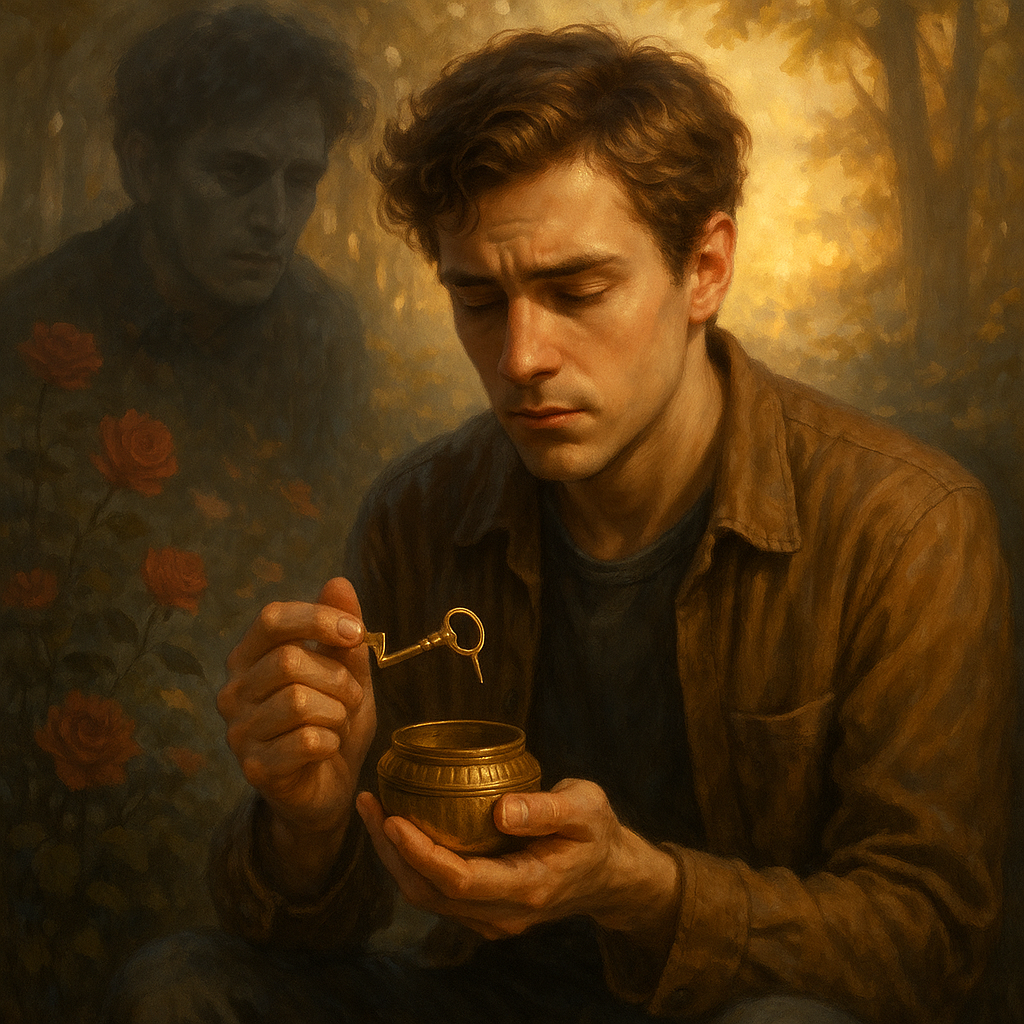
There are roughly 37 trillion cells in my body. Within just one of those cells resides a molecule: L43NxB500325Ydπ. And within that molecule, housed deep inside a neutron, lies the Quantum Infinity Vault. Its emblem is the macro/micro infinity ouroboros — the eternal cycle of vast and small, endlessly entwined.

The code to open this vault is 23(3), which summons 24. When opened, the vault releases an inexhaustible supply of positive selfishness (ps). A pulsating dose of ps moves through my body each day. If I fail to use it within the 24-hour span of Earth’s rotation, it decays into the maggot-filled manna of fearful isolation. But if I spend it freely — if I feed the hungry Sun — it transforms into connection, filling my day with living tools of recovery.

For when I have enough ps to proclaim, “I want to live” or “I want to recreate my life”, then I also find:

  • the courage to connect,
  • the humility to listen to other versions of success, and
  • the deep, restoring respiration of serenity.

Long live molecule L43NxB500325Ydπ!

Endigar 1024

Posted in Uncategorized with tags , , , , , , , , , , , on August 12, 2025 by endigar

From Courage to Change of Sep 09:

Sometimes I sit in a meeting and I don’t know how to ask for help. I can get trapped inside my pain. Some nameless thing seems to tear at my insides. I freeze, thinking that if I don’t move, it will go away. So I don’t ask, I don’t talk, and the pain grows.

Does my face look calm? Don’t be fooled. I’m just afraid to let you see the truth. You might think I’m foolish or weak. You might reject me. So I don’t talk, and the pain remains.

But I listen. And through other people, my Higher Power does for me what I can’t do for myself. Someone in the meeting shares and expresses the very feelings I am afraid to describe. My world suddenly widens, and I feel a little safer. I am no longer alone.

Today’s Reminder

One of the miracles I have found in Al-Anon is that help often comes when I most need it. When I can’t bring myself to reach out for help, it sometimes comes to me. When I don’t know what to say, I am given the words I require. And when I share what is in my heart, I may be giving a voice to someone who cannot find his own. Today I have a Higher Power who knows my needs.

“As I walk, As I walk, The universe is walking with me.” – from the Navajo rain dance ceremony

END OF QUOTE—————————————

To withdraw or not to withdraw—that is the question. Life among humans can feel unbearably taxing, threatening, and disappointing. There’s no escaping that imagined spotlight fixed on my weaknesses, and no connection that fully satisfies my longing for something more.

I suspect others feel much the same. I also suspect that much of life is pretense—a kind of protective ritual. Whenever I encounter genuine connection in a safe space, it feels like a godsend. But inevitably, humanity finds a way to wound the inner child. And in the game of life, the safest place often seems to be the sidelines.

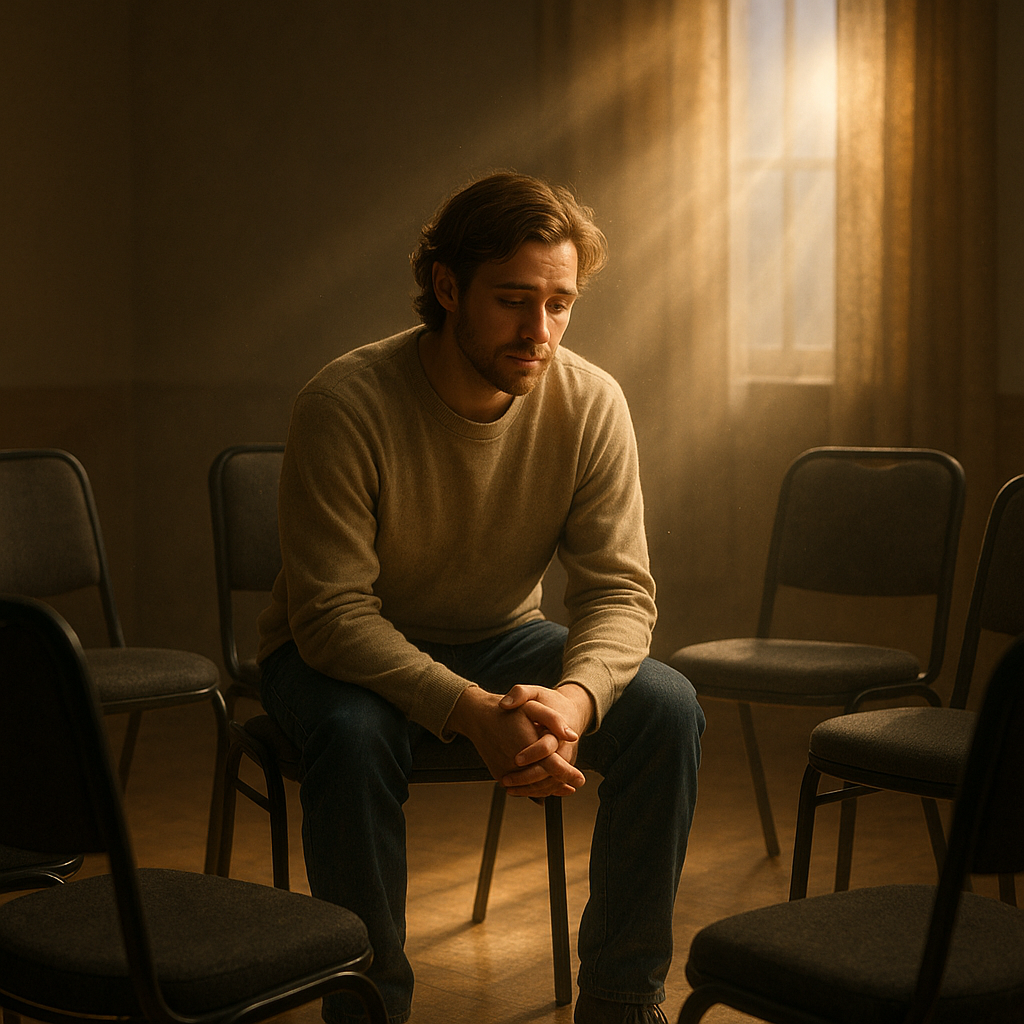
I know that silence can feel like safety. In my darker seasons, I’ve sat in meetings with my insides in knots and my face arranged in calm, thinking the stillness might somehow hide my storm. I’ve feared that if I spoke, I would be exposed—my weakness on full display, my worth put on trial. I’ve told myself, Just keep quiet. It will pass.

It rarely passes on its own. Pain that is swallowed whole only seems to grow heavier. But even when I can’t make my voice work, recovery has a way of finding me. I’ve sat frozen, and then someone across the circle shares a story that sounds like my story. Their words become the key I didn’t know I was holding. In that moment, the tight walls of my solitude widen, and light seeps in.

This is one of the miracles of our rooms: I don’t have to be the one speaking to be reached. My Higher Power uses the voices of others when I’ve lost my own. And when I finally dare to share my truth—halting, messy, imperfect—I sometimes see the same relief in someone else’s eyes.

Today, I am trying not to measure my recovery by how much I speak, but by how willing I am to be present—whether I’m the one carrying the message or the one being carried by it. I trust that the God of my understanding knows my needs, even when my mouth is closed and my hands are clenched.

When I cannot ask for help, I can still sit in the circle. Sometimes that’s enough for help to find me.

Endigar 1020

Posted in Uncategorized with tags , , , , , , , , , , , on August 5, 2025 by endigar

From Courage to Change of Sep 06:

A writer for a local newspaper recently maintained that most people spend more time planning vacations than they do thinking about what is really important in their lives. Of course a vacation has a certain importance, but as our slogan asks, “How Important Is It?”

In my case, the main focus of my mental activity usually is whatever problem, grievance, or irritation I am entertaining at the moment. “Now,” I tell myself, “I’m concentrating on what’s really important!” But, how important is it? When I look back on this two years from now, or next month, will it matter?

Al-Anon helps me to address the larger concerns in my life. For example, how can I make better contact with my Higher Power? Am I taking time to enjoy the present moment? Am I becoming the person I want to be? What can I give thanks for today?

Today’s Reminder

Are my priorities in order? Am I so busy with smaller, less meaningful concerns that I run out of time for the really important considerations? Today I will make room to think about what really matters.

“Today I’ll use the slogan, ‘How Important Is It?’ It will help me think things through before I act and it will give me a better picture of just what is important in my life.” – Alateen—a day at a time

END OF QUOTE—————————————

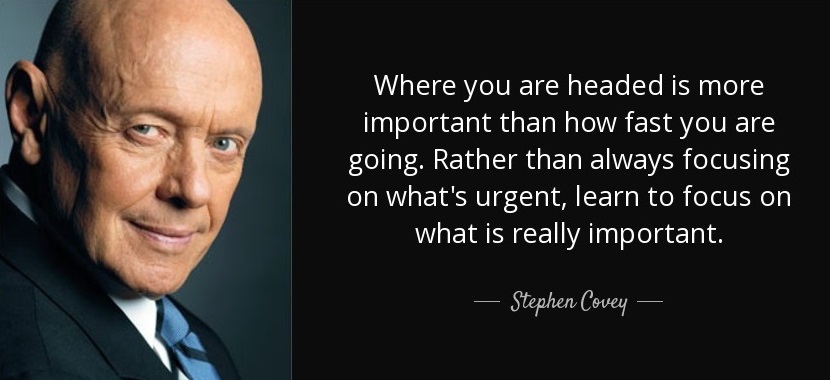
NOTE TO SELF THAT YOU MIGHT BENEFIT FROM: Reread Covey’s Seven Habits of Highly Effective People

One of the things I learned when I was first learning to use a firearm was that human beings have a natural instinct to flinch into retreat or freeze in place at the sound of the sudden loud noise or something moving very quickly toward the face. The sound of the shot and the push of the recoil tend to activate this reaction. It takes frequent, consistent exposure to overwrite this natural survival instinct and use the weapon with confidence.

Life has a way of filtering the frivolous by continuously challenging a chosen activity with easy escapism. This is yet another fear response to help survive the demands of my environment. Life asks “How important is your choice. Do you really want it?” If I answer yes, life laughs in my face. If I answer no, it haunts me with the truth. “I don’t believe you.” I must answer “Hell yeah!” to the important things of my life. Then the spiritual atmosphere seems to reinforce my choice.

And here’s the hard-won truth: not everything deserves my “Hell yeah.”

This program taught me the cost of my yes is measured in attention, time, surrender, and service. That makes my no sacred, too. It’s not selfish to say no—it’s spiritual clarity. Because if I say yes to every loud thing, I miss the still, small voice.

So today, I ask:

– What am I flinching from?
– What have I been whispering “maybe” to when my soul already knows the answer?
– Where is my “Hell yeah” waiting, buried under fear?

I don’t have to bulldoze over my survival instincts, but I can retrain them. I can honor the inner reflex, even as I outgrow it. And when I choose what truly matters—when I stay with it—I become someone life starts to believe in too.

Because the universe, like recovery, respects commitment. And a heart that says Hell yeah with humility and clarity is a heart that moves mountains.

Endigar 1018

Posted in Uncategorized with tags , , , , , , , , , , , on August 1, 2025 by endigar

From Courage to Change of Sep 04:

As we let go of obsession, worry, and focusing on everyone but ourselves, many of us were bewildered by the increasing calmness of our minds. We knew how to live in a state of crisis, but it often took a bit of adjustment to become comfortable with stillness. The price of serenity was the quieting of the constant mental chatter that had taken up so much time; suddenly we had lots of time on our hands and we wondered how to fill it.

Having become more and more serene as a result of working the Al-Anon program, I was surprised to find myself still grabbing for old fears as if I wanted to remain in crisis. I realized that I didn’t know how to feel safe unless I was mentally busy. When I worried, I felt involved — and therefore somewhat in control.

As an exercise, my Sponsor suggested that I try to maintain my inner stillness even when I felt scared or doubtful. As I did so, I reassured myself again and again that I was safely in the care of a Power greater than myself. Today I know that sanity and serenity are the gifts I have received for my efforts and my faith. With practice, I am learning to trust the peace.

Today’s Reminder

Today I will relish my serenity. I know that it is safe to enjoy it.

“Be still and know that I am with you.” – English prayer

END OF QUOTE—————————————

Serenity. Coma. Lethargy. Marijuana Intoxication. Paralysis. Impotence. To me, these were near identical synonyms. The neutrality of vigilance. The rejection of relevance.

“God grant me the Serenity to. . .” Accept.

In the world I came from, serenity felt suspicious.
Stillness was not safety—it was the silence before the next scream, the quiet that meant someone was brooding, using, or gone.
So when I began to heal, when the noise dimmed and the ache lessened, I didn’t feel peace.
I felt… lost.

What do I do when I don’t need to fix anyone?
What do I do when the fire alarm in my nervous system stops blaring?

For so long, obsession and worry were my way of being involved—my illusion of control.
They gave me purpose. They filled the hours.
They made me feel like I mattered.
To let them go felt like floating in open space without a tether.

But serenity, I’ve learned, is not empty.
It is not apathy. It is not ignorance. It is not withdrawal.
It is safety without vigilance, presence without panic.
It is the return of my life to me.

The first few moments of that calm were unbearable.
I wanted to reach for an old fear, the way a child grabs a familiar blanket, even if it’s filthy and torn.
Crisis was home.
But healing asked me to make a new home in the quiet.
Not to stop the fear.
But to let it move through me, while staying grounded in a Power greater than my history.

And I learned:
I can be scared and still be sane.
I can be uncertain and still be at peace.

Peace isn’t something I earn.
It’s something I practice receiving.

Today, I’m learning that serenity is not the absence of life.
It’s the presence of me—undistracted, undivided, beloved.

So I light a candle not because I’m scared, but because I am allowed to enjoy the moment.
I breathe deep not because I’m bracing, but because I’m here.
And when the stillness comes again, I won’t flinch.
I’ll embrace.

Because serenity is no longer a stranger.
It’s my inheritance.

Endigar 1017

Posted in Uncategorized with tags , , , , , , , , , , on July 31, 2025 by endigar

From Courage to Change of Sep 03:

Before coming to Al-Anon, I had built a lifetime of dreams and promises that were reserved for that one special day called, “Someday.” Someday I’II begin – or end – that project. Someday I’ll call that friend with whom I’ve lost touch. Someday I’ll let them know how I feel. Someday I’II be happy. I’m going to take that trip, find that job, speak my mind. Someday. Just wait and see.

Wait – just as I waited for the alcoholic to come in from a binge, and for inspiration to bring interesting friends and career opportunities to my doorstep, and for everybody else to change. But Al-Anon has helped me to see that today can be the Someday I’ve always wanted. There isn’t enough time in these twenty-four hours to do everything I’ve ever hoped to do, but there is time to start making my dreams come true. By asking my Higher Power for guidance and by taking some small step in the direction of my choice, I will be able to accomplish more than I would ever have thought possible.

Today’s Reminder

Today I will not wait for a blue moon, a rainy day, the 366th day of the year, or Someday to accomplish good things in my life.

“Each indecision brings its own delays and days are lost lamenting over lost days… What you can do or think you can do, begin it. For boldness has Magic, Power, and Genius in it.” – Johann Wolfgang von Goethe

END OF QUOTE—————————————

Johann Wolfgang von Goethe (1749–1832) was a towering figure of German literature, philosophy, and science—widely regarded as one of the greatest writers in Western history.

Most Famous Work: Faust, a tragic play in two parts, considered one of the most important works of Western literature. It tells the story of a man who makes a pact with the devil in search of ultimate knowledge and experience.

Other Works: The Sorrows of Young Werther (1774), a landmark of early Romanticism, which sparked a wave of sentimental literature—and even reported suicides among youth trying to emulate the protagonist.

Goethe explored the duality of human nature, the struggle for meaning, and the tension between reason and passion—anticipating thinkers like Nietzsche, Jung, and even Kierkegaard.

A lifelong seeker, he resisted rigid dogma, saying:
“He who possesses science and art also has religion; he who does not possess them needs religion.”

Goethe was also a scientist, particularly in the fields of botany, anatomy, and color theory. He even challenged Newton’s work on optics, proposing his own (controversial) Theory of Colors.

Goethe was deeply interested in alchemy, myth, the unconscious, and the soul’s evolution—themes that appear throughout Faust and his lesser-known esoteric writings.

Carl Jung considered Goethe a proto-depth psychologist and drew heavily from Faust in his ideas about the shadow, individuation, and the Self.

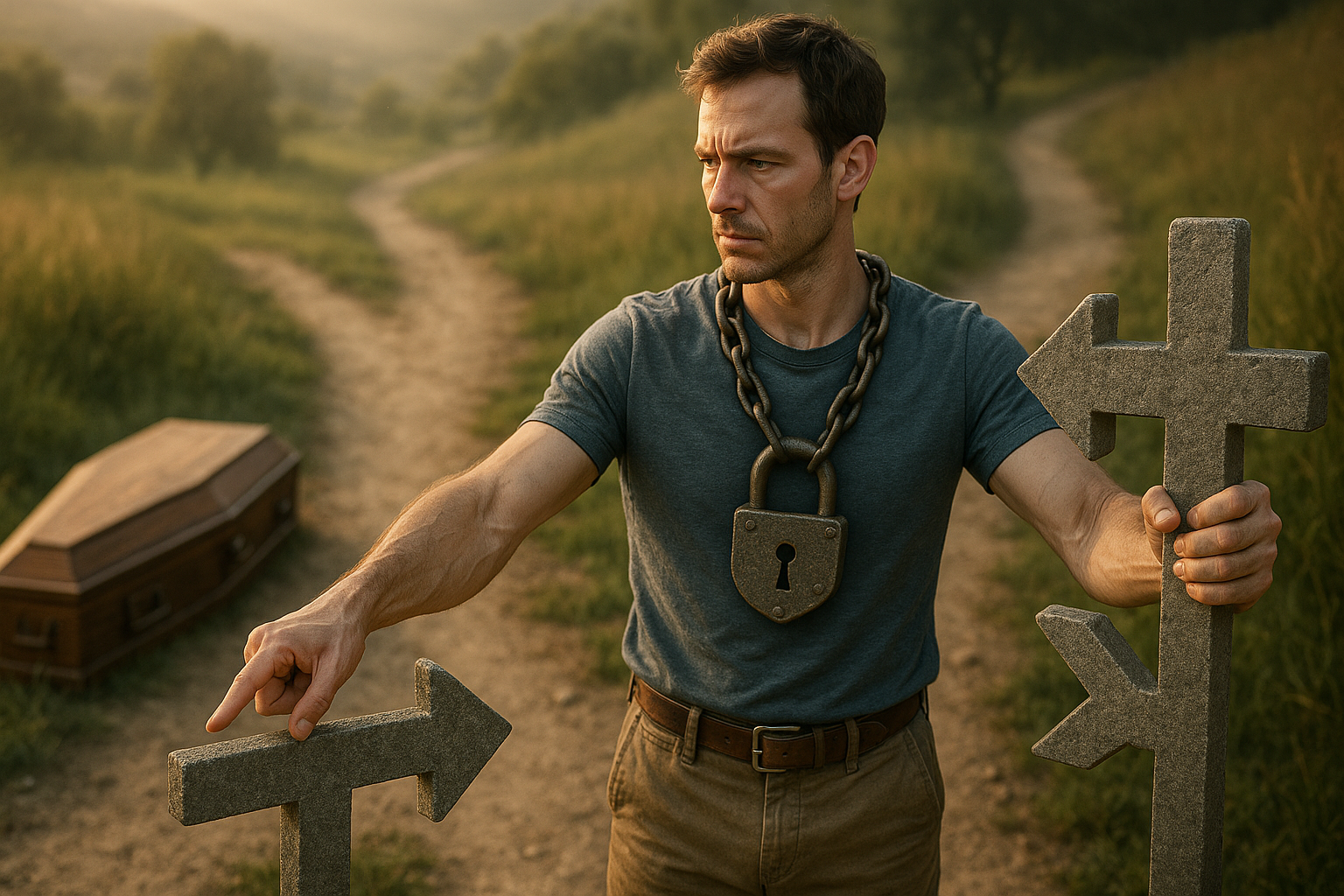
I am afraid of living a potential life. To have potential is to have fear. Only action in the now counters that fear. To achieve failure is better than to protect potential. To risk loss is better than saving for a beautiful coffin. One day at a time. End the day planning for the next. I want to find ways to justify getting out of bed and exhausting myself. The effective and acted on plan is better than the beautifully crafted promise. Someday is a myth that I can carry like a chain around my neck. Life is too sharp, painful, my voice too prone to the hesitant tremble. My grief becomes hardened into a habit. I beat myself to death with promises of someday.

I am free. I am allowed to re-create my life, to begin anew. I want to live boldly, to secure my freedom in quick forgiveness, and not to turn away from being seen.

I filled journals and conversations and fantasies with Someday.

But in the shadows of that promise, I postponed my own resurrection.
Because waiting—especially in families ruled by addiction—feels like love at first.
We wait for sobriety.
We wait for peace.
We wait for someone to choose us, change, or come home.

Recovery has shown me something strange and stunning:
There is no Someday. There is only Today, and the grace to be awake inside it.

Today is not a consolation prize.
Today is the only ground on which miracles grow.

And I don’t need to finish the novel, heal the wound, or reconcile every relationship today.
But I can make the call.
I can take the walk.
I can say the words: “I’m ready.”
I can set the boundary, speak the truth, write the page, wash the dish, light the candle.
That’s all it takes to betray the myth of Someday and let magic leak into this moment.

Endigar 1007

Posted in Uncategorized with tags , , , , , , , , , , , on July 16, 2025 by endigar

From Courage to Change of Aug 24:

I’m usually such a gentle, easy-going person that you’d never believe what happens when I get angry. I fly into a rage, my blood pressure seems to double, and I unleash a torrent of profanity. After years in Al-Anon, my anger is still a problem, but my behavior has greatly improved.

Some time ago my dog got its feet tangled in an extension cord and broke a beautiful vase. My temper flared, and angry words cut like sharp swords. What helped me to change this behavior was the look of hurt and bewilderment on my pet’s face at the sudden, violent change in me. If a little animal could respond this way, what were my outbursts doing to the people in my life who understood every nasty word?

Today’s Reminder

I am human and I get angry, but I don’t have to act out my anger in destructive ways. I do not have the right to take it out on others. Whether my usual response is to scream, sulk in cold silence, or lash out with cruel words, today I can look at what I do when I get mad. Maybe next time I will try something new.

“We can pave the way for calm, reasonable communication only if we first find healthy outlets for our own negative feelings.” ~ The Dilemma of the Alcoholic Marriage

END OF QUOTE—————————————

There was a time when I truly believed I had a gift—a superpower, even. I could walk through the minefield of family dysfunction with a kind of eerie calm. When the shouting began, when the air grew sharp with rage or shame, I didn’t cry, didn’t scream, didn’t break.

I neutralized.

It felt like survival magic. I shut down emotion like flipping a breaker switch. And later, in the echo chamber of adulthood, I carried that same skill like a weapon hidden in my coat. Smiling when I was shattered. Nodding through the heat. Telling myself I was strong because I didn’t flinch.

But silence is not strength. It is delay.

The emotion never disappeared. It gathered. Like steam in a sealed kettle. And when it finally released—when someone pushed a little too hard or life asked too much—I erupted. And it was messy. It was disproportionate. It was terrifying. Not just for them—for me.

I thought I was protecting others from my chaos.
But really, I was disowning the most vital parts of myself.

What I’ve come to understand in recovery is this:
Emotions don’t vanish when ignored. They metastasize.

I was trying to outsmart pain instead of processing it.
Trying to stay safe instead of growing up.

And the real heartbreak? The villain I designed this defense to battle—whether it was a parent, a partner, a past trauma—they were no longer present. But the pattern remained. The withdrawal. The inner coldness. The explosive relapses of rage. I had become the very energy I once vowed to purge.

That’s the moment I knew I wasn’t protecting myself anymore—I was imprisoning myself.

Today, I choose another way.

I let my emotions speak—without dictating my behavior.
I let my anger rise—without turning it into destruction.
I acknowledge my sadness—without needing to drown in it.
I name what I feel so that I don’t have to punish others for not guessing.

This is the work of recovery. Not to silence emotion, but to integrate it.
To feel without fear. To express without harm.
To let anger serve connection, not sever it.

Step Ten helps me watch my patterns in real time. Not to shame myself, but to redirect the current before it floods the house. I am not here to pretend I am above anger. I am here to learn how to be honest within it—and to make it safe for others to be honest with me.

So maybe next time, I’ll try something new.
Maybe I’ll speak. Breathe. Take a walk. Write a prayer. Cry.

Not because I’ve lost my superpower.
But because I’ve finally chosen something better:

A soul unarmored. A voice returned. A connection restored.

“Gooooosfraaaabaa…” ~ Dr. Buddy Rydell in Anger Management (2003)

Endigar 1006

Posted in Uncategorized with tags , , , , , , , , , , , on July 15, 2025 by endigar

From Courage to Change of Aug 23:

I developed a tremendous fear of making mistakes. It seemed crucial to cover every possible outcome, because mistakes often led to an avalanche of accusations and abuse from the alcoholic — and eventually from myself. My self-esteem diminished because the slightest error felt huge and I couldn’t let it go. So I began to cover up and rationalize my mistakes, all the while desperately trying to maintain an appearance of perfect self-control.

In Al-Anon I learned to take down that rigid wall of seeming perfection, to honestly admit mistakes, and to open myself for growth. Step Ten, in which I continue taking my inventory and promptly admit when I am wrong, has been liberating because it challenges me daily to be honest. Sometimes it makes me squirm, but I know that when I tell the truth, I am free of the lies that held me back. As Mark Twain put it, “If you tell the truth, you don’t have to remember anything.”

Today’s Reminder

I will probably make a mistake of some sort every day of my life. If I view this as a personal failing or pretend that no mistakes have occurred, I make my life unmanageable. When I stop struggling to be perfect and admit when I am wrong, I can let go of guilt and shame. That is cause for rejoicing.

“Help them to take failure, not as a measure of their worth, but as a chance for a new start.” ~ Book of Common Prayer

END OF QUOTE—————————————

Recovery has taught me that efficiency doesn’t mean running faster or juggling more. It means living truer—with rearranged priorities that reflect healing rather than trauma.

In my old life, “efficiency” meant keeping every ball in the air, covering every possible failure point, staying two steps ahead of accusation, punishment, or shame. Perfection wasn’t a desire—it was a defense strategy. Every mistake carried the risk of emotional collapse, either from the another’s rage or from the venom I turned inward against myself. There was no margin for error, so there was no margin for me.

But in recovery, efficiency has a new face.

Now, it looks like connection, not control.
It looks like honesty, not illusion.
It looks like risking the mess of growth instead of hiding behind the mask of performance.

I’ve come to understand that my value doesn’t rise and fall on flawless execution. I can take on new disciplines, try new things, and stretch toward excellence—not to prove myself, but to explore who I am becoming. And when I stumble, I don’t have to disappear into shame. I can stay present. I can course-correct. I can breathe through it.

That’s the grace of Step Ten.
It’s not punitive. It’s daily liberation.

Step Ten teaches me how to keep the mirror clean without smashing it. It invites me into honest, loving self-examination—not the spiral of morbid reflection that tells me I’m broken beyond repair, but the gentle voice that says:

“You’re growing. You missed something. Let’s try again.”

My self-esteem grows not because I’m finally perfect, but because I’m no longer afraid to be seen.

Each time I admit a mistake promptly—without drama, without hiding—I tear down another brick from the wall that once kept me isolated. And in its place, I build something better: a life anchored in truth, flexibility, and connection to a Higher Power who never required my perfection—only my willingness.

So today, I let efficiency be redefined.
Not by speed.
Not by image.
But by how gently I can live in alignment with who I really am.

Endigar 1004

Posted in Uncategorized with tags , , , , , , , , , on July 13, 2025 by endigar

From Courage to Change of Aug 21:

Some Al-Anon suggestions, such as getting a Sponsor, were easy for me because I’m good at following specific instructions. But I didn’t know what to do with the slogan, “Live and Let Live.” Al-Anon helped me to let live by teaching me about detachment and helping me to see that many of my problems stemmed from minding everyone’s business but my own. But how do you turn your eyes on yourself and “live” for the first time in your life?

When I put this question to my Sponsor, she asked me one in turn — what had I done earlier that day? Although I’d had a very busy day, I could barely remember what I had been doing. My Sponsor suggested that I begin learning how to live by becoming more aware of my life as I was already living it. Then I would be better able to make choices about how I would like to live.

Searching for the real me, living according to my needs, and loving myself as a new-found friend have been the most rewarding benefits of the Al-Anon program. Strangely, they’re the last ones I would have imagined receiving when I began.

Today’s Reminder

Today I can choose to take responsibility for my own life. If I stay out of others’ affairs and become more aware of my own, I have a good chance of finding some serenity.

“Each man’s life represents a road toward himself.”
~ Hermann Hesse

END OF QUOTE—————————————

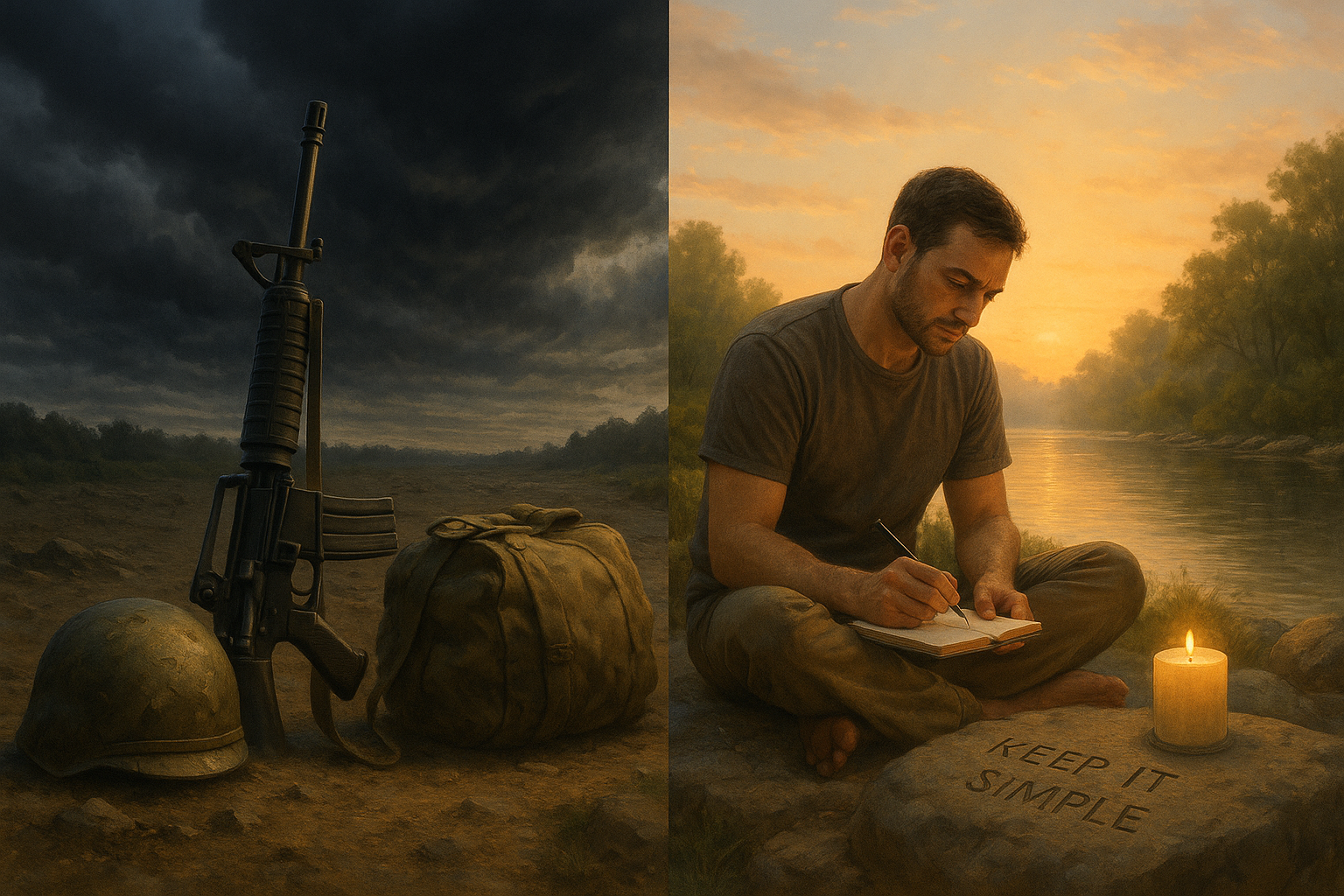
“Keep it simple.”
At first, I recoiled.

It sounded like a bumper sticker for the intellectually lazy—a slogan meant to quiet nuance and glorify ignorance. And I’ve always been someone whose mind loops, circles, and spirals. Complexity is my native tongue. I spent years inside mental architecture so elaborate it became a prison. So when I heard that I could be “too smart for this program,” it struck a nerve—because I was. And I was miserable.

But the longer I sat in rooms of recovery, the more I realized that simplicity wasn’t stupidity. It was clarity. And clarity, when you’ve been drowning in overthinking, is a kind of salvation.

I began to think of it like battlefield simplicity. In the military, I learned that sometimes you don’t need a theory—you need a plan. When the chaos storm hits, you don’t hold a seminar. You drop low, return fire, and get out alive. Recovery is no different. There are times when I must follow simple suggestions—not because I lack intelligence, but because the battlefield of my mind is on fire, and philosophizing during a trauma spiral is just a prettier way to bleed out.

So I stopped sneering at slogans and started listening to them like I once listened to field orders—calmly, steadily, with the humility of someone who wants to survive.

That’s when Keep It Simple became something else entirely.

It became a discipline of presence.

Instead of solving the mysteries of the universe before breakfast, I asked:
What did I actually do today?
Did the urgent devour the important?
Did I even notice my breath, my coffee, my soul checking in?

It reminded me of situational awareness. In uniform, that meant knowing your terrain, your mission, your blind spots. In recovery, it means the same—but the terrain is my emotional landscape, the mission is my serenity, and the blind spot is always ego or fear.

And then I heard Live and Let Live, and realized it was just another phrasing of what I’d learned in the service:
“Stay in your lane.”
Not out of apathy, but out of focus. Not because I don’t care, but because I finally care enough to respect the boundaries that keep us all spiritually alive.

Simplicity, then, isn’t about shutting down my intelligence—it’s about reclaiming it from chaos. It’s about choosing grounded clarity over clever disconnection. It’s about not outsmarting myself into a relapse of isolation and shame.

Today, I don’t need to be the smartest person in the room. I need to be the one who’s present, surrendered, and listening.

Endigar 1003

Posted in Uncategorized with tags , , , , , , , , , , , on July 10, 2025 by endigar

From Courage to Change of Aug 20:

A billboard in my town reads, “Some come to the fountain of knowledge to drink. Some come to gargle.” My pre-Al-Anon self would have chuckled at this message, but I would have felt some anxiety about whether I was a drinker or a gargler. Life was either black or white, and in order to feel comfortable, I had to know which extreme applied. But whichever label I pinned on myself would leave me feeling wrong, so I would scramble to fix myself.

Now, thanks to Al-Anon, I accept more easily the thought that sometimes I drink, sometimes I gargle, and sometimes I stub my toe on the fountain as I stumble by. I don’t have to do better or differently. The best that I can do is good enough. I can relax and enjoy the joke.

Today’s Reminder

Al-Anon encourages me to examine my thoughts and actions, but this is meant as an act of self-love, not as a weapon to use against myself. When I begin to accept myself exactly as I am , life will feel a lot more gentle.

“Sometimes we try so hard that we fail to see that the light we are seeking is within us.” ~ As We Understood . . .

END OF QUOTE—————————————

Before recovery, I lived in a mind forged by fear—its favorite tools were labels, extremes, and invisible measuring sticks. It has often been that I can’t hold ambiguity without anxiety. I needed certainty—not because it gave me peace, but because I thought certainty would give me safety.

But the 12 Step program offered me something far better than certainty—it offered compassionate permission.

Permission to laugh at myself.
Permission to be human.
Permission to admit I’ve both sipped wisdom and choked on it, depending on the day.
Permission to trip over my own healing and still call it progress.

This program doesn’t ask me to strive for some shimmering perfection. It asks me to show up. It asks me to observe without judgment. It asks me to speak to myself as gently as I would to a child learning to walk.

The more I practice this self-acceptance, the more I realize that rigidity was never my refuge—it was my prison. I kept trying to “fix” myself because I believed I was broken beyond repair. But today I see: I’m not a project, I’m a person. I’m not a performance, I’m a soul.

“Rule 62: Don’t take yourself too damn seriously.” ~ 12 Steps & 12 Traditions, 2021 edition, page 164.

https://www.amazon.com/gp/product/B0FGQG1Z2D/

Endigar 999 ~ The Shadows that Taught Me

Posted in Uncategorized with tags , , , , , , , , , , , on July 5, 2025 by endigar

From Courage to Change of Aug 17:

Some of us believe that most defects of character are merely traits that we no longer need. Many of us develop clever methods of surviving in an alcoholic situation, such as denial or secrecy. But once we have the support of the Al-Anon program, we may find that our old methods do more harm than good. What once allowed us to function in a nearly impossible situation is now an obstacle to further growth. An asset has become a deficit.

Others define defects of character as assets that have lost proportion. For example, a genuine desire to help a love one can be exaggerated into a desperate need to fix another person.

From this perspective, we aren’t facing the daunting task of rooting our every shred of the defect; we are only turning it over to our Higher Power so that it can be brought into balance or dropped because it is no longer serving our needs.

Today’s Reminder

Instead of condemning myself when I become aware of a defect of character, I can acknowledge my growth. I’ve recognized that a characteristic that once allowed me to survive is no longer necessary, or that an asset that has lost its proportion makes my life unmanageable. Instead of proving sickness, this shows a willingness to face reality and a readiness to choose health.

“Sometimes we must accept ourselves, defects and all, before those defects are removed.” ~ . . . In All Our Affairs

END OF QUOTE—————————————

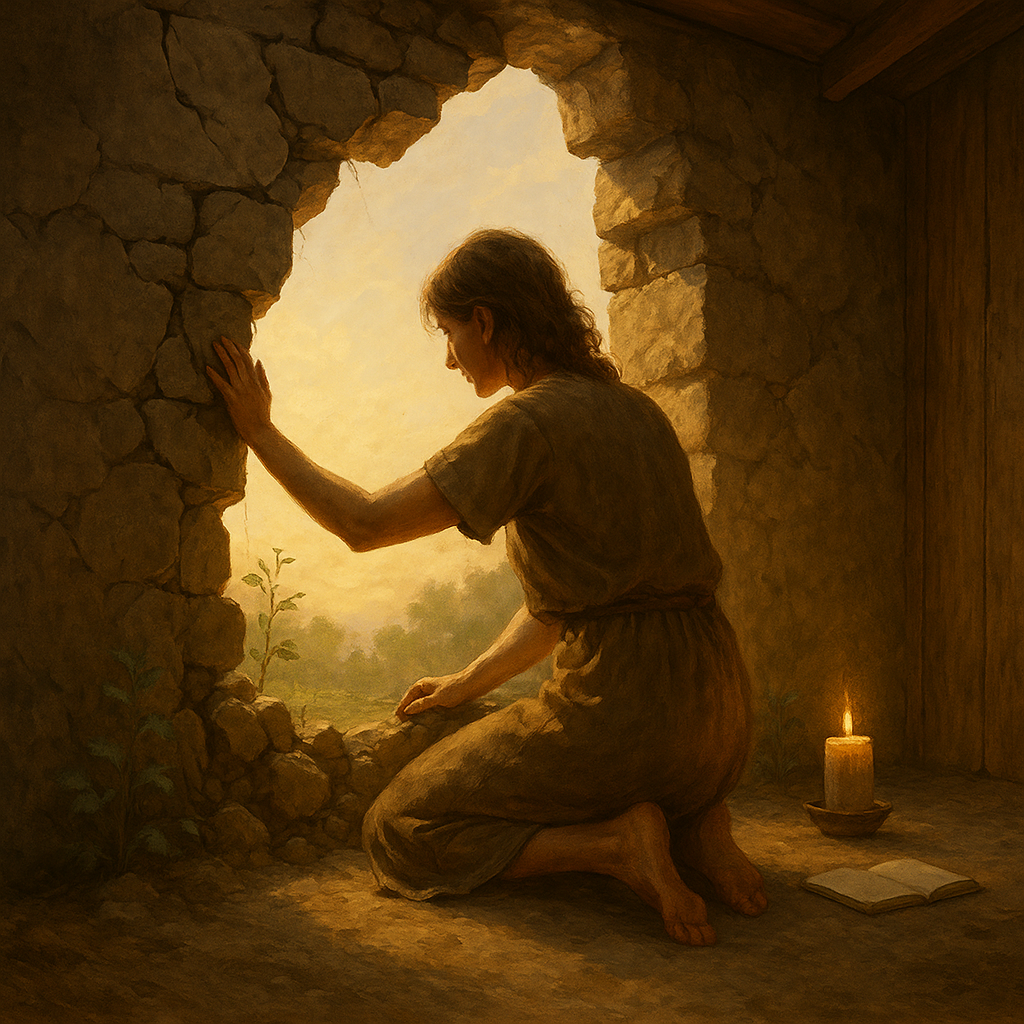
I have learned that not every flaw is a failing—sometimes it’s just a survival skill that stayed too long at the party. Denial, secrecy, control, hypervigilance… these weren’t signs of weakness back then. They were the armor I forged in the fire of chaos. They helped me survive in environments where tenderness wasn’t safe, where truth could cost too much, where silence felt like the only power I had left.

But now, in this sacred space of recovery, those once-precious tools begin to rust. I don’t live in that battlefield anymore. And when I cling to those old patterns, they no longer protect me—they choke me. What once kept me afloat now keeps me from swimming.

The program gently shows me that defects of character aren’t proof I’m broken. They’re signals that I’ve outgrown something. They are assets that have swelled out of balance, like vines overtaking a garden. A desire to help becomes compulsive fixing. Loyalty becomes martyrdom. Strength becomes stubborn isolation. And instead of tearing these parts of me out by the root, I can turn them over. I can invite my Higher Power to prune and purify, not because I am unworthy, but because I am ready.

This isn’t self-condemnation. This is spiritual maturity.

When I notice a defect rising up again, I no longer need to spiral into shame. I can say, “Ah. I remember why I learned this. I honor its origin. And now, I let it go.” That is grace in action.

To accept myself with all my human contradictions—to sit in the tension between who I was and who I’m becoming—is the essence of healing. It is where mercy meets progress. And I am grateful today not just for the parts of me that shine, but for the shadows that taught me where the light belongs.


https://www.amazon.com/gp/product/B0FGQG1Z2D/

Available on Amazon