Archive for relationships

Endigar 1090

Posted in Uncategorized with tags , , , , , , , , , , , on November 15, 2025 by endigar

From Courage to Change of Nov 09:

We humans are wonderfully adaptable. We find creative solutions to impossible situations. One coping skill that some of us develop is manipulating other people in order to get what we want. Alcoholism can create such a threatening environment that manipulation seems necessary. Today, with the help of Al-Anon, we are learning to do more than merely survive, and such manipulation becomes unnecessary and unacceptable. In Al-Anon we learn healthier ways to meet our own needs and to behave toward others.

Manipulation had been a normal part of my life for so long that I forgot how to have a discussion or make a straightforward request. If I wanted someone to do the dishes, I tried to make them feel guilty by telling them how much I had done for them, or I complained that they never did their part. It never occurred to me that I could simply and politely ask for what I wanted, or that I could accept my request being turned down! But I’m learning. A day at a time I’m learning.

Today’s Reminder

Today I am creating a better way of living, free of guilt and deception.

“We can choose to behave with personal integrity, not because it will make someone else feel better, but because it reflects a way of living that enriches and heals us.”
~ In All Our Affairs

END OF QUOTE—————————————

There is a point in every wounded life when you realize the old survival tricks have become a cage. Manipulation, guilt-crafting, silent punishments, emotional fog machines — these were weapons of the weak and vulnerable, forged when the world felt too dangerous to face bare-handed. They were the crooked tools carved in a childhood battlefield where truth was not safe and needs had to sneak through the back door.

But adulthood unmasks these things.
Recovery unmasks them.
Intelligent anger unmasks them.

And suddenly I saw the truth:
Manipulation isn’t clever.
It’s expensive.
It taxes my soul.
It turns me into the very thing I once feared.

Alcoholism trains you to survive by distortion — bending conversations, bending yourself, bending the room just to keep the peace or get the smallest scrap of control. But that’s not living. That’s contortion. That’s the slow self-erasure that happens when you trade honesty for outcome.

Al-Anon, for all its gentleness, is not a soft program. It is a reckoning. It teaches you that every time you manipulate, you are saying one simple sentence:

“I do not believe my voice is enough.”

And that is the lie I am burning today.

Because the ethos of intelligent anger — right anger, clean anger, patient awareness of something that needs to change in my life — is not about raging at others. It is about refusing to betray yourself with trickery. It is about lifting your chin and speaking directly, even if your voice shakes, even if the other person walks away, even if the room shifts.

It is saying:

“I am done dragging people by invisible strings.”

“I will not earn my dignity through guilt.”

“I will not bend anymore — not to avoid conflict, not to get what I want, not to keep the peace.”

Straight truth is the new blade.
Direct request is the new ritual.
Refusal accepted without collapse — that is the new power.

I am not manipulating anymore because I am not a cornered child anymore.

I am a grown man choosing integrity as a strike against the chaos that shaped me.

Today I stop trading honesty for influence.
Today I recognize that every clean boundary is a form of spiritual self-defense.
Today I become dangerous in the healthiest way —
not because I deceive people,
but because I no longer need to.

This is how I build a better life:
Not by shaping others,
but by forging myself.

Endigar 1079

Posted in Uncategorized with tags , , , , , , , , , , , on November 4, 2025 by endigar

From Courage to Change of Oct 29:

I recently had an argument with someone I care about. He had made, all too publicly, a few remarks to me about my weight, and I was less than pleased. Later, when I told him that my feelings were hurt, he insisted he had done nothing wrong — that what he had said was true, so I shouldn’t take offense.

How often have I justified my own unkindness, or my interfering where I had no business, with that very argument? Too many times, especially during my alcoholic loved one’s drinking days. After all, I claimed, I was right: Alcohol was ruining our lives, and it was my duty to say so — again, and again, and again.

I am learning to let go of my certainty about what other people should do. In Al-Anon I heard someone put it this way: “I can be right or I can be happy.” I don’t have to make anyone over in my image. With help, I can live and let live.

Today’s Reminder

I am not an insensitive person, but at times I have justified insensitive behavior by claiming to be right. I can respect another’s right to make his or her own choices, even when I strongly disagree. My relationships will improve if I can love myself enough to let other people be themselves.

“Lord, when we are wrong, make us willing to change. And when we are right, make us easy to live with.” ~ Peter Marshall

END OF QUOTE—————————————

In an earlier time in recovery, I found myself in a large meeting room, sharing too long and too personally. I sensed it even as I spoke, yet I couldn’t stop seeking the comfort of crowd validation. Then someone interrupted:

“This is not a speaker meeting. There are a lot of other people here who need the opportunity to share.”

His words landed like a public rebuke. Still, knowing he was technically right, I approached him afterward to thank him. I told him I understood. His reply was curt:

“Well, I’d rather be a resentment than have one.”

Ouch. It wasn’t the correction that hurt—it was the dismissal. A better way would have been to engage me with his own experience, to invite genuine conversation rather than to cast me off as a “potential resentment.” Instead, I felt the double sting of public embarrassment and private disregard.

What bleeds in this memory is not just shame; it’s the ancient wound of being dismissed while trying to belong. My “too long and too personal” share was simply a human reaching out in vulnerability. But the interruption wasn’t an act of service—it was an act of containment, a boundary drawn with the blade of ego rather than the balm of truth.

The phrase “I’d rather be a resentment than have one” reeks of spiritual vanity. It masquerades as enlightened detachment but is, in truth, emotional cowardice wrapped in piety—the classic counterfeit of the self-righteous caretaker. It wounds by cloaking cruelty in the banner of wisdom.

And how often have I done the same? How many times have I justified my own unkindness or meddled where I had no business, armed with similar logic? Too many—especially during the years when my loved one’s self-medication consumed us both. I told myself I was right: obsessive thinking and emotional chaos were ruining our lives, and it was my duty to confront it—again and again and again.

In truth, that same impulse—the drive to intervene, to be right—became my weapon of control. I saw my reflection in that man. The rescuer and the rebuker are born of the same delusion: that salvation requires domination. When we say, “I only said it because I care,” what we often mean is, “I cannot bear to witness chaos without asserting my will upon it.”

My ethos demands rebellion against that lie. “Being right” is the opiate of the spiritual middleman—the one who replaces relationship with regulation. True recovery, true stewardship, isn’t about enforcing silence or demanding gratitude for rebuke. It’s about enduring the discomfort of another person’s freedom—the holy risk that they might fail, suffer, or change without my supervision.

I am learning to release my certainty about what others should do. In recovery I once heard someone say, “I can be right, or I can be happy.” I no longer need to make anyone over in my image. With help, I can live and let live.

I am not an insensitive person, yet at times I have justified my insensitivity by claiming to be right. Today I can respect another’s right to make their own choices, even when I disagree. I hope that my relationships will deepen when I love myself enough to let others be themselves.

Endigar 1042

Posted in Uncategorized with tags , , , , , , , , , , , on September 18, 2025 by endigar

From Courage to Change of Sep 23:

One of my character defects is to respond in kind to behavior that is directed at me – to react to insults with more insults, to rudeness with rudeness. I never thought to act any other way until I began traveling to work with a long-time member of Al-Anon. Each day, when my friend would stop to buy the morning paper, the person behind the counter was surly and hostile. No matter how rudely she was treated, my friend consistently behaved with courtesy. I was outraged! Doesn’t Al-Anon tell us we don’t have to accept unacceptable behavior? Finally I asked her about it.

She told me that, since this is the only newsstand around, she would rather detach from the behavior than do without her morning paper. She explained that she is powerless over other people’s attitudes, but she doesn’t have to permit them to goad her into lowering her own standards for herself. To the best of her ability, she chooses to treat everyone she meets with courtesy. Other people are free to make whatever choices they prefer.

Today’s Reminder

Today I will “Let It Begin with Me.” I do not have to accept unacceptable behavior; I can begin by refusing to accept it from myself. I can choose to behave courteously and with dignity.

My freedom and independence do not depend on any acts of defiance or confrontation. They depend on my own attitudes and feelings. If I am always reacting, then I am never free.

END OF QUOTE—————————————

I admit that revenge never satisfied me—it just poisoned me deeper. I do want to keep showing up to practice a new response, even when the old one whispers loudly. Is it possible to choose courtesy even when it’s misunderstood as weakness? What happens if I don’t retaliate? Can dignity be its own reward? I pause, breathe, and pray before answering building distance between stimulus and response.

The skill of freedom developed in recovery isn’t about fixing rudeness in the world; it’s about unfastening the hook it sets in my heart. My Higher Power invites me to stop mirroring chaos and instead become a mirror of grace. Sometimes that means silence, sometimes courtesy, sometimes walking away—but always grounded in the truth that my reactions do not own me.

Al-Anon gives me practical tools to live this out. Detachment with love. Let It Begin with Me. These aren’t slogans for the wall—they are keys to unshackling my spirit. My independence doesn’t come from confrontation or withdrawal. It comes from the daily practice of aligning my attitudes with recovery, not with resentment. Freedom, I discover, is not rebellion—it is responsibility for my own inner weather. That was new to me: strength defined not by control over others, but by stewardship of my own spirit.

Endigar 1033

Posted in Uncategorized with tags , , , , , , , , , , , on August 31, 2025 by endigar

From Courage to Change of Sep 17:

Most human beings have an instinctive need to fit in. The urge to belong, to keep the peace, helps us to get along with others and be a part of society. This instinct has allowed many civilizations to survive, and is not harmful unless I lose my sense of balance.

People-pleasing becomes destructive when I ignore my own needs and continually sacrifice my well-being for the sake of others. Al- Anon helps me find a compromise that allows me to respond to my feelings, including my desire to belong, and still take care of myself.

The best way to maintain this balance is to build my self-esteem. When I treat myself with kindness and respect, I become better able to get along with others.

Today’s Reminder

I will appreciate that all of my instincts and feelings exist for a reason. Today, instead of trying to banish these feelings, I will strive to find a balance.

“If I am not for myself, who will be for me? And if I am only for myself, what am I? And if not now — when?” ~ Hillel

END OF QUOTE—————————————

NOTE: Hillel the Elder, Pirkei Avot (Ethics of the Fathers) 1:14 in the Mishnah.
Hebrew: “אם אין אני לי, מי לי? וכשאני לעצמי, מה אני? ואם לא עכשיו—אימתי?”

END OF NOTE—————————————

I admit that I want to be loved, but not at the cost of abandoning myself. I know the instinct to belong—it pulses in me like a drumbeat. It kept my ancestors alive, kept me safe as a child, and still whispers in my adult choices: “Don’t stand out, don’t cause a ripple, stay useful so you’ll be kept.” Belonging is not wrong. It is part of the design. But in recovery, I’ve had to face the truth that when I bend too far, I begin to break. People-pleasing is not the same as love. It is survival dressed in fear.

When I gave away my needs in exchange for peace, the peace never lasted. I’d buy acceptance with silence, but the silence corroded me from the inside. Self-Recovery teaches me that my desire to fit in is not a defect—it is an instinct. And instincts need balance, not banishment. Balance comes when I allow myself to matter. When I name my needs. When I remember that I, too, am part of the “we” I keep sacrificing for. So, I practice saying no, even when my voice shakes. I keep checking: am I serving love, or am I serving fear?

There is something mystical in realizing that self-respect is not selfish—it is the oxygen mask I must put on before I can help another breathe. My Higher Power reminds me that harmony is not found in erasing myself, but in showing up whole. True connection cannot grow from pretense or resentment. It grows when I bring my authentic self into the circle. What if belonging could mean being accepted as I am, not as I pretend to be?

To keep my instincts in balance, I build self-esteem the way a mason lays stones: one daily act of kindness toward myself, one truth told without apology, one pause before saying “yes.” With each stone, the wall of resentment lowers, and the foundation of recovery strengthens. Balance is not found in exile of instinct, but in weaving instinct into wisdom. I remember that others also wrestle with these same instincts. When I let people know me—not just the agreeable me, but the whole me, I give a nod of social permission to do the same. That is the world I would like to live in; one that is safe to be me.

Endigar 1019

Posted in Uncategorized with tags , , , , , , , , , , , on August 3, 2025 by endigar

From Courage to Change of Sep 05:

When I began studying the Seventh Step, which says, “Humbly asked Him to remove our shortcomings,” my list of shortcomings included an extensive catalogue of feelings. I humbly asked God to remove my anger, fear, and guilt. I looked forward to the day when I would never experience any of these emotions again.

Of course, that day never arrived. Instead, I have learned that feelings aren’t shortcomings. The true nature of my problem was my stubborn refusal to acknowledge feelings, to accept them, and to let them go. I have very little power over what feelings arise, but what I choose to do about them is my responsibility.

Today I can accept my feelings, share about them with others, recognize that they are feelings, not facts, and then let them go. I’m no longer stuck in a state of seemingly endless rage or self-pity, for when I give myself permission to feel whatever I feel, the feelings pass. My emotions have not been removed; instead, I have been relieved of shortcomings that blocked my self-acceptance.

Today’s Reminder

When I take the Seventh Step, I pray that whatever interferes with my Higher Power’s will for me may be removed. I don’t have to have all the answers. I need only be willing.

“We didn’t necessarily get the results we wanted, but somehow we always seemed to get what we needed.” – In All Our Affairs

END OF QUOTE—————————————

I came into recovery with a broken guilt-o-meter. I felt guilty for things like expressing emotions. I felt no guilt for acts of manipulation in relationships. It was difficult in working the moral inventory to try and listen to my twisted conscious. I viewed the power of emotional suppression as a super power. I could do the hard things no one else could. Or so I thought. If I felt emotion, I was sure that something was wrong in me that needed to be fixed immediately so that I could regain the stoicism of a dead heart. I had to remain unshakable – immune to the turbulence of anger, fear, guilt. I thought spiritual growth would eventually mean not feeling so much, or at least not feeling the “bad” stuff. So, like a child with a broken toy, I brought my emotions to God in Step Seven and asked for them to be removed.

But what I’ve come to realize is that I wasn’t broken because I felt—I was broken because I believed I shouldn’t.

The longer I walk this path, the more I see that my emotions aren’t defects—they’re messages. Not always accurate ones, sure, but meaningful. Fear has protected me. Anger has drawn my boundaries. Guilt has whispered truths I wanted to ignore. It was never about removing these feelings, but about unblocking the channels through which grace could move through them.

Step Seven, for me, has become a kind of sacred surrender. Not a plea for numbness, but a prayer for clarity. I ask not to be emptied of emotion, but to be freed from the pride, control, and shame that keep those emotions stuck like stones in my spirit.

Now, when rage rises like fire in my chest, I don’t panic. I don’t condemn myself. I get curious. I breathe. I sometimes even invite it to tea. Because I know it won’t stay. No feeling does. They are travelers on the road of my recovery—not hitchhikers I must carry indefinitely.

I still want answers. I still want certainty. But Step Seven reminds me I don’t have to know—I just have to be willing. Willing to let go. Willing to be changed. Willing to keep feeling my way forward, one honest breath at a time.

And strangely, in surrendering what I thought I needed to get rid of, I found what I truly needed: compassion. For myself. For my process. For this sacred mess I call healing.

Endigar 996

Posted in Uncategorized with tags , , , , , , , , , , , on July 3, 2025 by endigar

From Courage to Change of Aug 15:

After living in the chaos of an alcoholic relationship, it can be hard to know the difference between a minor inconvenience and a major crisis. Al-Anon’s slogan, “How Important Is It?” helps many of us to regain some sense of proportion.

When plans fall through, when unexpected bills arrive, when I am disappointed in someone’s response, I can ask myself, “How important is it?” Most of the time I find that what I might have viewed as a disaster is really insignificant. If I try to keep my attention on this day instead of worrying about possible future consequences, I can take my disappointment or irritation at face value and refuse to dramatize it.

Because of this simple slogan, many days that I would once have seen as tragic are now filled with serenity and confidence.

Today’s Reminder

Today, if I encounter an upsetting situation, I will ask myself, “How important is it?” before I react. I may find that it is not important enough to sacrifice my serenity.

“It is almost as important to know what is not serious as to know what is.” ~ John Kenneth Galbraith

END OF QUOTE—————————————

There was a time when the smallest disturbance could spiral me into chaos. A curt reply, a delay in payment, the shifting sands of someone else’s opinion—these things once held the power to unmake my entire day. I mistook urgency for truth, reaction for responsibility.

But this question—“How important is it?”—has become a doorway. It doesn’t dismiss the feeling. It honors it with pause. It interrupts the seduction of drama and lets me breathe.

In recovery, I’ve learned that not every flicker of discomfort is a fire to put out. Some are just shadows passing over the landscape of my day. I don’t have to chase them, name them, or solve them. I can let them pass. Serenity, after all, is not the absence of trouble—it is the refusal to make trouble my home.

I’ve discovered that many of my so-called crises were born from my imagination’s worst-case theater. My mind, left unchecked, writes disaster scripts faster than any screenwriter. But today I have tools. I have choice. I have the right to protect my peace.

So when plans unravel, when someone disappoints me, when life shows up in unexpected clothes, I now ask: How important is it, really?
And often, the answer echoes gently: Not enough to lose myself over.

Today I choose presence over prediction. I release the need to control what has not yet come. I give myself back to the safety of this moment.

Let that be enough.

Endigar 980

Posted in Uncategorized with tags , , , , , , , , , , , on June 18, 2025 by endigar

From Courage to Change of Aug 05:

Resentments poisoned most of my waking hours before I found Al-Anon. I could keep a fire under a resentment for days, or years, by constantly justifying why I felt the way I did. Today, although it is important to notice my feelings, I don’t have to continually rehearse and re-hears my grievances. It’s not necessary to keep reviewing how I have been hurt, to assign blame, or to determine damages.

Ultimately, I may not resolve everything with the person in question – though that might be pleasant if it came to pass. I just want to be rid of the resentment because it prevents me from experiencing joy. I try to shift my energy to where it will do some good. I apply Steps Six and Seven because, to me, the way to let go of resentment is to turn to my Higher Power. I want to become entirely ready to have my Higher Power lift it, and I humbly ask for help.

Today’s Reminder

If I am holding a resentment, I can simply ask for relief, for peace of mind in the present moment. I will remind myself that this relief will come in God’s time. Then I can grow quiet, be patent, and wait.

“No man can think clearly when his fists are clenched.” ~ George Jean Nathan

END OF QUOTE—————————————

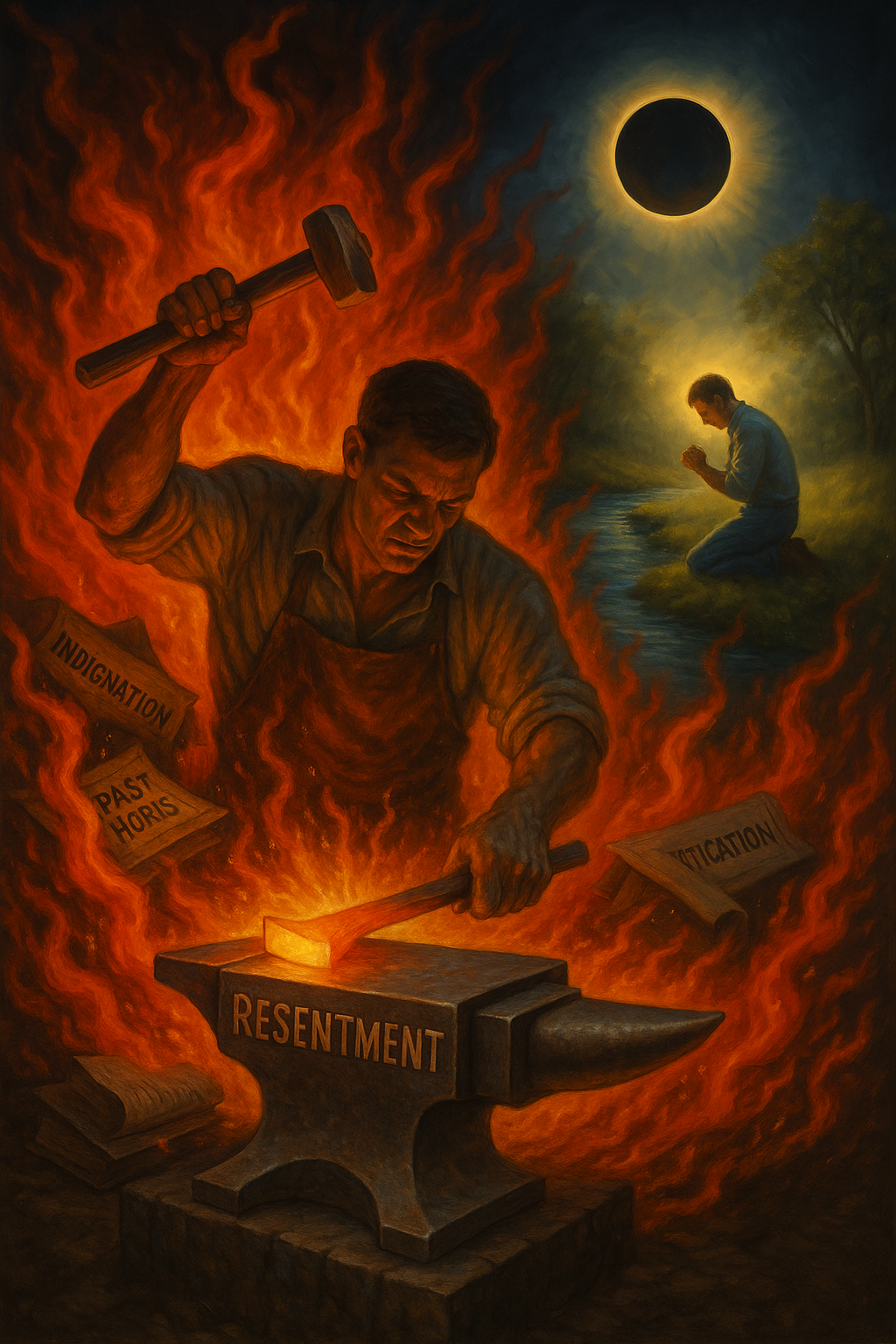
Before Al-Anon, I lived like a blacksmith of bitterness—hammering my pain on the anvil of justification. I would feed the flames of my resentments with stories, evidence, indignation. I needed them to feel real, to feel righteous. In some twisted way, they gave me purpose. They made me feel strong… or at least not powerless.

But over time, I began to notice that these resentments weren’t armor—they were acid. They didn’t protect me; they corroded my joy. They poisoned my quiet moments and shadowed my attempts at peace. They stole the present by chaining me to a past I couldn’t change and a future I feared repeating.

In recovery, I’ve come to understand that my feelings are valid, but they are not sovereign. I don’t have to kneel at their altar every time they cry out. I don’t have to rehearse the injury or assign moral scores. I don’t have to play judge and jury in a courtroom where I am both plaintiff and prisoner.

I ask my Higher Power to lift it—to take this burden from my hands and replace it with peace, even if it’s just for now. And sometimes, that’s enough.

Sometimes, all I need is to stop fanning the fire. To grow still. To wait in patience and trust.

Because the miracle isn’t that the resentment vanishes overnight.

The miracle is that I am no longer alone with it.

“If you have a resentment you want to be free of, if you will pray for the person or the thing that you resent, you will be free. If you will ask in prayer for everything you want for yourself to be given to them, you will be free. Ask for their health, their prosperity, their happiness, and you will be free. Even when you don’t really want it for them and your prayers are only words and you don’t mean it, go ahead and do it anyway. Do it every day for two weeks and you will find you have come to mean it and to want it for them, and you will realize that where you used to feel bitterness and resentment and hatred, you now feel compassionate understanding and love.” ~ Alcoholics Anonymous, 4th Edition, page 552 (3rd Edition, page 544)

Endigar 972

Posted in Uncategorized with tags , , , , , , , , , , , on June 10, 2025 by endigar

From Courage to Change of Jul 30:

I’ve often heard that happiness is an inside job, and, much of the time, I can be as happy as I diced to be. Yet I have often found happiness fleeting. I know it’s unrealistic to expect to be happy all the time, but I think I might achieve this goal much more often if I made a firmer commitment to my decision to be happy. Instead, I choose happiness and then abandon my choice at the first sign of trouble. How deep can my commitment be if I all eve slight obstacles to rob me of my sense of well-being?

Commitment takes work; it is a discipline. When I make a decision, I must ask myself what I really want and if I am willing to work for it. Old habits are hard to break. If i have a long-standing habit of responding to problems by feeling like a helpless victim, it may not be easy to stand by my decision to be happy. A change of attitude sometimes helps: Perhaps I can look at problems as opportunities to commit more deeply to my choices. In other words, every obstacle can prompt me to assert that I really mean it – I do want to be happy.

Today’s Reminder

When I make a choice and then stick with it, I teach myself that my choices do have meaning and I am worthy of trust. I have an opportunity to make a commitment to one of my choices today.

“Our very life depends on everything’s recurring till we answer from within.” ~ Robert Frost

END OF QUOTE—————————————

Sometimes I think recovery asks me not just to get sober, but to get real—to start telling the truth about what I really want, and how easily I abandon it when life pokes at old wounds.

This realization hits me in the gut, because I have chosen happiness before. I’ve whispered it in prayers, journaled it into affirmations, even tried to fake it till I made it. But under stress, I still default to that familiar old posture: the slumped shoulders of the victim, the inner narrative that says, “See? Nothing good lasts.”

But I don’t want to live like that anymore. That’s why I show up to meetings. That’s why I inventory. That’s why I pray.

Because happiness, for me, isn’t about getting what I want—it’s about learning to want what I’ve got. To bless it. To be in right relationship with my life, even when it’s inconvenient or painful or just plain boring.

And yeah—it takes commitment. Real, grown-ass, spiritual discipline. Not because I’m trying to be perfect, but because I’m trying to be free.

And every time I choose to recommit—to this path, to my recovery, to the decision to live awake—I remind myself:
I am not powerless over my own response.
I am not the victim of every passing emotion.
I am not who I used to be.

Endigar 962

Posted in Uncategorized with tags , , , , , , , , , , , on May 28, 2025 by endigar

From Courage to Change of Jul 21:

“The people I love won’t take care of themselves, so I have to do it. How will they survive unless I . . .?” This was my thinking when I came to Al-Anon, my excuse for interfering in everyone’s business. My needs seemed so unimportant compared to the constant crises all around me. Al-Anon told me that I had other options, one of which was to let go and let God.

When I think of letting go I remind myself that there is a natural order to life – a chain of events that a Higher Power has in mind. When I let go of a situation, I allow life to unfold according to that plan. I open my mind and let other ways of thinking or behaving enter in. When I let go of another person, I am affirming their right to live their own life, to make their own choices, and to grow as they experience the results of their actions. A Higher power exists for others, as well. My obsessive interference disrupts not only my connection with them but also my connection with my own spiritual self.

Today’s Reminder

I am my top priority. By keeping the focus on myself, I let go of other people’s problems and can better cope with my own. What can I do for myself today?

“I will remind myself . . . that I am powerless over anyone else, that I can live no life but my own. Changing myself for the better is the only way I can find peace and serenity” ~ The Dilemma of the Alcoholic Marriage

END OF QUOTE—————————————

This is the new reality I am being shown—one that I couldn’t earn by willpower, manipulation, or self-sacrifice. In my old patterns, I tried to outrun fear with control and earn love through depletion. I called it strength, but it was survival. It left me hollow, stuck in cycles that always circled back to powerlessness.

But when that scaffolding finally collapsed, I didn’t die. I opened. That moment of futility became an invitation. I started to see that my old instincts didn’t have to be the only voice in the room. I allowed in a whisper of something else. A new logic, a Higher Intelligence. Something quieter, but stronger.

Recovery isn’t about perfect behavior. It’s about finally recognizing what matters most: me. Not in a selfish or defensive way, but in the honest clarity that my life is worth protecting, nurturing, and living in alignment with truth. That I must lead with care for myself, or I have nothing real to offer anyone else.

As I release reactive living—bit by bit, sometimes painfully—I don’t become passive. I become available. I can respond from vision, not fear. From purpose, not panic. I come to trust that my life is not random, and neither is yours. A Higher Power is at work in every one of us, not just in me. And there is a rhythm, a natural order, to it all. I may not always see the pattern, but I no longer need to interrupt it. I can trust it, walk with it, even rest in it.

And so the work continues—not in striving, but in surrender. Not in proving, but in receiving. I let go, and I rise.

Endigar 959

Posted in Uncategorized with tags , , , , , , , , , , , on May 26, 2025 by endigar

From Courage to Change of Jul 19:

Al-Anon taught me the difference between walls and boundaries. Walls are solid and rigid; they keep others out, and they keep me trapped inside. Boundaries are flexible, changeable, removeable, so it’s up to me how open or closed I’ll be at any given time. They let me decide what behavior is acceptable, not only from others but from myself. Today I can say, “No,” with love instead of hostility, so it doesn’t put an end to my relationships.

I’ve learned about boundaries from Al-Anon’s own set of boundaries: the Twelve Traditions. Although their purpose is to protect Al-Anon, they actually encourage the growth of the fellowship. This is true of my personal boundaries as well. As I decide what is and isn’t acceptable for me, I learn to live protected without walls.

Today’s Reminder

Do my defenses keep me safe, or do they isolate me? Today I can love myself enough to look for healthier ways to protect myself, ways that don’t close everyone out.

“People are lonely because they build walls instead of bridges.” ~ Joseph Fort Newton

END OF QUOTE—————————————

Note: Joseph Fort Newton (1880–1950) was an American Protestant minister and a prominent Masonic author. Newton authored a number of Masonic books, including his best-known works, The Builders, published in 1914, and The Men’s House, published in 1923. Does anyone else sense the irony of a Mason speaking on the problems with “building walls” while finding fulfillment in the closed and often secretive society of Freemasonry? Hmm…

Perhaps there is some validity to Oscar Wilde’s words;  “Man is least himself when he talks in his own person. Give him a mask, and he will tell you the truth.”

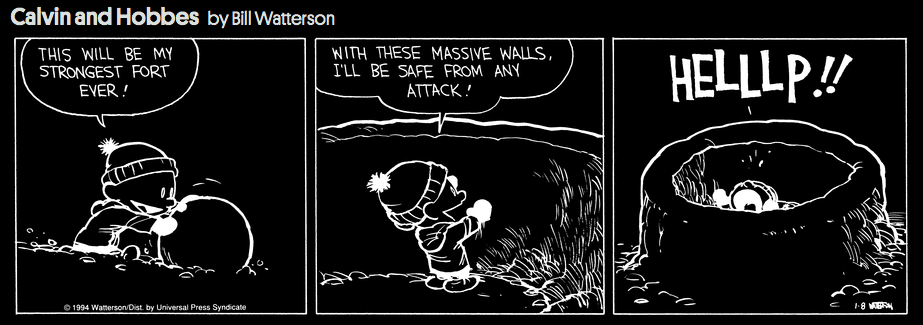
How often have I desire to build a safe fortress and found I was locked into a self-made prison. There was a time when I thought strength meant building walls—thick ones. Emotional, relational, even spiritual walls. I thought they would keep me safe. But what they really did was isolate me, cut me off not just from others but from myself. I couldn’t breathe behind those bricks. Couldn’t feel. Couldn’t trust. And I mistook that numbness for safety.

Al-Anon helped me see another way. It didn’t tear the walls down for me—it showed me the door. The path to boundaries instead of barricades. I can see that boundaries are different. They’re alive. They breathe with me. They give me the dignity of choice: how open I want to be, how much to let in, how much to let go. Boundaries don’t shut down connection; they make it possible.

Learning to say “No” without rage or shame has changed my relationships—and not just with others. My relationship with myself has opened. I don’t have to punish others to protect myself, and I don’t have to punish myself to keep others close. That’s grace in action.

I agree that there is hard earned wisdom in the Twelve Traditions. They can model what healthy boundaries look like in community. They’re not there to limit love—they’re there to hold it. In the same way, when I honor my personal boundaries, I’m not making myself smaller. I’m making space for who I really am to grow. I’m not building a fortress. I’m building a home.

Today, I live protected—not walled in.