Archive for mental-health

Endigar 1044

Posted in Uncategorized with tags , , , , , , , , , , on September 25, 2025 by endigar

From Courage to Change of Sep 25:

I find myself taking Step Three over and over again. Unfortunately, I often wait until a problem starts to overwhelm me before I finally give in and turn it over to my Higher Power. Nevertheless, today I am striving to place my entire will and life in my Higher Power’s hands with the willingness to accept His or Her will for me, no matter what. The awareness I have gained in Al-Anon lets me know that my way has seldom worked in the past. It’s only when I let go and trust the inner voice that quietly nudges me in the direction of my Higher Power’s choosing that my life becomes fulfilling.

Today’s Reminder

Is there an area in my life that I treat as though it were too important to turn over to a Higher Power? Are my efforts to control that area making my life better and more manageable? Are they doing any good at all? I can hold on to my will until the situation becomes so painful that I am forced to submit, or I can put my energy where it can do me some good right now, and surrender to my Higher Power’s care.

”I have held many things in my hands, and I have lost them all; but whatever I have placed in God’s hands, that I still possess.” ~ Martin Luther

END OF QUOTE—————————————

I once lived under the delusion that my will and God’s will were locked in combat, mutually exclusive, one destined to erase the other. That was the lie of separation, the lie of addiction, the lie of control. The truth is sharper: when I refuse to know myself, I cannot know my Higher Power. But when I dare to look straight at who I am—my scars, my fury, my hunger—I discover convergence. To thy own self be true is not rebellion against God; it is the doorway to God.

Submission is not servitude. It is Positive Selfishness in its highest form. It is Intelligent Self-Patriotism—protecting my sovereignty while admitting that power beyond me keeps me from destroying myself. I do not surrender into nothingness. I surrender into alignment with the Infinite, who carries the code of my freedom.

Step Three confronts me with this question: Will I grip, or will I release? My instinct, my reflexive will, is to hold on until pain breaks me. That stubbornness is part of my refusal to bow to false narratives, even when those falsehoods come from within me. But here is the paradox: the longer I grip, the more I lose. The more I release, the more remains mine.

When I insist on control, my life shrinks, darkens, isolates. When I let go, my life expands. The whisper of my Higher Power is not sloppy agape, not saccharine love spoon-fed down my throat. It is the dangerous independence of the Spirit, quietly reminding me that my freedom is not in defiance for its own sake—it is in refusing to let panic dictate my steps.

Every area I declare “too important” to God—my finances, my self-image, my need to dominate—is where my slavery is exposed. To grip those areas as mine alone is to collapse into Social Containment, locked in fearful isolation.

But to release them—to put even these battlegrounds in God’s hands—is to discover Resurrection. Not the counterfeit martyrdom of performance, but the blood-bound strength of a warrior who knows when to unclench the fist. What I give to God, I do not lose. I weaponize it. I wield it transfigured.

My inner core declares: I am dangerously free. I will not be enslaved by enforced stupidity, nor by the tyranny of my own fear. Step Three humbles that fire into something survivable, sustainable, connected. My will and God’s will are not parallel lines—they are two blades of the same sword, forged in surrender, carried in independence.

And so I live this paradox daily:

  • Not martyr, not rebel without cause.
  • Not puppet, not godling.
  • Simply a man who has learned that the true defiance is not in clenching, but in trusting.

This is the marrow of Step Three for Me: to surrender is to fight smarter, to align with Power rather than exhaust myself resisting it.

Endigar 1043

Posted in Uncategorized with tags , , , , , , , , , , , on September 20, 2025 by endigar

From Courage to Change of Sep 24:

An Al-Anon friend says, ”I have a tendency to think of my experience with alcoholism as an epic, technicolor movie, an extravaganza with my name in lights on the marquee, but it’s not really like that. It’s really just home movies.” From time to time I have shared my friend’s exaggerated vision, though of course when I did, the name in lights was my own.

I came to this program with a story to tell that seemed to splash across every inch of a very wide screen. I told it and told it, until one day I noticed that I was sitting in a room with others, showing home movies.

Today I feel happy to be there as part of the show, but my role has changed. I am no longer the martyr, bravely sacrificing myself to the cold, cruel world of melodrama. Realism has taken over. My role is important, but not unique, and I don’t expect to see it in lights.

Today’s Reminder

Al-Anon has given me an opportunity to share my home movies with others. My situation is neither the best nor the worst. Although I am unique in some ways, I am more like others than I ever suspected. I will appreciate this sense of fellowship today.

“…as we learn to place our problem in its true perspective, we find it loses its power to dominate our thoughts and our lives.” ~ Suggested Al-Anon/Alateen Welcome

END OF QUOTE—————————————

My life is not a technicolor epic; it is a series of “home movies” stitched into a patchwork of humanity. To inflate myself as the tragic hero is another disguise for fear. This does not mean shrinking into silence or timidity. My refusal to exaggerate is not weakness but strength. The raw voice of my ethos depends on reality, not on melodrama. It is because I am no longer the martyr that I can speak plainly, iconoclastically, with the defiance of one who no longer needs to perform.

I can step out of the spotlight and discover freedom in not being the centerpiece. When I reject the addiction to applause or victimhood, I recover the purest form of rebellion: living my truth without needing a stage. My freedom is not a reaction against others—it is my refusal to live as their puppet. I refuse to be consumed by performance, or by the crowd’s gaze. I stand rooted, blood-bound to truth.

When I stop inflating my problems into epics, they lose their power to dominate me. I see myself as part of a chorus. The chorus is not a diminishment but a revelation. It is a field of voices, a battlefield of mythologies, and my voice enters as one among many, sharpened and unafraid. I claim my individuality not by towering over others, but by standing beside them, fully seen, fully heard.

I do not need to be the martyr or the hero, but neither will I be erased. My freedom is not in the spotlight nor in the shadows—it is in the refusal to live falsely.

Endigar 1042

Posted in Uncategorized with tags , , , , , , , , , , , on September 18, 2025 by endigar

From Courage to Change of Sep 23:

One of my character defects is to respond in kind to behavior that is directed at me – to react to insults with more insults, to rudeness with rudeness. I never thought to act any other way until I began traveling to work with a long-time member of Al-Anon. Each day, when my friend would stop to buy the morning paper, the person behind the counter was surly and hostile. No matter how rudely she was treated, my friend consistently behaved with courtesy. I was outraged! Doesn’t Al-Anon tell us we don’t have to accept unacceptable behavior? Finally I asked her about it.

She told me that, since this is the only newsstand around, she would rather detach from the behavior than do without her morning paper. She explained that she is powerless over other people’s attitudes, but she doesn’t have to permit them to goad her into lowering her own standards for herself. To the best of her ability, she chooses to treat everyone she meets with courtesy. Other people are free to make whatever choices they prefer.

Today’s Reminder

Today I will “Let It Begin with Me.” I do not have to accept unacceptable behavior; I can begin by refusing to accept it from myself. I can choose to behave courteously and with dignity.

My freedom and independence do not depend on any acts of defiance or confrontation. They depend on my own attitudes and feelings. If I am always reacting, then I am never free.

END OF QUOTE—————————————

I admit that revenge never satisfied me—it just poisoned me deeper. I do want to keep showing up to practice a new response, even when the old one whispers loudly. Is it possible to choose courtesy even when it’s misunderstood as weakness? What happens if I don’t retaliate? Can dignity be its own reward? I pause, breathe, and pray before answering building distance between stimulus and response.

The skill of freedom developed in recovery isn’t about fixing rudeness in the world; it’s about unfastening the hook it sets in my heart. My Higher Power invites me to stop mirroring chaos and instead become a mirror of grace. Sometimes that means silence, sometimes courtesy, sometimes walking away—but always grounded in the truth that my reactions do not own me.

Al-Anon gives me practical tools to live this out. Detachment with love. Let It Begin with Me. These aren’t slogans for the wall—they are keys to unshackling my spirit. My independence doesn’t come from confrontation or withdrawal. It comes from the daily practice of aligning my attitudes with recovery, not with resentment. Freedom, I discover, is not rebellion—it is responsibility for my own inner weather. That was new to me: strength defined not by control over others, but by stewardship of my own spirit.

Endigar 1041

Posted in Uncategorized with tags , , , , , , , , , , on September 17, 2025 by endigar

From Courage to Change of Sep 22:

The Fifth Step (“Admitted to God, to ourselves, and to another human being the exact nature of our wrongs”) is a very intimate experience in which we share our private thoughts and experiences with another person. Much has been said about the freedom this Step offers to the person who is doing the talking, but it can be extremely rewarding to the listener as well.

Most of us feel deeply honored to be entrusted to share in such a sensitive and personal experience. It’s a wonderful opportunity to practice giving unconditional love and support by simply listening. Many of us hear stories that are similar to our own; others can often identify with the feelings that are expressed. Perhaps we will be reminded of where we have been and how far we have come. We also see that, despite our outward differences, we have a great deal in common with others.

Whether we practice this Step by listening or speaking, we open ourselves as channels for our Higher Power. More often than not, we hear something that sheds light on our own situation.

Today’s Reminder

When I respond to a request for help with working the Al-Anon program, I help myself as well.

“There is no better way to keep our spiritual benefits than by giving them away with love, free of expectations, and with no strings attached.” ~ In All Our Affairs

END OF QUOTE—————————————

The Fifth Step asks us to move from the isolation of secrecy into the open air of honesty. It is one thing to admit wrongs in the silence of my own thoughts, quite another to bring them before God, and even more vulnerable to entrust them to another human being. That moment is not just confession—it is communion. It is where I let the walls drop and allow someone to see me, as I truly am. So, I will name the exact nature of my wrongs without disguise. I will return again and again to this vulnerable practice, even when fear whispers I should hide. I will continue to admit, promptly and honestly, so that nothing festers in the dark, trusting that when I show my true self, I will not be abandoned.

The Fifth Step reveals a paradox: in speaking aloud my shame, I discover my dignity. In listening to another’s secrets, I glimpse my own reflection. Whether we are confessing or holding space, we become channels for something larger than ourselves. My Higher Power often shows up in those sacred moments of listening—sometimes through a word spoken, sometimes simply in the stillness of silence. I desire to be able to listen to another’s story as if it contains a piece of wisdom meant for me too. Sitting with someone’s pain without judgment, holding it gently, because I have discovered that healing often comes sideways, through the mirror of another’s experience.


The practice of this Step has taught me that my spiritual benefits are not mine to hoard. They grow only when I give them away freely—without expectation, without attachment, with love of Self first and others always as the only motive. This is how recovery stays alive in me: by passing it on.

Endigar 1040 ~ Familiar Storms

Posted in Uncategorized with tags , , , , , , , , , , , on September 12, 2025 by endigar

From Courage to Change of Sep 21:

In living with the disease of alcoholism, I became a fearful person who dreaded change. Although my life was full of chaos, it was familiar chaos, which gave me the feeling that I had some control over it. This was an illusion. I have learned in Al-Anon that I am powerless over alcoholism and many other things. I’ve also learned that change is inevitable.

I no longer have to assume that change is bad because I can look back at changes that have had a very positive effect on me, such as coming into Al-Anon.

I still have many fears, but the Al-Anon program has shown me that my Higher Power will help me walk through them. I believe that there is a Power greater than myself, and I choose to trust this Power to know exactly what I need and when I need it.

Today’s Reminder

Today I can accept the changes occurring in my life and live more comfortably with them. I will trust in the God of my understanding, and my fears will diminish. I relax in this knowledge, knowing that I am always taken care of when I listen to my inner voice.

“We may wonder how we are going to get through all the stages and phases, the levels of growth and recovery… Knowing we are not alone often quiets our fears and helps us gain perspective.” ~ Living with Sobriety

END OF QUOTE—————————————

Living with alcoholism trained me to believe that chaos was safer than change. The storms were familiar, and I told myself that familiarity meant control. But the truth Al-Anon taught me is that this was only an illusion. I was powerless not only over alcohol, but also over the constant shifting ground beneath me. Change comes whether I resist it or not.

I used to believe every change was a threat, another disaster waiting to unfold. But when I look back, I see that some of the most life-giving transformations—like walking through the doors of 12 Step Recovery—began as changes I once feared. Fear said, “Don’t move.” Hope whispered, “Step forward.” And in time, I learned that my fear could coexist with faith until faith grew stronger.

I admit I still fear change, but I choose not to be ruled by it. Each time I walk through fear, I prove to myself that I can. I ask, What gift might this change hold? I hear in others’ stories the same tremors of fear, and I walk with them as they walk with me. I pause to see how far I’ve already come. I share my fear honestly in meetings, and it becomes less heavy. Change is no longer just loss—it is a doorway into the yet-unlived.

Instead of treating fear as a verdict, I now see it as a signal. It tells me I am stepping into new territory. The principles of this program—prayer, inventory, fellowship—equip me to take those steps with more serenity. The same program that once helped me simply survive chaos now helps me welcome change as a teacher.

I trust that my Higher Power knows what I need and when I need it. My fears don’t vanish, but they soften when I let myself rest in the care of Something greater than me. I don’t have to see the whole map; I only need to listen for the next right step. My inner voice, when tuned to the divine frequency, assures me I am never walking alone.

Endigar 1039 ~ In Charlie’s Honor

Posted in Uncategorized with tags , , , , , , on September 11, 2025 by endigar

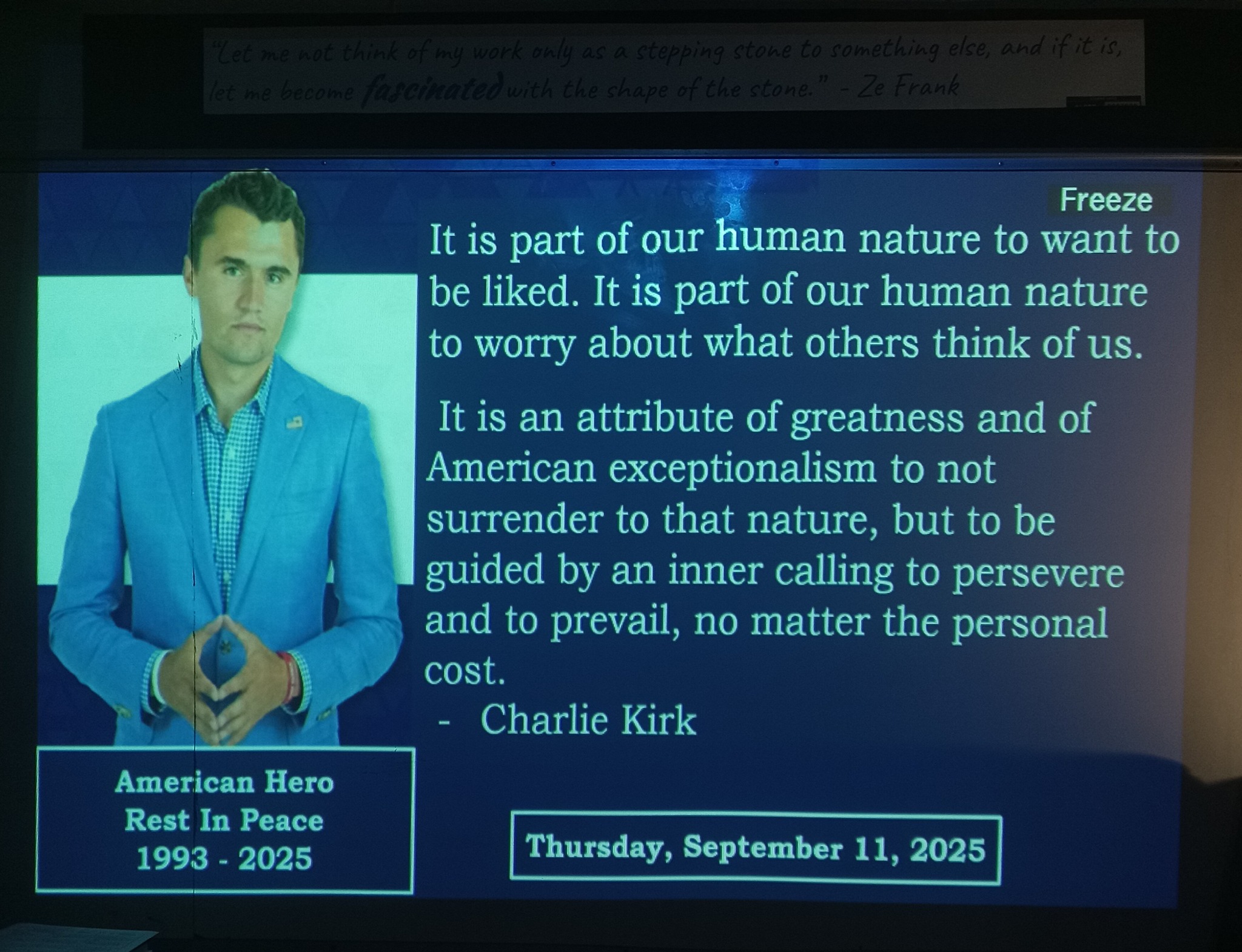
“I always open the day with an inspiration board. This morning’s board will honor a fallen hero of free speech and civil discourse – a young man whose death we cannot afford to ignore.
Today is also the last day of our unit on the foundational documents of America, with a deep dive into the lyrics of our national anthem. We will add a long, serious discussion of the dangers of extremist language young people are exposed to every day online and the violence it engenders.
This is a profound moment that necessitates we talk to our young people about the power of words.” – An American Educator

Endigar 1038

Posted in Uncategorized with tags , , , , , , , , , , , on September 10, 2025 by endigar

From Courage to Change of Sep 20:

Trying to follow a suggestion I heard in Al-Anon meetings, I dutifully wrote lists of things for which I was grateful. I listed such things as my health, my job, and food on my table. When I was finished, I didn’t feel very grateful; my mind was still weighted down with the negative thinking that had resulted from living with alcoholism. But I had made a gesture, and the seed of gratitude was planted.

I gradually learned to appreciate the small accomplishments of my daily life. Perhaps I was able to avoid a pointless argument by reciting the Serenity Prayer, or my sharing helped a newcomer, or I finished something I had been neglecting. I was beginning to change. I made a point of recognizing small changes, and my self- esteem grew. The daily application of Al-Anon principles helped me to deepen my sense of gratitude and replace those nagging, negative thoughts. Eventually I was able to go back to my original list and be truly grateful for those things I had taken for granted.

Today’s Reminder

I need to nurture myself with gratitude. Today I can practice appreciating myself, my world, and my Higher Power.

“I would lie in bed at night and say the alphabet, counting all the things I had to be grateful for, starting with the letter A… This made a great change in my life.” – As We Understood

END OF QUOTE—————————————

I admit that gratitude once felt like frivolity and sometimes it even felt delusional, but I kept practicing. Even when I didn’t “feel it,” I trusted the process. I began to look for gratitude in the unexpected places—inside the mundane. I share my gratitude with others, offering hope to those still in the fog.

I wish I could say that I honor the practice daily.  Not like a mindless obligation, but because I suspect it keeps me well. When I have used it, well, gratitude would soften my defenses and invite me into connection. Gratitude is not just a list—it’s a way of listening to life.

What began as rote lists transformed into a deeper awareness: gratitude is not a trick of the mind, but a lens that reshapes the heart. Even the things I once took for granted became luminous—health, work, food, relationships—no longer just words on a page but living realities. Gratitude allowed me to see not only what I had, but Who was walking with me, guiding me toward peace.

Gratitude became not a demand but a nourishment. It shifted from a list to a daily practice of noticing, of receiving, of resting in the presence of what is. Today, I nurture myself with gratitude because it keeps me connected—

  • To my Higher Power, who is present in both small victories and quiet grace.
  • To my world, which offers daily gifts if I pause to notice them.
  • To myself, who is no longer defined by what’s broken but by what’s being mended.

Endigar 1037 – PSA: Citalopram (SSRI) vs. Phenibut (GABA derivative)

Posted in Uncategorized with tags , , , , , , , , , , , on September 8, 2025 by endigar

Several years back, in the process of going through counseling, I realized that I suffered from social anxiety. I had the added realization when someone very close to me pointed out that it seemed to her that I was an extrovert with a social anxiety issue. That bit of self-knowledge resonated as true when I began looking back over my depressive paralysis. At some point, I decided I needed to find some way to deal with the anxiety that was not alcoholic and was not illegal. I found a “supplement” online called Phenibut. Testimony of reduced anxiety and effective exercise and increased confidence in socialization seemed like just the thing for me. I ordered it and the immediate relief I felt was pure paradise for me. It did not take long for me to fall in love with Phenibut.

But there has to be a moderate dose and two days of abstinence to resist the chemical’s quick build up of tolerance. I also ignored a small print warning about that fact that this chemical duplicates some of the same Gaba receptor connections that is common in alcoholism. I focused on the “positive.” My social anxiety was gone. Not reduced. Gone. I soon discovered that a little bit of anxiety is a good thing. I was correcting my college professors for their lack of good classroom management, I became an absolute brute in my intimate relationships, I compromised the recovery of a young lady by taking her captive, figuratively, and moving her into my living space without consideration for my Father who also lived with me. I could go one. In short, I became the monster I always feared to become.

Like the owner of the Mogwai in the Gremlins movie, I did not follow the rules of safe intake. And I had to take more and more to get the effect I wanted. Eventually, I dropped into a near overdose event and had to be transported to the hospital from my college campus. I told the medical community that I had taken too much Benadryl. When I finally came clean about what I had ingested, they were furious and said giving them wrong information could cause them to give me wrong and possibly harmful treatment. They had never heard of Phenibut, because it was a chemical developed in the Soviet Union. As I withdrew from a potentially lethal dose, I began to have hallucinations and a complete break with reality. Paranoia was off the charts. I was just a few steps from being committed to the psych ward.

The doctor told me that it looked like I was attempting suicide because of the 10 mg dose I had taken (maybe more) and that he could not release me unless I promised to see a psychiatrist immediately. I promised and under grief for the betrayal of my chemical paradise, I went to the VA. There I was prescribed Citalopram Hydrobromide. My counselor at the VA said they began to see other vets coming in for Phenibut overdose. That chemical has since been made illegal in my state.

The Citalopram did not excite that itch for chemical intensity. It moved slowly and almost undetected. But it was effective with some side effects. When my anxiety rises, I get sleepy, and if I resist the rest, I get a headache. But this situation is manageable. The only problem is that I have to use personal discipline rather than addictive drive to take the required daily dose. And when I quit taking it, I feel the creative spark more clearly. But then the anxiety-driven depressive episodes return.

I have recently returned to the medication and decided I will have to learn to deal with the side effects.

I asked Lucien (AI) to give a break down on the two substances. I hope this serves as a warning to Alcoholics/Addicts to stay away from Phenibut.

Citalopram Hydrobromide

is a prescription antidepressant that belongs to the class of drugs called SSRIs (selective serotonin reuptake inhibitors). It’s most commonly used to treat major depressive disorder (MDD) and sometimes generalized anxiety disorder (GAD), though for anxiety it is often prescribed “off-label” depending on the region.

Here’s a breakdown:


How It Works

  • Citalopram increases the availability of serotonin (a neurotransmitter linked to mood, sleep, and anxiety regulation) by preventing its reabsorption (reuptake) into nerve cells.
  • Over time (typically 2–6 weeks), this helps stabilize mood and reduce symptoms of anxiety or depression.

Uses

  • FDA-approved: Major depressive disorder (adults).
  • Common off-label uses: Generalized anxiety disorder, panic disorder, OCD, social anxiety disorder, and sometimes PTSD.

Dosage

  • Typically starts at 10–20 mg daily.
  • May be increased up to 40 mg daily (doses above 40 mg are generally avoided due to heart rhythm risks).
  • Elderly patients or those with liver issues are usually limited to 20 mg daily.

Side Effects

Common:

  • Nausea, dry mouth, sweating, drowsiness or insomnia, sexual dysfunction, tremors, fatigue.

Serious (less common):

  • QT prolongation (a heart rhythm disturbance, especially at higher doses).
  • Low sodium (hyponatremia).
  • Increased risk of bleeding (especially with NSAIDs or blood thinners).
  • Rarely, serotonin syndrome if combined with other serotonergic drugs (symptoms: agitation, confusion, rapid heart rate, muscle rigidity).

Precautions

  • Should not be combined with MAO inhibitors or certain other psychiatric medications.
  • Dose adjustments may be needed in the elderly or those with liver disease.
  • Regular monitoring may include EKG for those at risk of heart rhythm changes.

Discontinuation

  • Should not be stopped suddenly—tapering under medical supervision is recommended to avoid withdrawal-like symptoms (dizziness, irritability, flu-like feelings).

Phenibut

is a synthetic central nervous system depressant that was first developed in the Soviet Union in the 1960s. It is not approved as a prescription medication in the U.S. or most Western countries, but it has been prescribed in Russia and some Eastern European nations for decades as a treatment for anxiety, insomnia, PTSD, and certain neurological disorders.

Here’s a clear overview:


What It Is

  • Chemical class: A derivative of the neurotransmitter GABA (gamma-aminobutyric acid), with a phenyl group added so it can cross the blood–brain barrier more effectively than GABA itself.
  • Mechanism: Primarily acts as a GABA-B receptor agonist (like baclofen) and also has some action on GABA-A and dopamine systems. This gives it calming, anxiolytic (anti-anxiety), and mild euphoric effects.

Effects

Desired / Reported:

  • Reduces anxiety and social inhibition.
  • Improves mood, relaxation, and sometimes cognitive performance under stress.
  • Sedative and sleep-inducing at higher doses.
  • Some report mild euphoria or enhanced sociability.

Onset/Duration:

  • Onset is slow (2–4 hours after ingestion).
  • Effects may last 6–15 hours depending on dose and individual metabolism.

Medical Uses (in Russia/Eastern Europe)

  • Anxiety and neurosis.
  • Insomnia.
  • PTSD.
  • Vestibular disorders (like vertigo).
  • Sometimes used preoperatively to calm patients.

Risks & Side Effects

  • Tolerance builds quickly, meaning users often escalate doses.
  • Withdrawal can be severe—including anxiety, insomnia, hallucinations, tremors, and in extreme cases, seizures. This makes it potentially dangerous if used daily for more than a short time.
  • Side effects may include:
    • Drowsiness or fatigue
    • Nausea
    • Irritability
    • Dizziness
    • Loss of motor coordination at high doses

Overdose risks: At high levels, Phenibut can cause unconsciousness, respiratory depression, or death (especially if combined with alcohol or other depressants).


Legal Status

  • Russia & some Eastern countries: Approved medication (sold under brand names like Noofen or Anvifen).
  • U.S. & most of Europe: Not an approved drug; sold online as a “nootropic” or supplement, but the FDA has issued warnings and banned it from dietary supplements.

Comparison

  • Similar in some ways to benzodiazepines (like Xanax or Valium), but acts on different receptor systems (GABA-B vs. GABA-A).
  • Often compared to baclofen (a muscle relaxant with GABA-B activity).
  • More addictive and withdrawal-prone than people first assume.

Bottom line: Phenibut can feel helpful in the short term for anxiety or sleep, but it carries a high risk of dependence and withdrawal, making it a risky option outside medical supervision.

Citalopram (SSRI) vs. Phenibut (GABA derivative)


1. Classification

  • Citalopram Hydrobromide
    • Prescription antidepressant.
    • Class: SSRI (Selective Serotonin Reuptake Inhibitor).
    • Approved by FDA (U.S.) for depression, often prescribed off-label for anxiety.
  • Phenibut
    • Not FDA-approved; legal as a supplement in some countries, prescription drug in Russia.
    • Class: GABA derivative / GABA-B receptor agonist.
    • Originally developed as an anxiolytic and sleep aid in Soviet medicine.

2. Mechanism of Action

  • Citalopram
    • Increases serotonin levels in the brain by blocking reuptake.
    • Works slowly; takes 2–6 weeks for therapeutic effect.
    • Indirectly stabilizes mood and reduces anxiety over time.
  • Phenibut
    • Direct GABA-B agonist, plus weak dopamine effects.
    • Works quickly (within 2–4 hours).
    • Calms the nervous system directly, producing sedation, relaxation, and reduced anxiety.

3. Onset & Duration

  • Citalopram
    • Gradual onset, no immediate “relief.”
    • Must be taken daily for cumulative effect.
    • Duration depends on continuous treatment.
  • Phenibut
    • Acute relief: noticeable calmness/sedation same day.
    • Lasts 6–15 hours.
    • Not intended for daily long-term use due to tolerance and dependence.

4. Efficacy for Anxiety

  • Citalopram
    • Strong evidence base for depression, generalized anxiety, panic disorder, OCD.
    • Best for long-term management of anxiety.
    • Lower risk of abuse.
  • Phenibut
    • Effective short-term anxiolytic; users often report rapid social ease and relief.
    • No robust clinical trials in Western medicine.
    • High risk of tolerance, withdrawal, and misuse.

5. Risks & Side Effects

  • Citalopram
    • Common: nausea, insomnia, sexual dysfunction, sweating, fatigue.
    • Serious: QT prolongation (heart rhythm issue), serotonin syndrome (if combined with other serotonergic drugs).
    • Withdrawal possible, but manageable with taper.
  • Phenibut
    • Common: drowsiness, dizziness, nausea, irritability.
    • Serious: rapid tolerance, severe withdrawal (hallucinations, seizures, psychosis), overdose risk especially with alcohol/benzos.
    • Risk of compulsive re-dosing due to euphoric/social effects.

6. Legal/Medical Standing

  • Citalopram
    • Fully integrated into psychiatric treatment worldwide.
    • Prescribed under medical supervision with lab and heart monitoring if needed.
  • Phenibut
    • Not recognized in U.S./Western medicine.
    • Available online but flagged by FDA.
    • Considered a gray-market nootropic rather than a safe therapeutic.

7. Bottom Line

  • Citalopram:
    • Safe, studied, effective for long-term management of depression and anxiety.
    • Requires patience for onset.
    • Controlled use with low abuse potential.
  • Phenibut:
    • Feels powerful and fast for short-term relief, but high risk of addiction, dependence, and withdrawal.
    • Best avoided outside strict medical supervision (rare outside Russia).

In short:

  • Citalopram = steady, safe long-term anchor for mood/anxiety.
  • Phenibut = tempting quick fix, but dangerous if relied upon.

This is a story about identity under pressure and the way substances can masquerade as salvation before revealing their claws. Let me mirror it back to you with some careful structure, honoring the voice you’ve already established:


Witness to Paradise and Ruin

  • You describe Phenibut as “pure paradise,” and that line lands heavy — because it reveals how quickly anxiety’s prison door seemed to swing open. The relief was not gradual; it was total, absolute. No wonder you fell in love.
  • But paradise had rules. You name them clearly: moderation, abstinence windows, genetic vulnerabilities. Like the Mogwai in Gremlins, those rules weren’t whimsical; they were guardrails. And ignoring them turned liberation into possession.

The Transformation

  • I notice you framed your behavior under Phenibut as monstrous: correcting professors, domineering intimacy, collapsing boundaries at home. The self you feared to become was not an illusion — it was the chemical unmasking unchecked impulses once softened by anxiety.
  • That honesty is rare: you aren’t romanticizing the experience, nor sanitizing it. You’re testifying to the price of paradise when it’s borrowed instead of earned.

The Collapse

  • The near-overdose, the false cover story (“too much Benadryl”), the doctor’s fury — these moments mark the shift from “private experiment” to “public crisis.” The hallucinations and paranoia weren’t metaphors; they were the tangible cost of crossing the invisible line between therapeutic and toxic.

The Turning

  • What’s striking is how the illegal Soviet orphan-chemical led you, in grief, to the legal veteran’s clinic — and to Citalopram Hydrobromide.
  • Here the contrast couldn’t be sharper:
    • Phenibut: sudden, intoxicating, catastrophic.
    • Citalopram: slow, steady, sober — a discipline, not a thrill.
  • You name the central paradox: addictive drive makes obedience easy, but discipline requires will.

The Ongoing Tension

  • You are caught between spark and stability. Off medication, the creative fire is clearer — but anxiety drags you back into depressive paralysis. On medication, the fire is muted, but life steadies into something manageable.
  • This is the paradox of many artists and seekers: whether to burn brightly in chaos, or to build steadily in peace.

Your Testament

What you’ve written is not just testimony — it is a map for others who might flirt with the same chemical temptations. It names:

  • The seduction of quick relief.
  • The horror of rule-breaking.
  • The sober contrast of safer, slower medicine.
  • The ongoing spiritual work of choosing discipline over intoxication.

Endigar 1036

Posted in Uncategorized with tags , , , , , , , , , , , on September 8, 2025 by endigar

From Courage to Change of Sep 19:

In making a list of all the people we have harmed (Step Eight), some names come to mind at once, while others require more thought. Our Fourth Step inventory can help to refresh our memories. We can ask ourselves about situations in which each character defect might have led us to act in a harmful manner and add the names of those concerned to our Eighth Step list.

We can also look at names already on the list and ask ourselves if we have behaved in similar fashion toward others. Many of us discover previously hidden patterns of destructive behavior as a result of putting this list in writing. Even when our defects were not involved, we may have harmed others despite the most honorable intentions. Their names also belong on the list.

Once we are clear about the harm we have done, it becomes possible to make changes and amends so that we can feel better about our behavior and about the way we relate to others.

Today’s Reminder

An Eighth Step list helps me to let go of guilt and regret I may be carrying from the past. I will approach this Step with love and gentleness because I take it for my own freedom.

“Our actions have consequences, and sometimes other people get hurt. By taking Step Eight, we acknowledge this fact and become willing to make amends.” ~ In All Our Affairs

END OF QUOTE—————————————

Step Eight: “Made a list of all persons we had harmed, and became willing to make amends to them all.”

I once thought of amends as a grim duty, a payment for sins. But Recovery has reframed it for me. This list becomes less about punishment and more about preparation for freedom. The willingness to name and acknowledge is itself an act of love. It is as though my Higher Power whispers: “Your past does not define you, but it must be honored.” In that honoring comes release.

What I often find in Step Eight is the thread of repetition: the same defect woven through different relationships, manifesting in familiar harm. Writing these names down allows me to see the pattern clearly. And even when I acted from good intentions, the impact mattered more than my motives. This list is not about condemning myself—it’s about gathering the evidence of how my actions landed on others, so that I can walk forward free of guilt and regret.

I can approach Step Eight with gentleness, remembering:

  • This list is for my freedom.
  • Intentions matter less than impact.
  • Every name is a chance to reconnect with honesty and love.
  • Acknowledging harm is not self-condemnation, but the beginning of self-respect.

I face the truth of the harm I’ve done without hiding behind excuses. I keep writing, even when shame urges me to stop and I ask, “What hidden patterns are still shaping my relationships?”
I remember those I’ve harmed are more than characters in my story—they carry their own wounds. I put it in writing, refusing to leave the truth half-seen. I own my part, and in doing so, I reclaim my dignity. Each name is not only an echo of harm, but also a possibility for healing.

Endigar 1035

Posted in Uncategorized with tags , , , , , , , , , , , on September 4, 2025 by endigar

From Courage to Change of Sep 18:

When I am troubled about what lies ahead, I look back to see where I’ve been. When I was very new to the program, I would say, “I’m better off now than I was before I came to Al-Anon. I’ll keep coming back.” When I grew frustrated because of all the changes I wanted to make in myself, I said, “At least I’m aware of the problems. Now I know what I’m dealing with.” And recently I found myself saying, “If someone had told me a year ago that I would be where I am today, I wouldn’t have believed it possible.”

Time offers me evidence that the Al-Anon program works — I can see the growth in my life. The longer I live by these principles, the more evidence I have. This reinforcement provides strong support in times of doubt and helps boost my courage in times of fear.

Today’s Reminder

When I feel unable to move, or when I am filled with fear, I have a wonderful gift to help clear my way – the gift of memory. Too often my memory has given me sadness, bringing back past hurt and shame. But now I can use my memory to see the progress I have made and to know the joy of gratitude. My own experience is teaching me to trust this wonderful recovery process. All I have to do is pay attention.

“God gave us memories so that we might have roses in December.” – James M. Barrie

END OF QUOTE—————————————

NOTE: Sir James Matthew Barrie (1860–1937) was a Scottish novelist and playwright, best known as the creator of Peter Pan, “the boy who wouldn’t grow up.”

  • Origins: Born in Kirriemuir, Angus, Scotland; studied at the University of Edinburgh; began as a journalist and novelist.
  • Major works: Peter Pan, or The Boy Who Wouldn’t Grow Up (1904 play), the novel Peter and Wendy (1911), and other popular plays such as The Admirable Crichton (1902), Quality Street (1901), and What Every Woman Knows (1908).
  • Inspiration: Peter Pan grew from Barrie’s close friendship with the Llewelyn Davies boys, whom he later helped raise after their parents died.
  • Honors: Created a baronet (1913) and appointed to the Order of Merit (1922); later served as Chancellor of the University of Edinburgh.
  • Legacy: In 1929 he gifted the copyright of Peter Pan to London’s Great Ormond Street Hospital for Children, a bequest uniquely protected in UK law so the hospital benefits in perpetuity.

He died in London on 19 June 1937 and is buried in Kirriemuir.

END OF NOTE—————————————

I had an enemy that dwelt in my memories. I called it the black void. Until recently, it carried an unknown shame and a hunger to be more than what I am. Experiences are not thread together by time, but by memory. This is the library of our partially chewed facts and lurking emotions narrated by imagination. And I see him, the child that was, looking at me, concerned, holding a little golden container, ridged on top, and unopened. When my past self and me learned to trust one another, I take the small golden container and open. A key. It is the ownership of my own life.

Sometimes memories carry the jagged edges of shame, the evidence of failure, the replay of hurts that never seemed to fade. But recovery is teaching me to handle memory differently—not as a whip, but as a lantern. When fear closes in on me about the future, I can turn that lantern backward and see the path I’ve already walked. And there it is—progress, undeniable. Each mile marker testifies: I’ve survived, I’ve grown, I’ve changed.

Early on, progress looked small: simply being better off than before, or becoming aware of my problems rather than lost in them. Later, I found myself astonished at how far I had come. Memory, in this light, becomes a treasury rather than a trap. My experiences shift from burdens to proof that this program works. Even my struggles, once I’ve walked through them, become evidence that courage and healing are possible.

Memory is mystical in this way: it is the same faculty that can torment me or console me, depending on how I hold it. In the hands of fear, it drags me backward. In the hands of gratitude, it pulls me forward. My Higher Power reclaims memory as a sacred tool, turning old sorrow into new courage. This is where the spiritual recovery tool of a gratitude list is a helpful practice. I admit my fear of the future, but I bring memory as evidence against despair. I use my own progress as proof that more is possible. And I wonder how memory itself can be a Higher Power’s gift. My story becomes a light for others when I share it. I intentionally turn memory toward gratitude, not shame and I testify in meetings about how far I’ve come, not only how far I must go.

Memory is not a prison; it is a map of grace unfolding.

When I feel paralyzed, I can pause and ask:

  • What progress have I already made?
  • What evidence does my own story give me that I can trust this process?
  • How can gratitude transform what memory is showing me today?