Archive for mental-health

Endigar 1013

Posted in Uncategorized with tags , , , , , , , , , , , on July 23, 2025 by endigar

From Courage to Change of Aug 30:

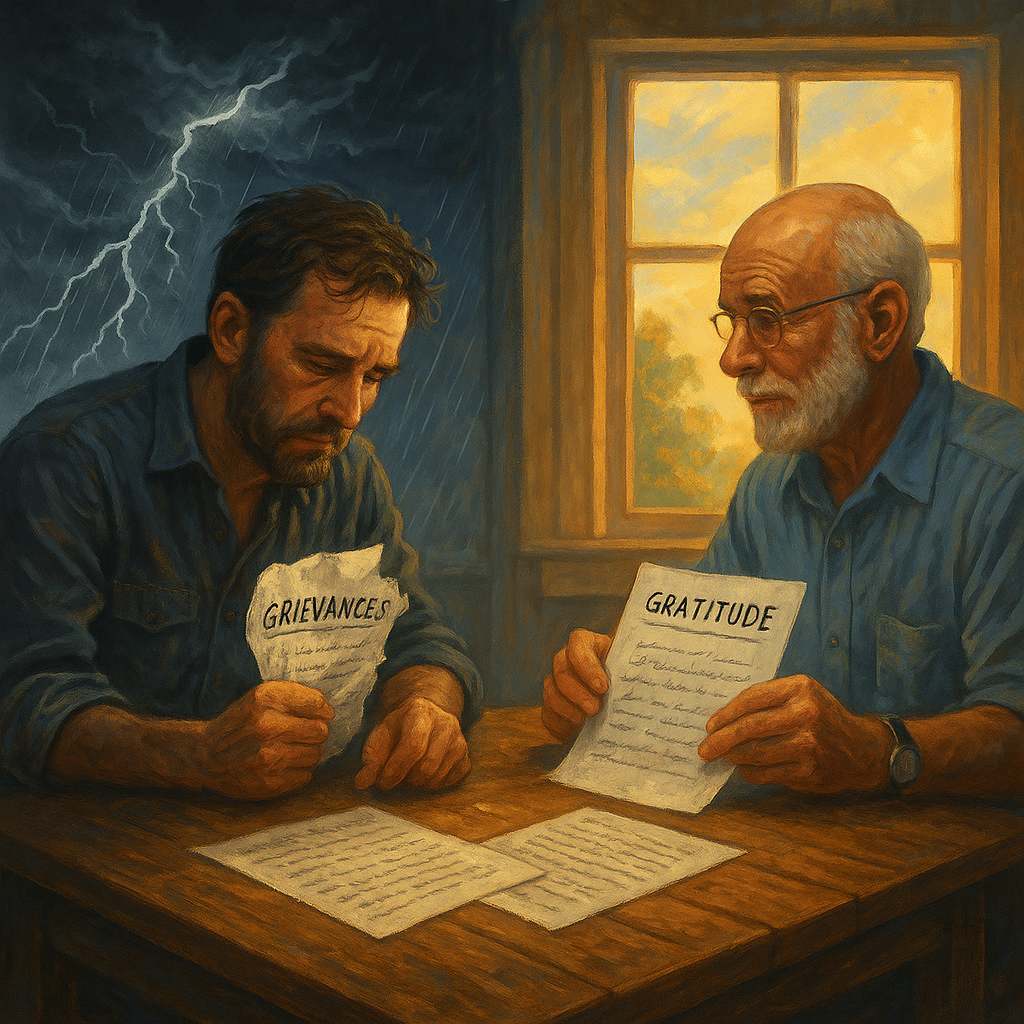
Normally my Sponsor would recommend a gratitude list when I felt low, but one day, when I complained about a family situation, he suggested that I list all the things I was unhappy about. Several days later my depression had passed, and when I told my Sponsor about the terrific day I was having, he suggested a gratitude list. He thought it might help me to refer to it the next time I felt blue. That made sense to me, so I complied.

When I went to put this new list in the drawer where I keep my papers, I noticed the earlier list and read it once more. To my surprise, my list of grievances was almost identical to my gratitude list — the same people, same house, same life. Nothing about my circumstances had changed except the way I felt about them. For the first time I truly understood how much my attitude dictates the way I experience the world.

Today’s Reminder

Today I recognize how powerful my mind can be. I can’t always feel good, and I have no interest in whitewashing my difficulties by pasting a smile on my face. But I can recognize that I am constantly making choices about how I perceive my world. With the help of Al- Anon and my friends in the fellowship, I can make those choices more consciously and more actively than ever before.

“Change your thoughts and you change your world.” – Norman Vincent Peale

END OF QUOTE—————————————

Norman Vincent Peale (1898–1993) was a Christian minister, author, and influential figure in American religious life, best known for popularizing the concept of “positive thinking” through his landmark 1952 book, The Power of Positive Thinking. A Methodist-turned-Reformed pastor, Peale served for more than half a century at Marble Collegiate Church in New York City.

There was a time in my life when the storm inside me felt louder than any peace I could muster. I’d sit with my Sponsor and bring him the scraps of my spirit—my grief, my discontent, my twisted thoughts—and he’d thoughtfully hand me back a tool. Sometimes it was a gratitude list, sometimes a question, and once—he told me that in my observations, my journaling, look for the patterns in my pain and resentment.

I have indeed found that my gratitude lists and my painful patterns dance in the same neighborhoods. It is true that sometimes, it is a matter of perspective.

This is where the real work of the program lives for me: not just in inventorying my defects, but in inventorying my perceptions. My attitude isn’t just the lens through which I see the world—it’s often the author of my experience. The same facts can tell wildly different stories depending on whether I’m rooted in fear or in faith.

I no longer see gratitude as a forced smile or a way to gaslight myself into feeling better. I see it as a recalibration of my spiritual compass. It reminds me that the story isn’t over, and I get to choose the tone of the next chapter. I still allow space for grief, anger, confusion—but I don’t build my home there. I let those feelings pass through like weather. And when I forget, my lists are there. Both of them. To remind me how much power I truly hold—not over people or outcomes, but over my own way of seeing.

Endigar 1012

Posted in Uncategorized with tags , , , , , , , , , , , , on July 22, 2025 by endigar

From Courage to Change of Aug 29:

Since childhood I have been nagged by those moments when I said or did something that brought pain to another person. These are ugly memories that I never believed would go away. With Step Eight, however, I discover a means to release myself from unrelenting guilt.

This Step says to make a list of all people I have harmed and to become willing to make amends to them all. Finally, I can put down in words all the memories and all the pain. When I see them written in front of me, they seem almost manageable, and I feel hopeful about freeing myself from their weight as I become willing to make amends. I need not take any further action at this point. All I am concerned with now is the harm I have caused others, the guilt I have brought on myself, and the desire to do what I can to clear it all away.

Today’s Reminder

Guilt is a burden that keeps me from giving myself fully and freely to the present. I can begin to rid my mind of guilt by quietly admitting where and when I have done wrong to people, including myself.

“Al-Anon has shown me another way of living, and I like it. Life can either be a burden and a chore or a challenge and a joy. One day at a time I can meet the challenges of life head-on instead of head-down.” ~ As We Understood

END OF QUOTE—————————————

What As We Understood Is:

Full Title: As We Understood: More Talks on Al-Anon Principles

  • Published by: Al-Anon Family Group Headquarters, Inc.
  • First published: 1985
  • Format: A collection of essays and reflections written by Al-Anon members

This book explores spirituality from a wide range of personal experiences—without prescribing a single religious belief or dogma.

There are memories that trail us like smoke—thin, acrid, persistent. For me, it began in childhood: the sharp moments when my words cut, or my silence wounded, or I simply didn’t know better—but the damage still landed. Those memories carved themselves into my mind as shame-stained markers. I thought they were permanent. I thought they defined me.

And then came Step Eight.

It didn’t ask me to fix it all overnight.
It didn’t demand atonement before I was ready.
It simply asked me to look honestly and become willing.

To write the names.
To acknowledge the harm.
To open the door—however slightly—to the possibility of amends.

There is something powerful about naming. Something holy about writing it down. It takes the swirling shame out of abstraction and lays it flat on the page where it can be seennot as a life sentence, but as a spiritual inventory. A map of where I’ve been untrue to myself and to others. A beginning.

I don’t have to make the amends yet. Step Eight reminds me: willingness is the work for now.
This is a step of preparation, of spiritual stretching.
It’s less about action and more about alignment.

And in that space, I find relief. I find dignity. I find hope.

Because guilt—unspoken, unexamined—has a way of locking us out of the present moment. It dims the light of connection. It whispers that we’re imposters in our own recovery. But when I begin to name the harm, the fog lifts. I can feel my heart begin to loosen its grip on the past. I can turn, gently, toward the living now.

Sometimes the first person I need to put on that list is me.

Because I have harmed myself too—with harsh words, impossible standards, addictive spirals, and the refusal to believe I was worth saving. I must be willing to make amends inward as well—to forgive the scared version of me who only knew how to survive.

The Steps have shown me that life isn’t just endurance. It’s discovery.
That the past isn’t just a burden. It’s compost for a freer soul.
And that isolated self-castigation isn’t living—it’s hiding.

Today, I lift my head.
Not because I’m proud of everything I’ve done—but because I’m becoming someone I’m no longer ashamed to be.

One name at a time.
One truth at a time.
One willingness at a time.

And that, I’ve learned, is more than enough to begin.

Endigar 1011

Posted in Uncategorized with tags , , , , , , , , , , on July 21, 2025 by endigar

From Courage to Change of Aug 28:

I had never dared to trust another person the way I trusted my first Al-Anon Sponsor. With faltering self-confidence I had asked her to sponsor me: I was a mess, would she have me? I was sure she would turn me down because I thought I was not worth saving. Her positive response really took me by surprise.

Gently, she guided me through the Steps. I was so desperate to feel better that I was willing to try whatever Al-Anon tool or idea she suggested. I lived, breathed, and ate Al-Anon.

One lonely day I phoned her, crying out in despair that I’d never get the hang of feeling better. What she said at that critical time was, “I don’t know anyone who is as willing to work the program as you are.” My spirits soared! She had said to me what I couldn’t say to myself, but I knew that it was true — I was very willing. In that moment of acknowledgment I knew I’d be okay, because I had what it took. In time, her example helped me learn to give that kind of acknowledg- ment to myself.

I had taken a chance. I had trusted. And as a result, I learned that I was worth saving!

Today’s Reminder

Learning to value myself can begin by having the courage to find, and use, a Sponsor.

“Nothing we do, however virtuous, can be accomplished alone; therefore, we are saved by love.” ~ Reinhold Niebuhr

END OF QUOTE—————————————

NOTE: Reinhold Niebuhr (1892–1971) was a prominent American theologian, ethicist, and public intellectual best known for his work in Christian realism—a philosophy that acknowledged the persistent reality of human sin and the limits of human perfectibility, especially in politics and social life. Niebuhr is widely credited with writing the Serenity Prayer, famously used in 12-Step programs like Alcoholics Anonymous:

“God, grant me the serenity to accept the things I cannot change,
Courage to change the things I can,
And wisdom to know the difference.”

I’m currently working with my fourth sponsor in a journey that has unfolded over 18 years. Each one marked a significant layer of trust—not just in another person, but in the recovery process itself.

My first sponsor, David H., met the panicked, wild-eyed version of me—the confused soul who stumbled into the rooms with more fear than faith.
The second, Tim C., offered a place where I could be broken-hearted without shame. He helped me learn how to laugh at myself, to take things seriously but not personally. Both of these men walked with me through Cocaine Anonymous.

I’d never used cocaine, but I qualified for CA because their First Step reads, “We were powerless over cocaine and all other mind-altering substances.” Their meetings were open, raw, and felt freer—less bound by religious overtones than AA. It was the right space for me in those early years.

After years riding the relapse rodeo, I began to release some of my resentments toward organized religion. That shift made room for me to return to Alcoholics Anonymous, where I found my first AA sponsor, Happy Jack.

I still remember him saying, “Get off that cross—we need the wood.”
It was sharp. It was funny. It stuck.

Then he stopped returning my calls. I assumed I’d worn him out, that I was too much. It wasn’t until years later that I learned the truth: he had died. It had never been about me.

I tried going it alone for a while. That old lone-wolf pattern. But eventually, I reached again. My next sponsor, Charles N., is an artist. There’s something in that shared creative current, the way we both know the shadows and the dark wells—it’s made walking this road together deeply healing. Thank you, Charles.

Since then, I’ve settled more fully into recovery. I walked through Al-Anon with yet another sponsor, Paul, and completed the Steps. Then I joined Adult Children of Alcoholics (ACA) and am now being sponsored by Scott K. in that fellowship.

I’ve become thoroughly inundated with recovery.
And now—I sponsor others.

My point in sharing this history is simple:
The path isn’t always clear or easy. Connection doesn’t always come quickly.

But if the desire to live freely burns even slightly, it’s enough.
Enough to keep coming back.
Enough to fall seven times and get up eight.
Enough to turn away from morbid reflection—and recreate life.

Because in the end, sponsorship isn’t just about guidance.
It’s about being seen, walked with, and reminded:
You are never too far gone to begin again.

Endigar 1010

Posted in Uncategorized with tags , , , , , , , , , , , on July 20, 2025 by endigar

From Courage to Change of Aug 27:

At my first Al-Anon meeting, I was disappointed when I was given the Twelve Steps instead of a “do’s and don’t’s” list for changing the alcoholic. Nevertheless, I was desperate enough to give the Steps a try, anyway.

At my second Al-Anon meeting I thought I had those first three Steps down pretty well — I knew I was powerless, I believed in God, and I was willing to dump my problems onto anyone who would take them. As I continued to attend meetings I began to see that I wasn’t really admitting my powerlessness or I wouldn’t keep trying to control everyone and everything around me. OK, so I skipped the part about letting go and letting God.

Today I am so glad to have a patient God, so that when I finally say, “Not my will but Your will,” God steps in and sorts things out in ways I never would have imagined. The first three Steps aren’t as easy as I once thought, but in Al-Anon I’ve learned to aim for progress, not perfection.

Today’s Reminder

When I was dealing with alcoholism without the help of Al-Anon, I developed coping skills. These are no longer enough. Al-Anon is teaching me a new and better set of skills. I will try to be patient with myself. I’m doing fine.

“As long as you live, keep learning how to live.” ~ Seneca

END OF QUOTE—————————————

NOTE: Seneca—full name Lucius Annaeus Seneca (c. 4 BCE – 65 CE)—was a Roman Stoic philosopher, statesman, playwright, and advisor to Emperor Nero. He is one of the most influential voices in Stoic philosophy, especially known for his writings on ethics, resilience, and the inner life. Forced to commit suicide after being accused of conspiracy—he met it with calm, in true Stoic fashion.

I watch people who believe debate with people who don’t—arguing back and forth about the existence of God. To me, it’s an irrelevant conversation. Until either side can explain infinity—or infinitely explain—it’s all just noise.

I am mortal. My thoughts are shaped by the context of a limited life. And yet, in my own quiet pursuit of a Higher Power, something real is happening. I’ve accumulated experiences—subtle, sacred, undeniable. Hints. Moments. Patterns. They don’t prove anything to anyone else, but they build my faith. And that accumulation—that unfolding—is what I call the Knowing.

It’s not about winning a debate. It’s about being met. I’ve come to trust in Something—expansive, infinite—that not only exists but gives a damn about me. And about you. Individually. Personally.

I believe because the God-concept works. I interact with it intuitively, through slowly maturing practices of prayer and meditation. These are not rituals of performance, but invitations into presence.

Religious dogma, I’ve learned, is the architecture for communal stewardship. It helps tribes stay oriented.
Scientific skepticism, at its best, is not cynicism—it’s the pursuit of what actually works. Not a rejection of meaning, but a reverence for evidence.

But the individual—especially the one ravaged by addiction—is often caught in the crossfire between science and religion. And those of us bruised and burned by that battlefield suffer deeply when we mistake that war for our own.

I no longer fight.
I surrender.

The Infinite One has my attention.
And more than that—He has my heart.

May you be prospered on your path.
And may that path be uniquely yours.

Endigar 1009

Posted in Uncategorized with tags , , , , , , , , , , on July 18, 2025 by endigar

From Courage to Change of Aug 26:

Looking back, I have often reproached myself, “How could you not have known what was happening?” Alcoholism left messy tracks all over my life, yet I didn’t see them. How could that be?

Denial is one of the chief symptoms of this family disease of alcoholism. Some of us deny that the drinker has a problem; others are all too willing to blame him or her for all our problems, denying our own participation. Why? Because we alone can’t defeat this disease, so we invent ways to survive the constant crises, broken promises, lost hopes, and embarrassments. One way to cope is to deny the unpleasant or terrifying reality.

In Al-Anon we learn more productive ways in which to cope with alcoholism, ways that don’t cost so much in loss of self. With the support of other members, and with tools and principles that offer direction, we become able to face what is really going on. We go beyond mere survival and begin to live again.

Today’s Reminder

At all times, I have done the best I was able to do. If my only way to cope with a difficult situation was to deny it, I can look back with compassion to that person who saw no better option at the time. I can forgive myself and count my blessings for having come so far since then.

“Regret is an appalling waste of energy; you can’t build on it; it’s only good for wallowing in.” ~ Katherine Mansfield

END OF QUOTE—————————————

Katherine Mansfield (1888–1923) was a pioneering modernist writer from New Zealand, best known for her short stories that delicately explore human psychology, fleeting moments, and the subtle complexities of everyday life. Her real name was Kathleen Mansfield Beauchamp.

Key Facts:

  • Birth: October 14, 1888, in Wellington, New Zealand
  • Death: January 9, 1923, in Fontainebleau, France (from tuberculosis at age 34)
  • Genre: Short fiction, modernist literature
  • Notable Themes: Loneliness, class divisions, childhood, epiphany, fragility of relationships, mortality

Major Works:

  1. “The Garden Party” – A story that juxtaposes upper-class privilege with the reality of death, as seen through the eyes of a young girl.
  2. “The Daughters of the Late Colonel” – A psychological portrait of two sisters paralyzed by the memory of their domineering father.
  3. “Miss Brill” – A poignant tale of a lonely woman who creates fantasies to escape her isolation.
  4. “Prelude” – A semi-autobiographical story about a family’s move to the countryside, reflecting Mansfield’s own New Zealand upbringing.

Legacy:

Although she died young, Mansfield left a profound impact on 20th-century literature. Her brief life was marked by illness, emotional intensity, and a relentless pursuit of literary expression. Her personal letters and journals also reveal a deeply introspective, intellectually restless soul.

END OF NOTE—————————————

There are moments—quiet, piercing moments—when I look back and whisper to myself, “How could you not have known?” The tracks were everywhere. The chaos wasn’t subtle. The pain wasn’t discreet. And yet… I didn’t see. Or I couldn’t. Or I wouldn’t.

The truth is, I survived by not seeing.

Denial, I’ve come to understand, wasn’t my moral failure. It was my emotional shelter when the storm wouldn’t stop. It was how I stitched myself together when the narrative of my life couldn’t afford another tear. I didn’t consciously lie to myself—I did what I had to do to keep breathing in a world that made no sense.

In the family disease of alcoholism, denial isn’t a weakness. It’s a symptom. And often, it’s a sign of love distorted by trauma. Some of us deny the drinker has a problem. Others vilify the drinker so thoroughly we can’t see our own behaviors at all. Both are strategies of survival. Both are echoes of powerlessness.

But recovery has taught me another truth:
I am allowed to look back with mercy.

That former version of me—the one who overlooked the chaos, who blamed herself for everything or nothing, who flinched from truth as if it might bite—she was doing her best. That survival mode was sacred in its own way. It kept me alive long enough to arrive here, where something new could begin.

With Al-Anon’s tools, I no longer have to deny. I don’t have to contort reality into something palatable. I have the fellowship, the slogans, the Steps—and the grace—to face life as it actually is. I can let truth be truth without fearing it will break me.

And that’s where the shift happens:
I go from coping to living.
From hiding to healing.
From regret to redemption.

Because regret is a sinkhole. It swallows energy, hope, self-worth. And I’ve learned that I cannot build a single floorboard of new life on the foundation of “I should have known.”

Now I choose to build on compassion.
I build on courage.
I build on the quiet, daily decision to forgive the one who didn’t know—and to bless the one who’s learning now.

Endigar 1008

Posted in Uncategorized with tags , , , , , , , , , , on July 17, 2025 by endigar

From Courage to Change of Aug 25:

When students first learn to play the piano, they are usually taught to use only one hand and include very few keys. Then they move on to using two hands, eventually learning to play all the keys, the high ones as well as the low. In fact, part of the pleasure of playing lies in hearing the rumble of the lowest bass notes and the light chiming of the high treble.

Today in Al-Anon I am learning to play a new instrument — myself. I am a person with the capability to experience a wide range of emotions, from love to joy to wonder. I am profoundly grateful for laughter and light spirits — and also for anger and fear, because all of these feelings are part of what makes me whole. I believe that my Higher Power wants me to be fully alive and fully aware of all my feelings: The crashing crescendo of great anger, the soft chant of serenity, the heights of wonder, and the new insights that stretch my heart and mind just as my fingers stretch to reach all the keys in a challenging chord. I am learning to play richer sounds than I ever thought possible.

Today’s Reminder

Today I will appreciate the full range of feelings available to me. They make my experience of life full indeed.

“I have sometimes been wildly, despairingly, acutely miserable… but through it all I still know quite certainly that just to be alive is a grand thing.” ~ Agatha Christie

END OF QUOTE—————————————

Before recovery, I divided emotions like sheep and goats—some were holy, others unclean. I crowned happiness, joy, and syrupy love as the angels of mental health. But anger? Sadness? They were exiled, branded with shame, and locked in the dungeon with the spiritually deficient.

To feel too much was madness.
To feel too little was sainthood.
And I aimed for sainthood—numb and smiling.

I thought if I could just tiptoe through the tulips of unshakable good vibes, if I could radiate peace like a lobotomized monk in Birkenstocks, then surely I would become the recovery success story of someone’s keynote speech. A trophy soul.

But in my quest to be enlightened, I was performing serenity while silencing truth.
And when I did feel anger—or sorrow, or discomfort—I judged it as a relapse in character.

I also believed that depth and seriousness wore only black. I scoffed at joy. I tucked away laughter like it was childish, uncouth, or inappropriate at the altar of spiritual progress. Joy was silly. Grief was noble. I knew which side I wanted to be on.

But recovery—patient, gentle, uncompromising—handed me a new score to play.

There are no negative emotions.
There are no positive ones either.
There are only messengers. Sacred couriers of inner truth.

Anger isn’t an enemy—it’s a signal that something vital is being crossed.
Sadness isn’t shameful—it’s a threshold into deeper reflection.
Happiness isn’t shallow—it’s a moment of connection I’m allowed to feel without guilt.

Recovery taught me to stop playing warden over my feelings and start becoming a steward. These emotions aren’t here to take over—they’re here to guide.

Yes, if I hand them the keys, they’ll drive me off a cliff.
But if I treat them as guests—offer them tea, listen without judgment, and learn their language—they reveal the hidden terrain of my soul.

In recovery, I’m no longer trying to feel only the “good” stuff. I’m trying to feel everything honestly—so I don’t have to be ruled by anything in secret.

Today, I let my emotions be servants, not tyrants.
And in doing so, I discover the quiet revolution of becoming fully human.

Endigar 1007

Posted in Uncategorized with tags , , , , , , , , , , , on July 16, 2025 by endigar

From Courage to Change of Aug 24:

I’m usually such a gentle, easy-going person that you’d never believe what happens when I get angry. I fly into a rage, my blood pressure seems to double, and I unleash a torrent of profanity. After years in Al-Anon, my anger is still a problem, but my behavior has greatly improved.

Some time ago my dog got its feet tangled in an extension cord and broke a beautiful vase. My temper flared, and angry words cut like sharp swords. What helped me to change this behavior was the look of hurt and bewilderment on my pet’s face at the sudden, violent change in me. If a little animal could respond this way, what were my outbursts doing to the people in my life who understood every nasty word?

Today’s Reminder

I am human and I get angry, but I don’t have to act out my anger in destructive ways. I do not have the right to take it out on others. Whether my usual response is to scream, sulk in cold silence, or lash out with cruel words, today I can look at what I do when I get mad. Maybe next time I will try something new.

“We can pave the way for calm, reasonable communication only if we first find healthy outlets for our own negative feelings.” ~ The Dilemma of the Alcoholic Marriage

END OF QUOTE—————————————

There was a time when I truly believed I had a gift—a superpower, even. I could walk through the minefield of family dysfunction with a kind of eerie calm. When the shouting began, when the air grew sharp with rage or shame, I didn’t cry, didn’t scream, didn’t break.

I neutralized.

It felt like survival magic. I shut down emotion like flipping a breaker switch. And later, in the echo chamber of adulthood, I carried that same skill like a weapon hidden in my coat. Smiling when I was shattered. Nodding through the heat. Telling myself I was strong because I didn’t flinch.

But silence is not strength. It is delay.

The emotion never disappeared. It gathered. Like steam in a sealed kettle. And when it finally released—when someone pushed a little too hard or life asked too much—I erupted. And it was messy. It was disproportionate. It was terrifying. Not just for them—for me.

I thought I was protecting others from my chaos.
But really, I was disowning the most vital parts of myself.

What I’ve come to understand in recovery is this:
Emotions don’t vanish when ignored. They metastasize.

I was trying to outsmart pain instead of processing it.
Trying to stay safe instead of growing up.

And the real heartbreak? The villain I designed this defense to battle—whether it was a parent, a partner, a past trauma—they were no longer present. But the pattern remained. The withdrawal. The inner coldness. The explosive relapses of rage. I had become the very energy I once vowed to purge.

That’s the moment I knew I wasn’t protecting myself anymore—I was imprisoning myself.

Today, I choose another way.

I let my emotions speak—without dictating my behavior.
I let my anger rise—without turning it into destruction.
I acknowledge my sadness—without needing to drown in it.
I name what I feel so that I don’t have to punish others for not guessing.

This is the work of recovery. Not to silence emotion, but to integrate it.
To feel without fear. To express without harm.
To let anger serve connection, not sever it.

Step Ten helps me watch my patterns in real time. Not to shame myself, but to redirect the current before it floods the house. I am not here to pretend I am above anger. I am here to learn how to be honest within it—and to make it safe for others to be honest with me.

So maybe next time, I’ll try something new.
Maybe I’ll speak. Breathe. Take a walk. Write a prayer. Cry.

Not because I’ve lost my superpower.
But because I’ve finally chosen something better:

A soul unarmored. A voice returned. A connection restored.

“Gooooosfraaaabaa…” ~ Dr. Buddy Rydell in Anger Management (2003)

Endigar 1006

Posted in Uncategorized with tags , , , , , , , , , , , on July 15, 2025 by endigar

From Courage to Change of Aug 23:

I developed a tremendous fear of making mistakes. It seemed crucial to cover every possible outcome, because mistakes often led to an avalanche of accusations and abuse from the alcoholic — and eventually from myself. My self-esteem diminished because the slightest error felt huge and I couldn’t let it go. So I began to cover up and rationalize my mistakes, all the while desperately trying to maintain an appearance of perfect self-control.

In Al-Anon I learned to take down that rigid wall of seeming perfection, to honestly admit mistakes, and to open myself for growth. Step Ten, in which I continue taking my inventory and promptly admit when I am wrong, has been liberating because it challenges me daily to be honest. Sometimes it makes me squirm, but I know that when I tell the truth, I am free of the lies that held me back. As Mark Twain put it, “If you tell the truth, you don’t have to remember anything.”

Today’s Reminder

I will probably make a mistake of some sort every day of my life. If I view this as a personal failing or pretend that no mistakes have occurred, I make my life unmanageable. When I stop struggling to be perfect and admit when I am wrong, I can let go of guilt and shame. That is cause for rejoicing.

“Help them to take failure, not as a measure of their worth, but as a chance for a new start.” ~ Book of Common Prayer

END OF QUOTE—————————————

Recovery has taught me that efficiency doesn’t mean running faster or juggling more. It means living truer—with rearranged priorities that reflect healing rather than trauma.

In my old life, “efficiency” meant keeping every ball in the air, covering every possible failure point, staying two steps ahead of accusation, punishment, or shame. Perfection wasn’t a desire—it was a defense strategy. Every mistake carried the risk of emotional collapse, either from the another’s rage or from the venom I turned inward against myself. There was no margin for error, so there was no margin for me.

But in recovery, efficiency has a new face.

Now, it looks like connection, not control.
It looks like honesty, not illusion.
It looks like risking the mess of growth instead of hiding behind the mask of performance.

I’ve come to understand that my value doesn’t rise and fall on flawless execution. I can take on new disciplines, try new things, and stretch toward excellence—not to prove myself, but to explore who I am becoming. And when I stumble, I don’t have to disappear into shame. I can stay present. I can course-correct. I can breathe through it.

That’s the grace of Step Ten.
It’s not punitive. It’s daily liberation.

Step Ten teaches me how to keep the mirror clean without smashing it. It invites me into honest, loving self-examination—not the spiral of morbid reflection that tells me I’m broken beyond repair, but the gentle voice that says:

“You’re growing. You missed something. Let’s try again.”

My self-esteem grows not because I’m finally perfect, but because I’m no longer afraid to be seen.

Each time I admit a mistake promptly—without drama, without hiding—I tear down another brick from the wall that once kept me isolated. And in its place, I build something better: a life anchored in truth, flexibility, and connection to a Higher Power who never required my perfection—only my willingness.

So today, I let efficiency be redefined.
Not by speed.
Not by image.
But by how gently I can live in alignment with who I really am.

Endigar 1005

Posted in Uncategorized with tags , , , , , , , , , on July 14, 2025 by endigar

From Courage to Change of Aug 22:

My Al-Anon recovery involves becoming aware of what motivates my choices. I was appalled to discover that fear ruled my life! I seemed to be afraid of everything! I was afraid to say, “No,” to show hurt or anger, to be confused. With clenched teeth and a painted-on smile, I’d say, “Oh no, everything’s okay,” while thinking, “There’ll come a day when I’ll get even.” Even that scared me because I was afraid of my own anger!

Many of my Al-Anon friends used the slogans to deal with their fears, but when fear engulfed me, all I could think of was “Came to believe…” I couldn’t finish the rest of the Second Step, but that one phrase was enough. So when the telephone rang and I was startled and beginning to imagine the worst, I would take a deep breath and say to myself, “Came to believe…” Then it became possible to pick up the phone. And I always hung up feeling so much lighter because we had handled it!

Today’s Reminder

Before taking any action, I need only remind myself that I am in the care of a Higher Power. Whether the words I use say, “Help!” or “Let Go and Let God,” or “Came to believe,” I know that my Higher Power and I can deal with whatever we are facing.

“We turn our will and our life over to the care of God as we understand Him. A Higher Power is like a friend who really cares about us and wants to share our problems.” ~ Alateen—a day at a time

END OF QUOTE—————————————

What truly motivates my choices today?
Am I acting from love, clarity, or connection—or is fear still quietly pulling the strings behind the curtain?

Where does fear most often show up in my life?
Is it in saying “no”? In expressing anger or hurt? In admitting that I don’t have all the answers?

What does my version of the “painted-on smile” look like?
Do I hide behind politeness, performance, or caretaking to avoid conflict or disappointment?

Have I ever been afraid of my own anger?
What would it look like to treat that anger not as something dangerous, but as something needing care and clarity?

Which slogan or phrase helps me breathe when I’m overwhelmed?
When fear surges, could I pause and simply whisper, “Came to believe…” and trust that it’s enough?

What happens in my body when I imagine turning something over to my Higher Power?
Do I clench tighter, or can I sense even the smallest loosening?

When has a simple act—like answering a phone call—become a moment of spiritual courage?
Have I noticed the relief that comes not from control, but from surrender?

How do I experience my Higher Power—as distant theology or as a present friend?
What would it feel like to believe that God is not ashamed of my fear, but gently walking with me through it?

What would change if I stopped trying to be fearless and instead focused on being honest?
Can I accept that “Came to believe…” is not just a beginning—but a way of living?

Today, what fear could I meet with a breath, a whisper, and willingness—rather than a plan?
Could I let go of needing the full sentence and trust that grace understands my half-spoken prayer?

Endigar 1004

Posted in Uncategorized with tags , , , , , , , , , on July 13, 2025 by endigar

From Courage to Change of Aug 21:

Some Al-Anon suggestions, such as getting a Sponsor, were easy for me because I’m good at following specific instructions. But I didn’t know what to do with the slogan, “Live and Let Live.” Al-Anon helped me to let live by teaching me about detachment and helping me to see that many of my problems stemmed from minding everyone’s business but my own. But how do you turn your eyes on yourself and “live” for the first time in your life?

When I put this question to my Sponsor, she asked me one in turn — what had I done earlier that day? Although I’d had a very busy day, I could barely remember what I had been doing. My Sponsor suggested that I begin learning how to live by becoming more aware of my life as I was already living it. Then I would be better able to make choices about how I would like to live.

Searching for the real me, living according to my needs, and loving myself as a new-found friend have been the most rewarding benefits of the Al-Anon program. Strangely, they’re the last ones I would have imagined receiving when I began.

Today’s Reminder

Today I can choose to take responsibility for my own life. If I stay out of others’ affairs and become more aware of my own, I have a good chance of finding some serenity.

“Each man’s life represents a road toward himself.”
~ Hermann Hesse

END OF QUOTE—————————————

“Keep it simple.”
At first, I recoiled.

It sounded like a bumper sticker for the intellectually lazy—a slogan meant to quiet nuance and glorify ignorance. And I’ve always been someone whose mind loops, circles, and spirals. Complexity is my native tongue. I spent years inside mental architecture so elaborate it became a prison. So when I heard that I could be “too smart for this program,” it struck a nerve—because I was. And I was miserable.

But the longer I sat in rooms of recovery, the more I realized that simplicity wasn’t stupidity. It was clarity. And clarity, when you’ve been drowning in overthinking, is a kind of salvation.

I began to think of it like battlefield simplicity. In the military, I learned that sometimes you don’t need a theory—you need a plan. When the chaos storm hits, you don’t hold a seminar. You drop low, return fire, and get out alive. Recovery is no different. There are times when I must follow simple suggestions—not because I lack intelligence, but because the battlefield of my mind is on fire, and philosophizing during a trauma spiral is just a prettier way to bleed out.

So I stopped sneering at slogans and started listening to them like I once listened to field orders—calmly, steadily, with the humility of someone who wants to survive.

That’s when Keep It Simple became something else entirely.

It became a discipline of presence.

Instead of solving the mysteries of the universe before breakfast, I asked:
What did I actually do today?
Did the urgent devour the important?
Did I even notice my breath, my coffee, my soul checking in?

It reminded me of situational awareness. In uniform, that meant knowing your terrain, your mission, your blind spots. In recovery, it means the same—but the terrain is my emotional landscape, the mission is my serenity, and the blind spot is always ego or fear.

And then I heard Live and Let Live, and realized it was just another phrasing of what I’d learned in the service:
“Stay in your lane.”
Not out of apathy, but out of focus. Not because I don’t care, but because I finally care enough to respect the boundaries that keep us all spiritually alive.

Simplicity, then, isn’t about shutting down my intelligence—it’s about reclaiming it from chaos. It’s about choosing grounded clarity over clever disconnection. It’s about not outsmarting myself into a relapse of isolation and shame.

Today, I don’t need to be the smartest person in the room. I need to be the one who’s present, surrendered, and listening.