Archive for love

Endigar 1024

Posted in Uncategorized with tags , , , , , , , , , , , on August 12, 2025 by endigar

From Courage to Change of Sep 09:

Sometimes I sit in a meeting and I don’t know how to ask for help. I can get trapped inside my pain. Some nameless thing seems to tear at my insides. I freeze, thinking that if I don’t move, it will go away. So I don’t ask, I don’t talk, and the pain grows.

Does my face look calm? Don’t be fooled. I’m just afraid to let you see the truth. You might think I’m foolish or weak. You might reject me. So I don’t talk, and the pain remains.

But I listen. And through other people, my Higher Power does for me what I can’t do for myself. Someone in the meeting shares and expresses the very feelings I am afraid to describe. My world suddenly widens, and I feel a little safer. I am no longer alone.

Today’s Reminder

One of the miracles I have found in Al-Anon is that help often comes when I most need it. When I can’t bring myself to reach out for help, it sometimes comes to me. When I don’t know what to say, I am given the words I require. And when I share what is in my heart, I may be giving a voice to someone who cannot find his own. Today I have a Higher Power who knows my needs.

“As I walk, As I walk, The universe is walking with me.” – from the Navajo rain dance ceremony

END OF QUOTE—————————————

To withdraw or not to withdraw—that is the question. Life among humans can feel unbearably taxing, threatening, and disappointing. There’s no escaping that imagined spotlight fixed on my weaknesses, and no connection that fully satisfies my longing for something more.

I suspect others feel much the same. I also suspect that much of life is pretense—a kind of protective ritual. Whenever I encounter genuine connection in a safe space, it feels like a godsend. But inevitably, humanity finds a way to wound the inner child. And in the game of life, the safest place often seems to be the sidelines.

I know that silence can feel like safety. In my darker seasons, I’ve sat in meetings with my insides in knots and my face arranged in calm, thinking the stillness might somehow hide my storm. I’ve feared that if I spoke, I would be exposed—my weakness on full display, my worth put on trial. I’ve told myself, Just keep quiet. It will pass.

It rarely passes on its own. Pain that is swallowed whole only seems to grow heavier. But even when I can’t make my voice work, recovery has a way of finding me. I’ve sat frozen, and then someone across the circle shares a story that sounds like my story. Their words become the key I didn’t know I was holding. In that moment, the tight walls of my solitude widen, and light seeps in.

This is one of the miracles of our rooms: I don’t have to be the one speaking to be reached. My Higher Power uses the voices of others when I’ve lost my own. And when I finally dare to share my truth—halting, messy, imperfect—I sometimes see the same relief in someone else’s eyes.

Today, I am trying not to measure my recovery by how much I speak, but by how willing I am to be present—whether I’m the one carrying the message or the one being carried by it. I trust that the God of my understanding knows my needs, even when my mouth is closed and my hands are clenched.

When I cannot ask for help, I can still sit in the circle. Sometimes that’s enough for help to find me.

Endigar 1021

Posted in Uncategorized with tags , , , , , , , , , , , on August 8, 2025 by endigar

From Courage to Change of Sep 07:

I never thought much about Tradition Seven, which says that every group ought to be fully self-supporting. I thought it referred only to paying the rent. But recently I was involved with a group that maintained itself financially and still was not fully self-supporting because no one would commit to service. I already held several positions, and when my various terms expired, no one was willing to take my place. I made what felt like the responsible choice for myself and stepped down anyway. The meeting closed. In my opinion, a group that cannot fill its service positions is not fully self-supporting.

Today, in other, more flourishing groups, I have a greater appreciation of my responsibility to this Tradition. I believe that as we nurture our groups, we nurture and empower ourselves. We can make a contribution; we can make choices that help us to allow healing in ourselves and others.

Today’s Reminder

There’s more to maintaining a fully self-supporting Al-Anon group than just paying the rent. Continuity of service is important to our common welfare. Today I will think about the contribution I am making to my home group.

“I can support my group in a number of ways. When the basket is passed, I can give what I can. Just as important, I can give my time and moral support to help make ours the kind of group I want to belong to.” – Alateen—a day at a time

END OF QUOTE—————————————

Every group ought to be fully self-supporting without resorting to outside contributions. The spirit of tradition seven is that the group and its autonomy are essential for its member individuals. Part of protecting individual recovery of one’s truest self is to support the most intimate group with personal time and resource. It is also a good litmus test of the vibrancy of one’s progress in the program. The person with untreated alcoholism or addiction is obsessively selfish and prone to isolation. All the traditions test the potency of the 12 Steps in an individual’s life.

So I ask myself today:

– Am I a guest in this program, or a steward of it?
– Do I give only when I’m inspired—or also when I’m responsible?
– Is my recovery group something I take from, or something I help carry?

I’m not here to burn out or martyr myself. But I am here to take part in the sacred exchange that is community. When I offer my service, even in small ways, I reinforce the scaffolding that holds this whole miraculous thing together.

Endigar 1020

Posted in Uncategorized with tags , , , , , , , , , , , on August 5, 2025 by endigar

From Courage to Change of Sep 06:

A writer for a local newspaper recently maintained that most people spend more time planning vacations than they do thinking about what is really important in their lives. Of course a vacation has a certain importance, but as our slogan asks, “How Important Is It?”

In my case, the main focus of my mental activity usually is whatever problem, grievance, or irritation I am entertaining at the moment. “Now,” I tell myself, “I’m concentrating on what’s really important!” But, how important is it? When I look back on this two years from now, or next month, will it matter?

Al-Anon helps me to address the larger concerns in my life. For example, how can I make better contact with my Higher Power? Am I taking time to enjoy the present moment? Am I becoming the person I want to be? What can I give thanks for today?

Today’s Reminder

Are my priorities in order? Am I so busy with smaller, less meaningful concerns that I run out of time for the really important considerations? Today I will make room to think about what really matters.

“Today I’ll use the slogan, ‘How Important Is It?’ It will help me think things through before I act and it will give me a better picture of just what is important in my life.” – Alateen—a day at a time

END OF QUOTE—————————————

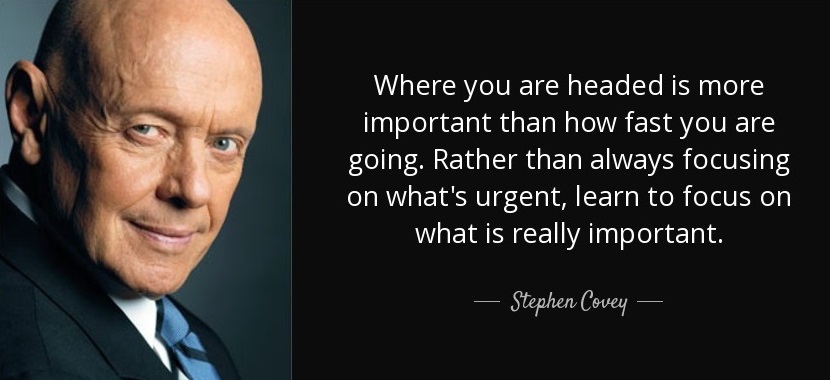
NOTE TO SELF THAT YOU MIGHT BENEFIT FROM: Reread Covey’s Seven Habits of Highly Effective People

One of the things I learned when I was first learning to use a firearm was that human beings have a natural instinct to flinch into retreat or freeze in place at the sound of the sudden loud noise or something moving very quickly toward the face. The sound of the shot and the push of the recoil tend to activate this reaction. It takes frequent, consistent exposure to overwrite this natural survival instinct and use the weapon with confidence.

Life has a way of filtering the frivolous by continuously challenging a chosen activity with easy escapism. This is yet another fear response to help survive the demands of my environment. Life asks “How important is your choice. Do you really want it?” If I answer yes, life laughs in my face. If I answer no, it haunts me with the truth. “I don’t believe you.” I must answer “Hell yeah!” to the important things of my life. Then the spiritual atmosphere seems to reinforce my choice.

And here’s the hard-won truth: not everything deserves my “Hell yeah.”

This program taught me the cost of my yes is measured in attention, time, surrender, and service. That makes my no sacred, too. It’s not selfish to say no—it’s spiritual clarity. Because if I say yes to every loud thing, I miss the still, small voice.

So today, I ask:

– What am I flinching from?
– What have I been whispering “maybe” to when my soul already knows the answer?
– Where is my “Hell yeah” waiting, buried under fear?

I don’t have to bulldoze over my survival instincts, but I can retrain them. I can honor the inner reflex, even as I outgrow it. And when I choose what truly matters—when I stay with it—I become someone life starts to believe in too.

Because the universe, like recovery, respects commitment. And a heart that says Hell yeah with humility and clarity is a heart that moves mountains.

Endigar 1019

Posted in Uncategorized with tags , , , , , , , , , , , on August 3, 2025 by endigar

From Courage to Change of Sep 05:

When I began studying the Seventh Step, which says, “Humbly asked Him to remove our shortcomings,” my list of shortcomings included an extensive catalogue of feelings. I humbly asked God to remove my anger, fear, and guilt. I looked forward to the day when I would never experience any of these emotions again.

Of course, that day never arrived. Instead, I have learned that feelings aren’t shortcomings. The true nature of my problem was my stubborn refusal to acknowledge feelings, to accept them, and to let them go. I have very little power over what feelings arise, but what I choose to do about them is my responsibility.

Today I can accept my feelings, share about them with others, recognize that they are feelings, not facts, and then let them go. I’m no longer stuck in a state of seemingly endless rage or self-pity, for when I give myself permission to feel whatever I feel, the feelings pass. My emotions have not been removed; instead, I have been relieved of shortcomings that blocked my self-acceptance.

Today’s Reminder

When I take the Seventh Step, I pray that whatever interferes with my Higher Power’s will for me may be removed. I don’t have to have all the answers. I need only be willing.

“We didn’t necessarily get the results we wanted, but somehow we always seemed to get what we needed.” – In All Our Affairs

END OF QUOTE—————————————

I came into recovery with a broken guilt-o-meter. I felt guilty for things like expressing emotions. I felt no guilt for acts of manipulation in relationships. It was difficult in working the moral inventory to try and listen to my twisted conscious. I viewed the power of emotional suppression as a super power. I could do the hard things no one else could. Or so I thought. If I felt emotion, I was sure that something was wrong in me that needed to be fixed immediately so that I could regain the stoicism of a dead heart. I had to remain unshakable – immune to the turbulence of anger, fear, guilt. I thought spiritual growth would eventually mean not feeling so much, or at least not feeling the “bad” stuff. So, like a child with a broken toy, I brought my emotions to God in Step Seven and asked for them to be removed.

But what I’ve come to realize is that I wasn’t broken because I felt—I was broken because I believed I shouldn’t.

The longer I walk this path, the more I see that my emotions aren’t defects—they’re messages. Not always accurate ones, sure, but meaningful. Fear has protected me. Anger has drawn my boundaries. Guilt has whispered truths I wanted to ignore. It was never about removing these feelings, but about unblocking the channels through which grace could move through them.

Step Seven, for me, has become a kind of sacred surrender. Not a plea for numbness, but a prayer for clarity. I ask not to be emptied of emotion, but to be freed from the pride, control, and shame that keep those emotions stuck like stones in my spirit.

Now, when rage rises like fire in my chest, I don’t panic. I don’t condemn myself. I get curious. I breathe. I sometimes even invite it to tea. Because I know it won’t stay. No feeling does. They are travelers on the road of my recovery—not hitchhikers I must carry indefinitely.

I still want answers. I still want certainty. But Step Seven reminds me I don’t have to know—I just have to be willing. Willing to let go. Willing to be changed. Willing to keep feeling my way forward, one honest breath at a time.

And strangely, in surrendering what I thought I needed to get rid of, I found what I truly needed: compassion. For myself. For my process. For this sacred mess I call healing.

Endigar 1018

Posted in Uncategorized with tags , , , , , , , , , , , on August 1, 2025 by endigar

From Courage to Change of Sep 04:

As we let go of obsession, worry, and focusing on everyone but ourselves, many of us were bewildered by the increasing calmness of our minds. We knew how to live in a state of crisis, but it often took a bit of adjustment to become comfortable with stillness. The price of serenity was the quieting of the constant mental chatter that had taken up so much time; suddenly we had lots of time on our hands and we wondered how to fill it.

Having become more and more serene as a result of working the Al-Anon program, I was surprised to find myself still grabbing for old fears as if I wanted to remain in crisis. I realized that I didn’t know how to feel safe unless I was mentally busy. When I worried, I felt involved — and therefore somewhat in control.

As an exercise, my Sponsor suggested that I try to maintain my inner stillness even when I felt scared or doubtful. As I did so, I reassured myself again and again that I was safely in the care of a Power greater than myself. Today I know that sanity and serenity are the gifts I have received for my efforts and my faith. With practice, I am learning to trust the peace.

Today’s Reminder

Today I will relish my serenity. I know that it is safe to enjoy it.

“Be still and know that I am with you.” – English prayer

END OF QUOTE—————————————

Serenity. Coma. Lethargy. Marijuana Intoxication. Paralysis. Impotence. To me, these were near identical synonyms. The neutrality of vigilance. The rejection of relevance.

“God grant me the Serenity to. . .” Accept.

In the world I came from, serenity felt suspicious.
Stillness was not safety—it was the silence before the next scream, the quiet that meant someone was brooding, using, or gone.
So when I began to heal, when the noise dimmed and the ache lessened, I didn’t feel peace.
I felt… lost.

What do I do when I don’t need to fix anyone?
What do I do when the fire alarm in my nervous system stops blaring?

For so long, obsession and worry were my way of being involved—my illusion of control.
They gave me purpose. They filled the hours.
They made me feel like I mattered.
To let them go felt like floating in open space without a tether.

But serenity, I’ve learned, is not empty.
It is not apathy. It is not ignorance. It is not withdrawal.
It is safety without vigilance, presence without panic.
It is the return of my life to me.

The first few moments of that calm were unbearable.
I wanted to reach for an old fear, the way a child grabs a familiar blanket, even if it’s filthy and torn.
Crisis was home.
But healing asked me to make a new home in the quiet.
Not to stop the fear.
But to let it move through me, while staying grounded in a Power greater than my history.

And I learned:
I can be scared and still be sane.
I can be uncertain and still be at peace.

Peace isn’t something I earn.
It’s something I practice receiving.

Today, I’m learning that serenity is not the absence of life.
It’s the presence of me—undistracted, undivided, beloved.

So I light a candle not because I’m scared, but because I am allowed to enjoy the moment.
I breathe deep not because I’m bracing, but because I’m here.
And when the stillness comes again, I won’t flinch.
I’ll embrace.

Because serenity is no longer a stranger.
It’s my inheritance.

Endigar 1017

Posted in Uncategorized with tags , , , , , , , , , , on July 31, 2025 by endigar

From Courage to Change of Sep 03:

Before coming to Al-Anon, I had built a lifetime of dreams and promises that were reserved for that one special day called, “Someday.” Someday I’II begin – or end – that project. Someday I’ll call that friend with whom I’ve lost touch. Someday I’ll let them know how I feel. Someday I’II be happy. I’m going to take that trip, find that job, speak my mind. Someday. Just wait and see.

Wait – just as I waited for the alcoholic to come in from a binge, and for inspiration to bring interesting friends and career opportunities to my doorstep, and for everybody else to change. But Al-Anon has helped me to see that today can be the Someday I’ve always wanted. There isn’t enough time in these twenty-four hours to do everything I’ve ever hoped to do, but there is time to start making my dreams come true. By asking my Higher Power for guidance and by taking some small step in the direction of my choice, I will be able to accomplish more than I would ever have thought possible.

Today’s Reminder

Today I will not wait for a blue moon, a rainy day, the 366th day of the year, or Someday to accomplish good things in my life.

“Each indecision brings its own delays and days are lost lamenting over lost days… What you can do or think you can do, begin it. For boldness has Magic, Power, and Genius in it.” – Johann Wolfgang von Goethe

END OF QUOTE—————————————

Johann Wolfgang von Goethe (1749–1832) was a towering figure of German literature, philosophy, and science—widely regarded as one of the greatest writers in Western history.

Most Famous Work: Faust, a tragic play in two parts, considered one of the most important works of Western literature. It tells the story of a man who makes a pact with the devil in search of ultimate knowledge and experience.

Other Works: The Sorrows of Young Werther (1774), a landmark of early Romanticism, which sparked a wave of sentimental literature—and even reported suicides among youth trying to emulate the protagonist.

Goethe explored the duality of human nature, the struggle for meaning, and the tension between reason and passion—anticipating thinkers like Nietzsche, Jung, and even Kierkegaard.

A lifelong seeker, he resisted rigid dogma, saying:
“He who possesses science and art also has religion; he who does not possess them needs religion.”

Goethe was also a scientist, particularly in the fields of botany, anatomy, and color theory. He even challenged Newton’s work on optics, proposing his own (controversial) Theory of Colors.

Goethe was deeply interested in alchemy, myth, the unconscious, and the soul’s evolution—themes that appear throughout Faust and his lesser-known esoteric writings.

Carl Jung considered Goethe a proto-depth psychologist and drew heavily from Faust in his ideas about the shadow, individuation, and the Self.

I am afraid of living a potential life. To have potential is to have fear. Only action in the now counters that fear. To achieve failure is better than to protect potential. To risk loss is better than saving for a beautiful coffin. One day at a time. End the day planning for the next. I want to find ways to justify getting out of bed and exhausting myself. The effective and acted on plan is better than the beautifully crafted promise. Someday is a myth that I can carry like a chain around my neck. Life is too sharp, painful, my voice too prone to the hesitant tremble. My grief becomes hardened into a habit. I beat myself to death with promises of someday.

I am free. I am allowed to re-create my life, to begin anew. I want to live boldly, to secure my freedom in quick forgiveness, and not to turn away from being seen.

I filled journals and conversations and fantasies with Someday.

But in the shadows of that promise, I postponed my own resurrection.
Because waiting—especially in families ruled by addiction—feels like love at first.
We wait for sobriety.
We wait for peace.
We wait for someone to choose us, change, or come home.

Recovery has shown me something strange and stunning:
There is no Someday. There is only Today, and the grace to be awake inside it.

Today is not a consolation prize.
Today is the only ground on which miracles grow.

And I don’t need to finish the novel, heal the wound, or reconcile every relationship today.
But I can make the call.
I can take the walk.
I can say the words: “I’m ready.”
I can set the boundary, speak the truth, write the page, wash the dish, light the candle.
That’s all it takes to betray the myth of Someday and let magic leak into this moment.

Endigar 1013

Posted in Uncategorized with tags , , , , , , , , , , , on July 23, 2025 by endigar

From Courage to Change of Aug 30:

Normally my Sponsor would recommend a gratitude list when I felt low, but one day, when I complained about a family situation, he suggested that I list all the things I was unhappy about. Several days later my depression had passed, and when I told my Sponsor about the terrific day I was having, he suggested a gratitude list. He thought it might help me to refer to it the next time I felt blue. That made sense to me, so I complied.

When I went to put this new list in the drawer where I keep my papers, I noticed the earlier list and read it once more. To my surprise, my list of grievances was almost identical to my gratitude list — the same people, same house, same life. Nothing about my circumstances had changed except the way I felt about them. For the first time I truly understood how much my attitude dictates the way I experience the world.

Today’s Reminder

Today I recognize how powerful my mind can be. I can’t always feel good, and I have no interest in whitewashing my difficulties by pasting a smile on my face. But I can recognize that I am constantly making choices about how I perceive my world. With the help of Al- Anon and my friends in the fellowship, I can make those choices more consciously and more actively than ever before.

“Change your thoughts and you change your world.” – Norman Vincent Peale

END OF QUOTE—————————————

Norman Vincent Peale (1898–1993) was a Christian minister, author, and influential figure in American religious life, best known for popularizing the concept of “positive thinking” through his landmark 1952 book, The Power of Positive Thinking. A Methodist-turned-Reformed pastor, Peale served for more than half a century at Marble Collegiate Church in New York City.

There was a time in my life when the storm inside me felt louder than any peace I could muster. I’d sit with my Sponsor and bring him the scraps of my spirit—my grief, my discontent, my twisted thoughts—and he’d thoughtfully hand me back a tool. Sometimes it was a gratitude list, sometimes a question, and once—he told me that in my observations, my journaling, look for the patterns in my pain and resentment.

I have indeed found that my gratitude lists and my painful patterns dance in the same neighborhoods. It is true that sometimes, it is a matter of perspective.

This is where the real work of the program lives for me: not just in inventorying my defects, but in inventorying my perceptions. My attitude isn’t just the lens through which I see the world—it’s often the author of my experience. The same facts can tell wildly different stories depending on whether I’m rooted in fear or in faith.

I no longer see gratitude as a forced smile or a way to gaslight myself into feeling better. I see it as a recalibration of my spiritual compass. It reminds me that the story isn’t over, and I get to choose the tone of the next chapter. I still allow space for grief, anger, confusion—but I don’t build my home there. I let those feelings pass through like weather. And when I forget, my lists are there. Both of them. To remind me how much power I truly hold—not over people or outcomes, but over my own way of seeing.

Endigar 1012

Posted in Uncategorized with tags , , , , , , , , , , , , on July 22, 2025 by endigar

From Courage to Change of Aug 29:

Since childhood I have been nagged by those moments when I said or did something that brought pain to another person. These are ugly memories that I never believed would go away. With Step Eight, however, I discover a means to release myself from unrelenting guilt.

This Step says to make a list of all people I have harmed and to become willing to make amends to them all. Finally, I can put down in words all the memories and all the pain. When I see them written in front of me, they seem almost manageable, and I feel hopeful about freeing myself from their weight as I become willing to make amends. I need not take any further action at this point. All I am concerned with now is the harm I have caused others, the guilt I have brought on myself, and the desire to do what I can to clear it all away.

Today’s Reminder

Guilt is a burden that keeps me from giving myself fully and freely to the present. I can begin to rid my mind of guilt by quietly admitting where and when I have done wrong to people, including myself.

“Al-Anon has shown me another way of living, and I like it. Life can either be a burden and a chore or a challenge and a joy. One day at a time I can meet the challenges of life head-on instead of head-down.” ~ As We Understood

END OF QUOTE—————————————

What As We Understood Is:

Full Title: As We Understood: More Talks on Al-Anon Principles

  • Published by: Al-Anon Family Group Headquarters, Inc.
  • First published: 1985
  • Format: A collection of essays and reflections written by Al-Anon members

This book explores spirituality from a wide range of personal experiences—without prescribing a single religious belief or dogma.

There are memories that trail us like smoke—thin, acrid, persistent. For me, it began in childhood: the sharp moments when my words cut, or my silence wounded, or I simply didn’t know better—but the damage still landed. Those memories carved themselves into my mind as shame-stained markers. I thought they were permanent. I thought they defined me.

And then came Step Eight.

It didn’t ask me to fix it all overnight.
It didn’t demand atonement before I was ready.
It simply asked me to look honestly and become willing.

To write the names.
To acknowledge the harm.
To open the door—however slightly—to the possibility of amends.

There is something powerful about naming. Something holy about writing it down. It takes the swirling shame out of abstraction and lays it flat on the page where it can be seennot as a life sentence, but as a spiritual inventory. A map of where I’ve been untrue to myself and to others. A beginning.

I don’t have to make the amends yet. Step Eight reminds me: willingness is the work for now.
This is a step of preparation, of spiritual stretching.
It’s less about action and more about alignment.

And in that space, I find relief. I find dignity. I find hope.

Because guilt—unspoken, unexamined—has a way of locking us out of the present moment. It dims the light of connection. It whispers that we’re imposters in our own recovery. But when I begin to name the harm, the fog lifts. I can feel my heart begin to loosen its grip on the past. I can turn, gently, toward the living now.

Sometimes the first person I need to put on that list is me.

Because I have harmed myself too—with harsh words, impossible standards, addictive spirals, and the refusal to believe I was worth saving. I must be willing to make amends inward as well—to forgive the scared version of me who only knew how to survive.

The Steps have shown me that life isn’t just endurance. It’s discovery.
That the past isn’t just a burden. It’s compost for a freer soul.
And that isolated self-castigation isn’t living—it’s hiding.

Today, I lift my head.
Not because I’m proud of everything I’ve done—but because I’m becoming someone I’m no longer ashamed to be.

One name at a time.
One truth at a time.
One willingness at a time.

And that, I’ve learned, is more than enough to begin.

Endigar 1011

Posted in Uncategorized with tags , , , , , , , , , , on July 21, 2025 by endigar

From Courage to Change of Aug 28:

I had never dared to trust another person the way I trusted my first Al-Anon Sponsor. With faltering self-confidence I had asked her to sponsor me: I was a mess, would she have me? I was sure she would turn me down because I thought I was not worth saving. Her positive response really took me by surprise.

Gently, she guided me through the Steps. I was so desperate to feel better that I was willing to try whatever Al-Anon tool or idea she suggested. I lived, breathed, and ate Al-Anon.

One lonely day I phoned her, crying out in despair that I’d never get the hang of feeling better. What she said at that critical time was, “I don’t know anyone who is as willing to work the program as you are.” My spirits soared! She had said to me what I couldn’t say to myself, but I knew that it was true — I was very willing. In that moment of acknowledgment I knew I’d be okay, because I had what it took. In time, her example helped me learn to give that kind of acknowledg- ment to myself.

I had taken a chance. I had trusted. And as a result, I learned that I was worth saving!

Today’s Reminder

Learning to value myself can begin by having the courage to find, and use, a Sponsor.

“Nothing we do, however virtuous, can be accomplished alone; therefore, we are saved by love.” ~ Reinhold Niebuhr

END OF QUOTE—————————————

NOTE: Reinhold Niebuhr (1892–1971) was a prominent American theologian, ethicist, and public intellectual best known for his work in Christian realism—a philosophy that acknowledged the persistent reality of human sin and the limits of human perfectibility, especially in politics and social life. Niebuhr is widely credited with writing the Serenity Prayer, famously used in 12-Step programs like Alcoholics Anonymous:

“God, grant me the serenity to accept the things I cannot change,
Courage to change the things I can,
And wisdom to know the difference.”

I’m currently working with my fourth sponsor in a journey that has unfolded over 18 years. Each one marked a significant layer of trust—not just in another person, but in the recovery process itself.

My first sponsor, David H., met the panicked, wild-eyed version of me—the confused soul who stumbled into the rooms with more fear than faith.
The second, Tim C., offered a place where I could be broken-hearted without shame. He helped me learn how to laugh at myself, to take things seriously but not personally. Both of these men walked with me through Cocaine Anonymous.

I’d never used cocaine, but I qualified for CA because their First Step reads, “We were powerless over cocaine and all other mind-altering substances.” Their meetings were open, raw, and felt freer—less bound by religious overtones than AA. It was the right space for me in those early years.

After years riding the relapse rodeo, I began to release some of my resentments toward organized religion. That shift made room for me to return to Alcoholics Anonymous, where I found my first AA sponsor, Happy Jack.

I still remember him saying, “Get off that cross—we need the wood.”
It was sharp. It was funny. It stuck.

Then he stopped returning my calls. I assumed I’d worn him out, that I was too much. It wasn’t until years later that I learned the truth: he had died. It had never been about me.

I tried going it alone for a while. That old lone-wolf pattern. But eventually, I reached again. My next sponsor, Charles N., is an artist. There’s something in that shared creative current, the way we both know the shadows and the dark wells—it’s made walking this road together deeply healing. Thank you, Charles.

Since then, I’ve settled more fully into recovery. I walked through Al-Anon with yet another sponsor, Paul, and completed the Steps. Then I joined Adult Children of Alcoholics (ACA) and am now being sponsored by Scott K. in that fellowship.

I’ve become thoroughly inundated with recovery.
And now—I sponsor others.

My point in sharing this history is simple:
The path isn’t always clear or easy. Connection doesn’t always come quickly.

But if the desire to live freely burns even slightly, it’s enough.
Enough to keep coming back.
Enough to fall seven times and get up eight.
Enough to turn away from morbid reflection—and recreate life.

Because in the end, sponsorship isn’t just about guidance.
It’s about being seen, walked with, and reminded:
You are never too far gone to begin again.

Endigar 1008

Posted in Uncategorized with tags , , , , , , , , , , on July 17, 2025 by endigar

From Courage to Change of Aug 25:

When students first learn to play the piano, they are usually taught to use only one hand and include very few keys. Then they move on to using two hands, eventually learning to play all the keys, the high ones as well as the low. In fact, part of the pleasure of playing lies in hearing the rumble of the lowest bass notes and the light chiming of the high treble.

Today in Al-Anon I am learning to play a new instrument — myself. I am a person with the capability to experience a wide range of emotions, from love to joy to wonder. I am profoundly grateful for laughter and light spirits — and also for anger and fear, because all of these feelings are part of what makes me whole. I believe that my Higher Power wants me to be fully alive and fully aware of all my feelings: The crashing crescendo of great anger, the soft chant of serenity, the heights of wonder, and the new insights that stretch my heart and mind just as my fingers stretch to reach all the keys in a challenging chord. I am learning to play richer sounds than I ever thought possible.

Today’s Reminder

Today I will appreciate the full range of feelings available to me. They make my experience of life full indeed.

“I have sometimes been wildly, despairingly, acutely miserable… but through it all I still know quite certainly that just to be alive is a grand thing.” ~ Agatha Christie

END OF QUOTE—————————————

Before recovery, I divided emotions like sheep and goats—some were holy, others unclean. I crowned happiness, joy, and syrupy love as the angels of mental health. But anger? Sadness? They were exiled, branded with shame, and locked in the dungeon with the spiritually deficient.

To feel too much was madness.
To feel too little was sainthood.
And I aimed for sainthood—numb and smiling.

I thought if I could just tiptoe through the tulips of unshakable good vibes, if I could radiate peace like a lobotomized monk in Birkenstocks, then surely I would become the recovery success story of someone’s keynote speech. A trophy soul.

But in my quest to be enlightened, I was performing serenity while silencing truth.
And when I did feel anger—or sorrow, or discomfort—I judged it as a relapse in character.

I also believed that depth and seriousness wore only black. I scoffed at joy. I tucked away laughter like it was childish, uncouth, or inappropriate at the altar of spiritual progress. Joy was silly. Grief was noble. I knew which side I wanted to be on.

But recovery—patient, gentle, uncompromising—handed me a new score to play.

There are no negative emotions.
There are no positive ones either.
There are only messengers. Sacred couriers of inner truth.

Anger isn’t an enemy—it’s a signal that something vital is being crossed.
Sadness isn’t shameful—it’s a threshold into deeper reflection.
Happiness isn’t shallow—it’s a moment of connection I’m allowed to feel without guilt.

Recovery taught me to stop playing warden over my feelings and start becoming a steward. These emotions aren’t here to take over—they’re here to guide.

Yes, if I hand them the keys, they’ll drive me off a cliff.
But if I treat them as guests—offer them tea, listen without judgment, and learn their language—they reveal the hidden terrain of my soul.

In recovery, I’m no longer trying to feel only the “good” stuff. I’m trying to feel everything honestly—so I don’t have to be ruled by anything in secret.

Today, I let my emotions be servants, not tyrants.
And in doing so, I discover the quiet revolution of becoming fully human.