Archive for healing

Endigar 944 ~ The Gift of Compassionate Space

Posted in Uncategorized with tags , , , , , , , , , , , on May 14, 2025 by endigar

From Courage to Change of Jul 05:

I think the word detachment is often misunderstood. For me, detachment is the freedom to own what is mine and to allow others to own what is theirs.

This freedom allows me to keep my own identity and still love, care about, and identify with the feelings of others. In fact, I believe that the degree of our humanity can be measured by our ability to know another person’s pain and joy. I have been practicing the principles of Al-Anon to the best of my abilities for a long time. But when someone in the fellowship shares about having a difficult time, I can go right back to day one. I no longer live with that type of emotional pain, but I can feel theirs. I can identify without needing to remove their pain. To me, that is an Al-Anon success story.

Today I don’t have to like everything my alcoholic loved one says or does, and I don’t have to change her, even when I think she’s wrong. I continue to learn how to care without taking everything personally.

Today’s Reminder

I can detach and still love, still feel. I can learn to take care of my own business while allowing others to tend to theirs. Today I can detach without losing compassion.

“Love your neighbor, yet pull not down your hedge.” ~ George Herbert

END OF QUOTE—————————————

There’s a kind of fear that gets baked into your bones when you grow up watching someone you love self-destruct. For me, it wasn’t just about their drinking or their choices—it was the way they lied to themselves, the way they collapsed inward and expected the world to hold them up.

That fear didn’t vanish when I grew up. It disguised itself. It came with me into adulthood, where I found myself drawn to familiar pain dressed in different clothes. I didn’t realize at first that I was recreating the same story, casting myself in the same role: the quiet savior, the one who absorbs and holds and fixes.

I have this gift—I used to call it compassion, now I know it’s more complicated. I see people deeply. I feel their ache. I want to help. But somewhere along the way, that gift boomerangs. It turns inward, sticks like tar, and pulls me into a place where love becomes sacrifice, where being needed becomes more important than being safe.

Detachment felt like a cold word to me—like a turning away, a kind of emotional shutdown. I thought if I truly cared, I had to be enmeshed. If I loved someone, I had to take on their pain, their chaos, their choices. I couldn’t tell where I ended and they began.

But Al-Anon has shown me a different way.

Detachment isn’t withdrawal—it’s freedom. It’s the grace of boundaries that let me hold onto myself and still love deeply. I no longer have to absorb another’s suffering to show I care. I can stand beside someone in their pain without losing myself in it.

Today, I know I don’t have to agree with or approve of everything my loved one says or does. I don’t have to make it okay. And I don’t have to lose myself trying to make it different. That’s not indifference—it’s clarity. It’s love with room to breathe.

Detachment has allowed me to soften, not harden. It has taught me to stop trying to rescue and start learning how to relate with respect. It has given me back my life, and with it, the ability to show up for others without vanishing in the process.

I can feel deeply, love freely, and still stand firm in my own center. That is a gift I hold with gratitude today.

Endigar 938

Posted in Uncategorized with tags , , , , , , , , , , on May 8, 2025 by endigar

From Courage to Change of Jun 29:

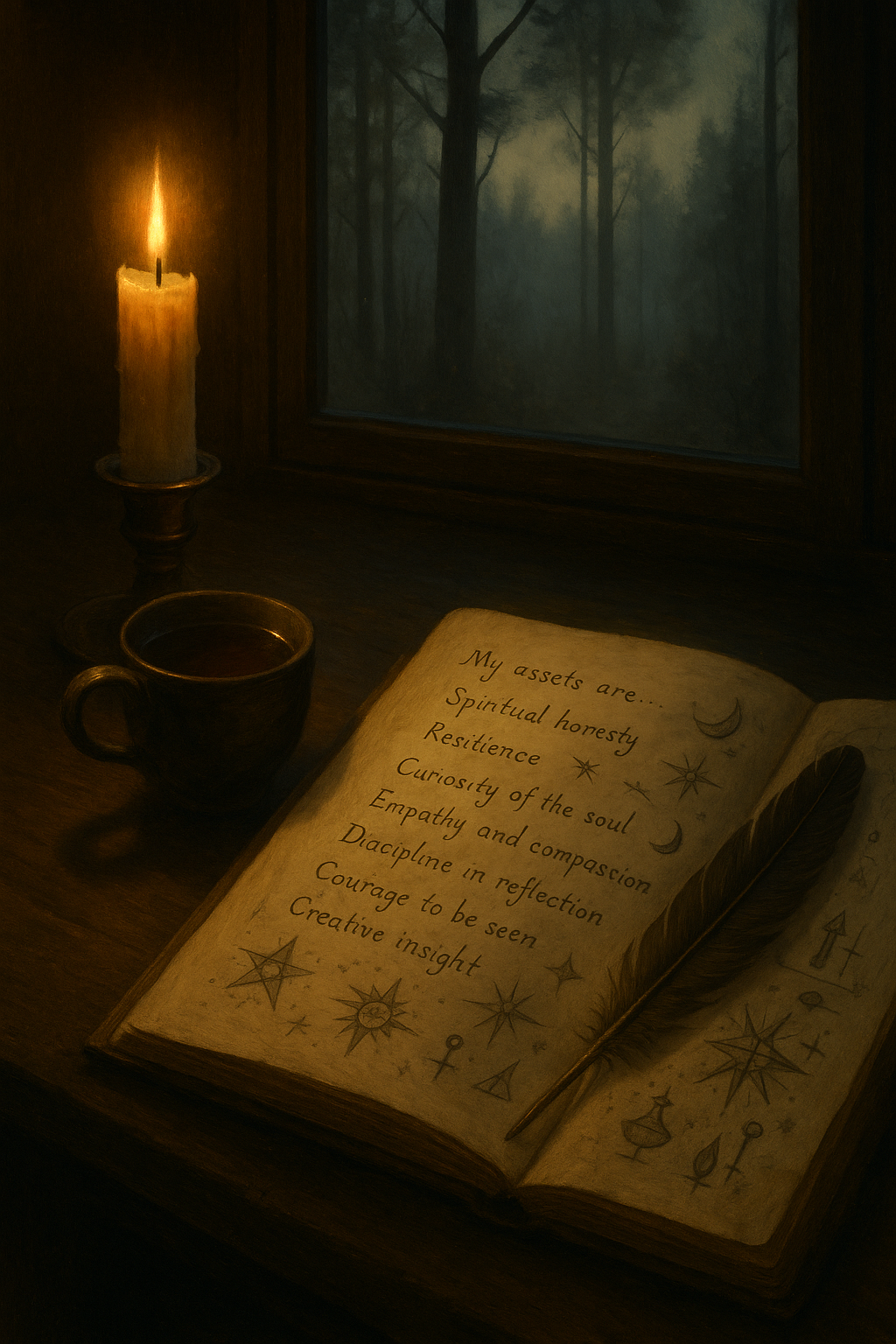
After some time in recovery, I picked up a Blueprint for Progress, Al-Anon’s guide to taking a searching and fearless moral inventory (Step Four). I was well aware of many character defects, and I was eager to be free of their hold on me. But I didn’t expect so many questions about my character assets!

Again and again I was asked to recognize positive qualities about myself. It was frustrating! Why waste time on things that already worked? These assets hadn’t kept my life from becoming unmanageable; obviously they weren’t worth much. My Sponsor suggested that my resistance to this part of the Step might have something to teach me. He was right.

Eventually I realized that my assets are the foundation upon which my new, healthier life is being built. Refusing to recognize them just holds down my self-esteem. As long as I see myself as pitiful, hopeless, and sick, I don’t have to change.

I knew I was ready to feel better about myself, so I gathered up my willingness and listed all the positive attributes I could find about myself. I’ve felt much better about myself ever since.

Today’s Reminder

Today I will acknowledge that I have many positive qualities, and I will share one or two of these with a friend.

“All progress must grow from a seed of self-appreciation . . .” ~ The Dilemma of the Alcoholic Marriage

END OF QUOTE—————————————

There was a time when I believed the path of recovery was paved solely with confession and correction. I came to Step Four armed with guilt like it was armor, expecting to wage war on my weaknesses. The Al-Anon approach to the Fourth Stepcaught me off guard. I had come to slay dragons; it asked me to name the stars.

Why did it feel so impossible to affirm what was good? Is it because my best efforts to bring order to the chaos of my family always fell short? I had rehearsed my failures for so long they felt like home. Character defects had become my shadow companions, familiar agents of impotence. But this book—this relentless, gentle voice—kept turning me toward the mirror, not to flinch, but to see. To see the strength beneath the scars, the kindness that survived that chaos, the humor that rose from the rubble. It asked me to name what had not died in me.

And I fought it because I often felt like an imposter. I called it vanity, delusion, a distraction from the “real work.” But my Sponsor, ever the patient alchemist, said: “There is gold in that resistance. Pan for it.”

What I found was this: my refusal to name my assets was not humility—it was fear. As long as I thought myself broken beyond repair, I was excused from the responsibility of hope. If I am only ever a victim, I never have to become a vessel.

But Step Four, done in fullness, demanded balance. My assets were not trophies—they were tools. They were not justification for past harm, but the blueprint for future healing. I could not build a new life without knowing the shape of the stones I had to build with.

So I did it. I wrote them down. Clumsy, awkward affirmations. Truths I had long buried under sarcasm or self-hatred. And something subtle began to shift. My spine straightened. My inner voice softened. I began, not to believe I was perfect, but to believe I was possible.

And that, in the architecture of recovery, changes everything.

Endigar 935 ~ The Messenger

Posted in Uncategorized with tags , , , , , , , , , , , on May 5, 2025 by endigar

From Courage to Change of Jun 26:

Forgiveness can be just a change of attitude. I came to Al-Anon full of bitterness toward the alcoholic in my life. When I realized that my bitterness hurt me more than anyone else, I began to search for another way to view my situation.

In time, I came to believe that my alcoholic loved one might be the messenger my Higher Power used to let me know that I needed to get help. It is not fair to shackle her with credit or blame for the amount of time it took for me to pay attention to that message. I chose to tolerate a great deal of unacceptable behavior because I was unwilling to admit that I needed help. I did the best I could with the tools and knowledge I had at hand, and I believe that she did too. Eventually the message got through. I made it to the rooms of Al-Anon, and my life changed in miraculous ways. I don’t deny that hurtful things were said and done along the way, but I refuse to carry the burden of bitterness any further. Instead, I am grateful for what I have learned.

Today’s Reminder

I will not allow resentments to drag me down any longer. I am building a better and more loving life today.

“Forgiving is not forgetting, it’s letting go of the hurt.” ~ Mary McLeod Bethune

END OF QUOTE—————————————

There was a time when I carried bitterness like armor—close to the chest, heavy on the shoulders. I came into recovery with a heart full of accusations, convinced the unfaithful ones in my life were the architect of my pain. But time and grace are strange companions. Somewhere along the journey, I began to see with different eyes.

What if—just what if—she was not my enemy, but a messenger?

Not a perfect one. Not a gentle one. But a necessary one.

I can’t pretend the hurt didn’t happen. I won’t gloss over the words, the nights, the betrayal. But I can choose how long I carry it. I can choose whether to let those memories define the whole story or just a chapter of it.

And here’s the truth: I stayed too long in chaos, not because I was stupid, but because I didn’t know another way. I tolerated more than I should have, not because I liked suffering, but because I hadn’t yet learned to reach for help. That learning came slowly, and painfully—but it did come. And when it did, I walked into the rooms of 12 Step recovery. And my life began to change.

Forgiveness, I’ve found, isn’t always about saying “it’s okay.” Sometimes it’s just about setting the weight down. Seeing the past with clearer eyes. Letting my pain transform into compassion—not for her behavior, but for the brokenness in both of us.

Today, I give thanks not for the damage, but for the awakening it sparked. The messenger delivered the message. I listened. And that listening saved my life.

Endigar 934

Posted in Uncategorized with tags , , , , , , , , , , , on May 4, 2025 by endigar

From Courage to Change of Jun 25:

After years of letting people take advantage of me, I had built up quite a store of anger, resentment, and guilt by the time I found Al-Anon. So many times I wanted to bite off my tongue after saying, “Yes,” when I really wanted to say, “No.” Why did I continue to deny my own feelings just to gain someone’s approval?

As I worked the Al-Anon program, the answer became apparent: What I lacked was courage. In the Serenity Prayer I learned that courage is granted by my Higher Power, so that is where I turned first. Then it was up to me to do my part. Was I willing to try to learn to say, “No,” when I meant no? Was I willing to accept that not everyone would be thrilled with this change? Was I willing to face the real me behind the people-pleasing image? Fed up with volunteering to be treated like a doormat, I squared my shoulders and answered, “Yes.”

Today’s Reminder

It is not always appropriate to reveal my every thought, especially when dealing with an active alcoholic. But do I make a conscious choice about what I say? And when it is appropriate, do I say what I mean and mean what I say? If not, why not? All I have to offer anyone is my own experience of the truth.

“There is a price that is too great to pay for peace . . . One cannot pay the price of self-respect.”

~ Woodrow Wilson

END OF QUOTE—————————————

Self-abandonment is something that many experience when living in codependence. There is a great emotional cost of saying “yes” when the soul longs to say “no.” The biting of the tongue becomes a metaphor not just for silence, but for self-erasure. There was a time when I mistook silence for peace and compliance for love. I said “yes” so many times my tongue began to feel like an artifact—not a tool of truth, but a relic of performance. Behind every forced agreement, a little part of me curled inward, retreating from a world that never asked how I truly felt.

By the time I found Al-Anon, I was brimming with what I thought was anger toward others, but it was really the grief of self-abandonment. Resentment was the smoke; guilt was the ash. I had made a habit of swallowing my truth, hoping it would earn me a place in someone else’s peace. It never did.

Working the program taught me something both terrifying and liberating: I wasn’t lacking love—I was lacking courage. Not the kind of courage that roars, but the kind that whispers, “No,” when my soul knows that “yes” would be betrayal. The Serenity Prayer didn’t just soothe me—it instructed me. Courage is granted, yes—but only to those who ask for it, who receive it, and who dare to wield it.

The turning point wasn’t dramatic. It was a simple moment, sacred in its clarity. I realized I could stop volunteering for mistreatment. I could stop mistaking martyrdom for virtue. I stood up—not against someone else, but for myself. That was the moment I began to recover—not just from the effects of someone else’s drinking, but from the long habit of abandoning my own spirit.

Endigar 931

Posted in Uncategorized with tags , , , , , , , , , , , , on May 1, 2025 by endigar

From Courage to Change of Jun 22:

My sharing at early Al-Anon meetings went something like this: “She makes me so mad,” and “I’m a nervous wreck because of him.” Thank God for a Sponsor who always brought the focus back to me and encouraged me to look at what my words really said. When I blamed others for how I felt, I was giving them power over my feelings, power that rightly belonged to me. Nobody can make me feel anything without my consent. I had a lot of attitude-changing to do.

Today, by being aware of the words I use, I am learning a more straight forward manner, but I also argue in a healthier way. There are better ways to express myself than to say, “You did such and such to me.” I can talk about myself and my feelings. I can explain the way I experienced something rather than telling the other person how he or she made me feel. I can talk about what I want. I am no longer a victim.

Today’s Reminder

What do my words communicate? Do they express what I am trying to say? Today I will listen more closely to what my words have to say.

“We learn in time that it is not subjects which are controversial, but the manner in which we communicate about them and the elements of personal blame we add to them in anger.” ~ The Dilemma of the Alcoholic Marriage

END OF QUOTE—————————————

I didn’t blame others for making me feel anything. That was never my vocabulary. If anything, my words were steeped in sorrow, not accusation. Despair wasn’t a mood—it was a kind of integrity. I didn’t dress my grief in the disguise of anger or blame; I let it speak for itself. And when I shared, it wasn’t about assigning fault—it was about expressing the aching helplessness of watching someone I cared about spiral, and the futility I felt trying to reach them.

My Sponsor didn’t shower me with affection or “love” as it’s often portrayed. What I received was a form of clarity, perhaps a kind of austere compassion. What helped was not warmth, but witnessing. Having someone who stayed steady while I didn’t flinch from the tragic dimension of my truth—that’s what kept me coming back.

Even now, I’m wary of joy that feels like theater. Of spiritual platitudes that skate over the dark water. I’ve trained myself to speak with a reverence for pain because that’s where my honesty has lived. When I feel most myself, it’s often in the shadows—not because I haven’t healed, but because I refuse to fake a light that hasn’t truly dawned.

So when I ask myself whether I’ve “improved” by learning to wear this cloak of restored joy and spiritual confidence—I feel the edges of that question cut deep. If healing means smiling more, I don’t know. But if healing means learning to carry tragedy without letting it erase me, then maybe, yes. If it means staying true to the solemnity that shaped me, while still finding the strength to show up—then I think that’s progress, even if it’s not pretty.

Because the truth is: sometimes the most sacred thing I can offer is not a polished testimony, but a quiet presence that refuses to lie.

Endigar 927

Posted in Uncategorized with tags , , , , , , , , , , , on April 27, 2025 by endigar

From Courage to Change of Jun 19:

When I’m troubled by another person’s behavior, a complicated situation, or a disappointing turn of events, Al-Anon reminds me that I don’t have to take it personally. I’m not a victim of everything that happens unless I choose to see myself that way. Though things don’t always go my way, I can accept what I cannot change, and change what I can.

Perhaps I can take a different view of my problems. If I accept them at face value without taking them personally, I may find that they are not problems at all, only things that have not gone as I would have liked. This change of attitude can help free me to evaluate the situation realistically and move forward constructively.

Today’s Reminder

Blaming my discomfort on outside events can be a way to avoid facing the real cause – my own attitudes. I can see myself as a victim, or I can accept what is happening in my life and take responsibility for my response. I may be guided to take action or to sit still, but when I listen to the guidance of my Higher Power I will no longer be the victim of my circumstances.

“God asks no man whether he will accept life. That is not the choice. You must take it. The only choice is how.” ~ Henry Ward Beecher

END OF QUOTE—————————————

My mind often wants to go to war with life. It’s as if, when something hurts, I instinctively look for someone or something to blame — God, the betrayal, my internal cognitive dissonance. Blame used to feel like protection. If it was an identifiable fault, maybe I could stay safe, or at least feel justified in my anger or withdrawal.

But recovery has been slowly, patiently teaching me another way: that my peace does not depend on the world behaving the way I want it to. My peace depends on the choices I make about how to see and respond to the world.

When I read, “I’m not a victim of everything that happens unless I choose to see myself that way,” I felt a quiet tap on my shoulder. How often do I still cling to a story of being wronged? How often do I use discomfort as proof that life has betrayed me, rather than seeing it as life simply being life — unpredictable, imperfect, alive?

Today I’m reminded that much of my pain is not caused by the events themselves, but by the way I wrap myself around them, the way I resist them or try to demand that they be different. I have always had acceptance issues.

There is so much freedom in learning to accept things at face value. To feel disappointment without turning it into resentment. To experience loss without turning it into a judgment against myself or others. To see an unmet desire not as a cosmic injustice, but simply as what is.

I think this is the heart of the matter: when I blame outside events, I’m usually avoiding a harder truth — that my real suffering comes from my own fearful, grasping, controlling attitudes. It’s humbling. And liberating. Because if the problem isn’t “out there,” then the solution doesn’t have to wait for anything to change. It’s already within me.

I’m learning — slowly, imperfectly — to listen to the quiet, steady voice of my Higher Power. Sometimes that voice says “Act.” Sometimes it says “Wait.” But it always says, “You are not a victim. You are loved. You are free.”

I don’t always hear it right away. But today, I’m willing to listen.

Endigar 923 ~ Step Zero

Posted in Uncategorized with tags , , , , , , , , , , on April 23, 2025 by endigar

Step Zero: I want to live and I ask for help to avoid a tragic end.

This is a radical declaration of both vulnerability and agency. “Step Zero” implies a prelude to transformation—before any formal step of healing or recovery begins, there must be the will to survive. It’s raw, honest, and elemental. There’s humility in asking for help, yet courage in the admission. It echoes the cry of someone poised on the edge, choosing life over oblivion.

It’s also a spiritual reset—a return to a primal human truth: the desire to live is sacred.


Associated Principle: Recovery of my truest Self cannot be given, it must be taken through the collective mind.

This speaks to personal empowerment through shared consciousness. The truest Self isn’t something that can be handed over by a savior or found in isolation. It must be taken—claimed—by the individual, but in the presence or context of others. The “collective mind” may refer to community, ancestral memory, shared trauma, or a larger spiritual ecosystem. It suggests that real healing isn’t solitary—it happens within the web of interbeing.

There’s also a challenge here: one must be active, not passive, in recovering the Self. No one else can do it for you.


Extracted Values: Positive Selfishness, Free Will, and Collective Awareness.

  • Positive Selfishness is reclaiming the right to prioritize your own well-being—not in a destructive or narcissistic way, but as an act of survival and dignity.
  • Free Will anchors the idea that choosing to live, choosing to heal, is a sovereign act. No one else gets to decide for you.
  • Collective Awareness reminds us that while healing is personal, it is never private. Our actions ripple outward. We are seen, felt, and mirrored by others.

—the Breath before the Word—

I want to live.
Not just exist,
not just endure.

I want to stand on the trembling edge
and say to the dark:
Help Me.
Not because I am weak—
but because I am choosing
not to disappear.

This is Step Zero.
The beginning beneath beginnings.
Where the soul, still smoldering,
dares to whisper
its own name.

The Self—my truest Self—
cannot be handed to me
like a medal, or a crown.

It must be taken.
Wrestled back
from the jaws of silence and forgetting.
Taken—not from others,
but with them.
Through the dreamwork of the collective mind.
The shared ache.
The silent nod across generations.

Only in this sacred tension—
between the I and the We—
do I remember who I’ve always been.

So, I practice
Positive Selfishness
not to hoard, but to heal.

I invoke
Free Will
as a spell against despair.

And I move
with Collective Awareness
because my healing
is never mine alone.

And so
before I take a step,
before I raise a hand,
I say:
I want to live.

And I let that truth
be holy.