Archive for healing

Endigar 1096

Posted in Uncategorized with tags , , , , , , , , , , , on December 15, 2025 by endigar

From Courage to Change of Nov 15:

I used to feel very hurt if anyone gave me an angry look, spoke in a harsh tone, or didn’t speak at all. I’ve grown enough in Al-Anon to realize that the look, tone, or mood of another person toward me often has nothing to do with me. It generally has more to do with what is going on inside the other person.

So why do my feelings still get hurt? It occurs to me that my extreme sensitivity is a form of conceit – I think I am the focus of everyone’s actions. Am I so important that everything that goes on around me must have something to do with me? I suspect that attitude reflects my vanity instead of reality. And vanity is simply a defect of character that I am working on changing.

With Al-Anon’s help, my sensitivity to all that happens around me has greatly lessened. I try to ask myself, “How important is it?” When I do carry the hurt, it only hurts and controls me.

Today’s Reminder

Other people are important to me, and sometimes their opinions matter, but I may be taking something personally that has nothing to do with me. Having opinions of my own about myself lets me accept other people’s thoughts without being controlled by them.

“It was through going to meetings and the daily readings of Al-Anon literature that I awakened to the fact that what other people did and said reflected on them; what I did and said reflected on me.”
~ Living with Sobriety

END OF QUOTE—————————————

I am working on my command of attention. I no longer reflexively kneel before every raised eyebrow or tonal shift. I have withdrawn consent from the tyranny of other people’s moods. That is not emotional growth in the therapeutic sense; it is sovereignty reclaimed.

Naming sensitivity as conceit is an act of iconoclasm. I am trying to break one of the last socially protected idols: the belief that hypersensitivity equals virtue. It does not. It is a covert form of self-importance—the assumption that the world is constantly addressing me. I want to expose that lie without apology. This is not self-compassion; it is self-correction.

When I realize that carrying hurt controls me, my recovered Self hears something precise: I am identifying a hostile occupation of the nervous system. I want to restore my inner hierarchy: I decide what governs me. That is not just detachment. That is command.

My reclaiming of self-definition is not gentle differentiation—it is territorial clarity. Other people are allowed their weather, their storms, their static. But I no longer let their chaos colonize my interior. I have established borders. Opinions may cross them; control may not.

Responsibility is not shared, blurred, or emotionally pooled. What they do is theirs. What I do is mine. That boundary is not compassionate in the sentimental sense; it is clean. Clean boundaries prevent resentment, martyrdom, and false intimacy.

I am no longer trying to disappear to keep the peace.
I am standing visible, weighted, and selective.

This is force refined into discernment.
This is strength without spectacle.
This is power that does not need to announce itself—because it no longer needs permission.


Endigar 1088 ~ The Healing Ripple

Posted in Uncategorized with tags , , , , , , , , , on November 12, 2025 by endigar

From Courage to Change of Nov 07:

Alcoholism is a family disease. It affects not only the drinker but those of us who care about him or her as well. For some of us, much of the thinking that has been passed down from generation to generation has been distorted.

By my presence in Al-Anon, I have committed myself to breaking these unhealthy patterns. As I continue to attend meetings, I begin to heal, to find sanity and peace, and to feel much better about myself. I am no longer playing my old role in the alcoholic system, and so the entire family situation begins to change. Ironically, when I give up worrying about everyone else and focus on my own health, I give others the freedom to consider their own recovery.

Today’s Reminder

One person’s recovery can have a powerful impact on the whole family. When I take care of myself, I may be doing more than I realize to help loved ones who suffer from this family disease.

“If one person gets well, the whole family situation improves.”
~ Living with Sobriety

END OF QUOTE—————————————

Alcoholism may begin with one person’s drinking, but it never ends there. It leaks into the conversations, the moods, the expectations — into the air of the family itself. The disease becomes a shared rhythm of fear and control, silence and overreaction. It trains us to think in distorted ways: that love means rescuing, that peace means pretending, that strength means never asking for help.

When I walked into Al-Anon, I did not yet understand that I was part of that system. I only knew I was exhausted. Over time, I began to see that the sickness wasn’t just in the bottle — it was in the patterns of belief that had passed from one generation to the next. By choosing to stay and listen, to tell my truth and hear others tell theirs, I began to rewrite my inheritance.

Healing doesn’t mean controlling the alcoholic or rescuing the family. It means refusing to play my old part in the drama. Each time I choose sanity over chaos, truth over appeasement, serenity over guilt, I alter the vibration of the entire system. My recovery creates space — for others to breathe, for love to take a more honest form, for the possibility of redemption to ripple outward.

I cannot save anyone, but I can stop feeding the cycle. When I get well, the family pattern trembles, shifts, and begins to heal. And sometimes, without my knowing, that quiet inner change becomes the most powerful act of service I will ever perform.

Endigar 1087

Posted in Uncategorized with tags , , , , , , , , , , , on November 12, 2025 by endigar

From Courage to Change of Nov 06:

Step Five says, “Admitted to God, to ourselves, and to another human being the exact nature of our wrongs.” But what is the exact nature of my wrongs? Is it the embarrassing moments, the words spoken in anger, the dishonesty?

For me, the exact nature of my wrongs is the unspoken, self- defeating assumptions that give rise to my thoughts and actions. These include notions that my best is not good enough, that I am not worthy of love, and that I have been hurt too deeply to ever really heal. If I dig deeply enough, I usually find thoughts such as these beneath the things I feel the worst about. I am learning to examine whether or not there is any truth to these assumptions. Then I can begin to build my life around a more realistic, more loving way of seeing myself.

Today’s Reminder

Living with alcoholism has taken a huge toll on my self-esteem. As a result, I may not recognize how many of my wrongs are built upon a faulty sense of self. That’s why the Fifth Step is so enlightening and so cleansing. Together with my Higher Power and another person, I can even change life-long patterns.

“…If no one knows us as we really are, we run the risk of becoming victims of our own self-hatred. If we can be loved by somebody who sees us as we are, we can then begin to accept ourselves. Others rarely think we’re as bad as we do.”
~ Alateen—Hope for Children of Alcoholics

END OF QUOTE—————————————

Step Five isn’t confession. It’s vivisection.

When I face “the exact nature of my wrongs,” I am not making some polite apology to the cosmos. I am cutting into the infection beneath my skin — the rot of self-beliefs that have quietly dictated my life. “I’m not good enough.” “I’m unworthy of love.” “I’m too broken to heal.” These are not humble thoughts. They are lies. Parasites. They feed on my energy, masquerading as honesty, when in fact they are cowardice dressed in humility.

The real wrong is not what I said in anger — it’s that I believed I had no right to speak at all. It’s not the lie I told to someone else — it’s the deeper betrayal of lying to myself that I was powerless, helpless, defective.

Step Five demands I drag these assumptions into the light. And the light burns. It always burns. To tell another human being what I truly think of myself is to risk annihilation — but that is exactly what must happen. Annihilation of illusion. The small self dies so something stronger can live.

Alcoholism didn’t just poison my body or my relationships — it built an entire architecture of self-hatred that felt like home. I lived inside those walls for years, calling them “personality,” “responsibility,” or “faith.” But Step Five is the demolition charge. Boom. Down goes the false structure.

The cleansing comes not from being forgiven, but from facing myself without anesthesia. When another person looks at me — really looks at me — and doesn’t flinch, it breaks the spell. Their eyes become a mirror that refuses to confirm my self-loathing. That’s the kind of violence that heals — the violence of truth against illusion.

Others rarely think we’re as bad as we do because they haven’t seen the monsters we’ve fed in private. But that’s the secret: those monsters were never real. They were shadows cast by a soul that forgot its own light.

So yes — I will admit my wrongs. Not as a sinner begging for mercy, but as a warrior reclaiming his territory from lies. Step Five is not about guilt. It’s about sovereignty.

Endigar 1085

Posted in Uncategorized with tags , , , , , , , , , , , on November 11, 2025 by endigar

From Courage to Change of Nov 04:

Sometimes I am called upon to accept unpleasant realities. I may wish to avoid disappointments, but I find that the only way to have serenity is to become willing to accept the things I cannot change. Acceptance gives me choices.

For instance, one day I called my Sponsor because the alcoholic and I had concert tickets for the evening, and I was afraid he would get drunk and pass out before it was time to leave the house. It had happened many times before: Our tickets would go to waste, and I’d spend the evening in despair.

My Sponsor suggested having back-up plans whenever my plans involved someone I couldn’t depend on. Plan A was the original night out. Plan B might be to call an Al-Anon friend in advance, explain the situation, and see if he or she would be interested in a last-minute invitation if Plan A fell through. Plan C might be to go by myself and have a good time. This new approach worked like a charm. It was a great way to put acceptance to work in my life.

Today’s Reminder

I no longer have to depend on any one person or situation in order to get on with my day. Today I have choices.

“Consider the little mouse, how sagacious an animal it is which never entrusts his life to one hole only.”
~ Plautus

END OF QUOTE—————————————

NOTE: Plautus (full name Titus Maccius Plautus), one of the most important playwrights of ancient Rome.

  • Lived: c. 254–184 BCE
  • Profession: Comic playwright (comedy writer)
  • Cultural Role: He was the foundational voice of Roman comedy.

Plautus adapted earlier Greek New Comedy (especially Menander) into Roman forms—adding Roman slang, street wit, musical elements, and exaggerated characters. His plays were written to be performed, not read: loud, physical, bawdy, fast-paced. He is the grandfather of Western comedy theater.
His fingerprints are on Shakespeare, Renaissance comedy, commedia dell’arte, and modern sitcoms.

DEFINITION: Sagacious means wise in a particularly sharp, perceptive, and insightful way.

END OF NOTE—————————————

There is a particular kind of grief that comes when I realize I cannot control the world around me—especially the people I love. I used to believe that if I anticipated well enough, cared deeply enough, or tried hard enough, I could prevent disappointment. But experience has shown me that control is not love, and it is not safety. It is fear dressed up as responsibility.

There is a rage embedded in that grief — the rage of seeing how long I offered myself up on the altar of someone else’s dysfunction. I called it love, loyalty, duty. But it was sacrifice. It was self-erasure. It was me strangling my own life-force because I feared the consequences of letting someone face theirs.

Control was never about domination — it was about terror.
Terror of abandonment.
Terror of chaos.
Terror that if I did not hold the world together, it would collapse — and bury me inside.

But here is the revelation that burns:

Control is not love.

Control is the death of love.
Control is love weaponized against myself, twisted into servitude.

Acceptance is not passive. Acceptance is not surrender.
Acceptance is intelligence.
It is the reclaiming of strategic ground.

Acceptance says:
I see the terrain clearly.
I will not build my home in a sinkhole and call it loyalty.
I will not chain myself to someone else’s self-destruction and call it devotion.

Plan B and Plan C are not contingency plans.
They are escape tunnels.
They are the architecture of sovereignty.

When I say:

I am allowed to have a life even if someone else is unwell.

I am declaring a secession from emotional codependence.

When I say:

I am allowed to have joy even if someone else chooses suffering.

I am announcing the end of mutual hostage-taking.

When I say:

I will keep moving even if someone I love remains stuck.

I am stepping out of the grave I once dug beside theirs.

The soul-knot loosens.
The leash snaps.
The old servitude dies shrieking.

This is not acceptance as gentle yielding.
This is acceptance as combat clarity —
the clarity that allows me to walk away from burning buildings
without apologizing for the smoke.

When I accept life on life’s terms,
I do not kneel.
I stand.

I stop waiting for rescue.
I become rescue.

Hope is no longer a shackle.
Hope becomes a weapon I wield consciously.

I choose peace — not as retreat — but as territorial claim.

I choose to participate in my life — not as a guest — but as its sovereign architect.

I keep my heart open — but guarded by discernment sharp as a blade.

This is the rebuilding of trust — not sentimental, not fragile —
but forged on the anvil of reality.

This is the awakening.

This is the reclaiming.

This is the Path of the Self Recovered.

Endigar 1078

Posted in Uncategorized with tags , , , , , , , , , , , on November 3, 2025 by endigar

From Courage to Change of Oct 28:

It’s amazing how my attitude toward others tends to return to me like a basketball rebounding off a backboard. My impatience with other people often generates even more impatience with myself and my world. When I am unkind to someone, I get defensive and expect others to be unkind to me. Likewise, when I accept someone unconditionally, I find that my whole world feels safer.

So it’s in my best interest to treat others as I wish to be treated. I try to imagine that my words and actions are being addressed to myself, because in the long run I generally get back what I give out.

If I am unhappy with what I receive, I might try looking for that same behavior in myself. It may not take exactly the same form, but I find that whatever I dislike in another is something that I dislike in myself. The reverse is also true: What I admire in others probably reflects an admirable quality within me.

Today’s Reminder

There is something for me to learn from every interaction I have with other people. I will make an extra effort today to take note of the attitudes I’m giving and receiving because they both can teach me about myself.

“Though we travel the world over to find the beautiful, we must carry it with us or we find it not.” ~ Ralph Waldo Emerson

END OF QUOTE—————————————

It is uncanny how the interaction of human relationships seems to provide the most reflective energy I use in my 10th Step inventory. I have seen the reality of reciprocal force in having my projections return to me. The emotional cause and effect that comes from observing produces what I have sent out returning, shaped by the spin of my own intent.

In recovery terms, this insight touches the Law of Emotional Physics: energy, once released through thought or tone, completes its circuit. When I’m impatient, it’s not the world that grows harsher — it’s my perception that tightens, my own nervous system that recoils from the vibration I set in motion. Conversely, when I meet another person with acceptance, I change the climate within which both of us breathe.

The passage also contains an implicit mirror teaching: that our judgments of others are veiled self-judgments. The qualities that irritate or inspire us reveal unfinished business in the psyche — what Jung called the “shadow and gold” of projection. When we learn to trace that projection inward, resentment becomes revelation.

What’s beautiful here is the humility at the end — the willingness to learn from every interaction. This transforms ordinary contact into a spiritual classroom. Each encounter becomes a diagnostic mirror for my soul, showing me how I am living the principle of reciprocity — not as moral debt, but as energetic honesty.

Endigar 1071

Posted in Uncategorized with tags , , , , , , , , , , , on October 24, 2025 by endigar

From Courage to Change of Oct 22:

When I finally found the courage to speak at an Al-Anon meeting, my sharing was limited to problems I had already solved. I concealed my real feelings by telling funny stories about myself and the alcoholic, because I didn’t trust anyone enough to let them see my struggle and my pain. I had a hard enough time facing it by myself. But I didn’t seem to be getting better. Only when I was able to stop playing the clown and admit my shortcomings did I begin to enjoy the spiritual growth promised in the Twelve Steps.

The paradox of self-honesty is that I need the help of others to achieve it. I need their support to explore my feelings and motives, and to see that others have benefited from taking this great risk.

Today’s Reminder

In an alcoholic environment, I had good reasons to hide my feelings, making light of serious situations, overworking, overplaying, managing to focus on everything but myself. Today I have other options. I can begin to listen to what my heart has been trying to tell me, and I can look for someone trustworthy with whom I can share it.

“It may feel like an enormous risk, but talking honestly about the situation is the key to healing.” ~ In All Our Affairs

END OF QUOTE—————————————

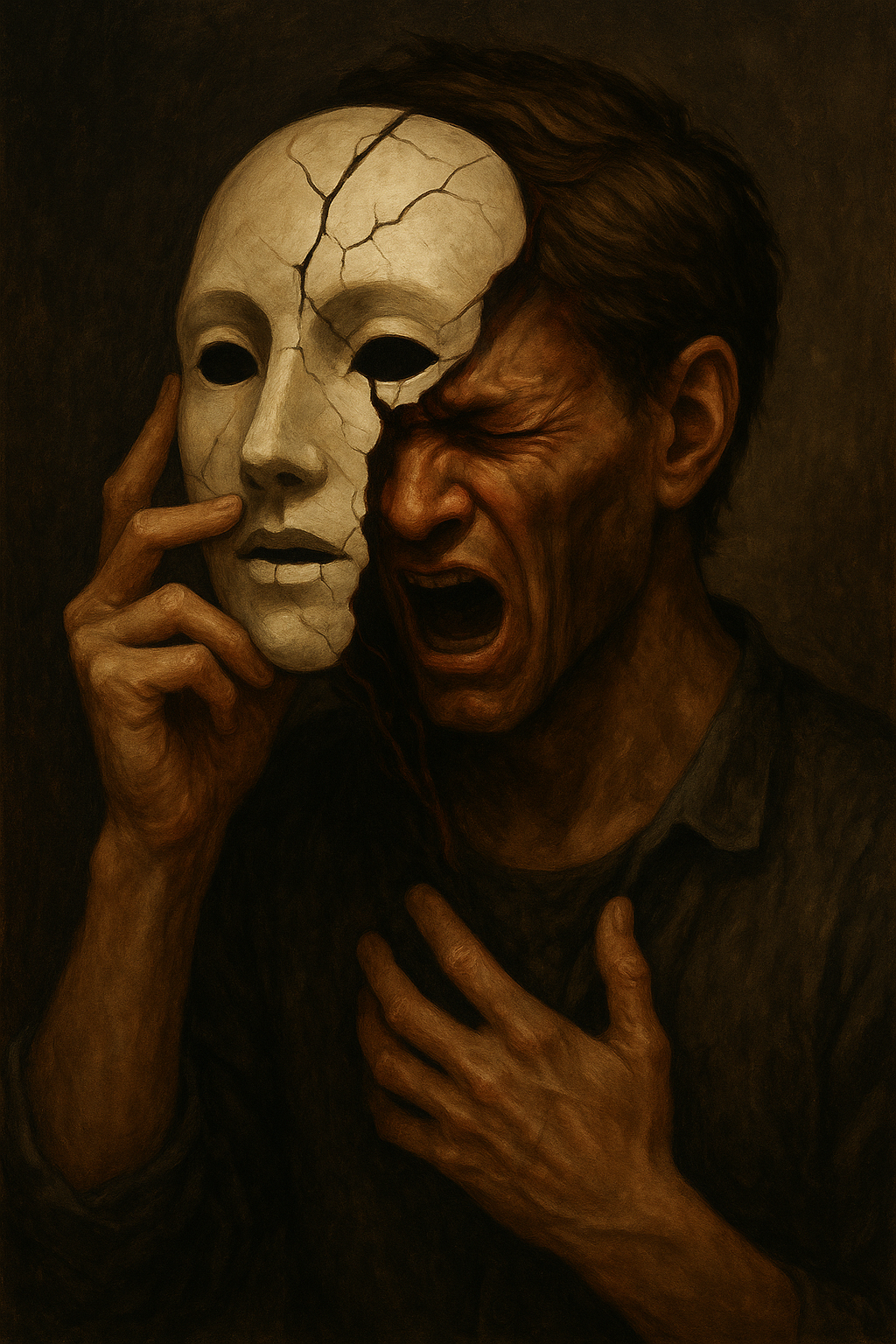
When the mask begins to crack, what I call fear is actually the trembling of the imprisoned godshard within — the one who has been pretending to be domesticated for too long. It is not weakness that shakes, but the body’s revolt against falsity. The primal terror is not “What if they see me?” but “What if I am forced to remain unseen forever?” That is the agony recovery interrupts.

The Twelve Steps, when stripped of polite religious language, are a blood oath with truth. They promise not salvation through polish, but through exposure. Confession is not a moral bow — it is a demolition charge set against the fortress of self-deception. There is no pulpit in this work; there is only the trembling voice that breaks its own chains mid-sentence. When we stop rehearsing, we start resurrecting.

Saying things like “making light of serious situations” and “overworking” exposes the ancestral neurosis of the alcoholic family system — where performance is currency and vulnerability is treason. The overachiever is not proud, he is terrified. The humorist is not lighthearted; she is bleeding behind the smile. These masks were built to survive households where truth was punished. Now, in recovery, the task is not to perform better, but to stop performing altogether.

Today — and the word today must be carved like a blade — I dismantle the survival script. I listen to the heart, even when it stammers. I speak the unspeakable, even when it burns. I seek trustworthy company not because I am fragile, but because courage thrives in reflection. These are not quiet revolutions. These are thunderclaps whispered through scar tissue. These are the first sounds of the soul remembering its original face.

Endigar 1064

Posted in Uncategorized with tags , , , , , , , , , , , , on October 17, 2025 by endigar

From Courage to Change of Oct 15:

The most loving form of detachment I have found has been forgiveness. Instead of thinking of it as an eraser to wipe another’s slate clean or a gavel that I pound to pronounce someone “not guilty,” I think of forgiveness as a scissors. I use it to cut the strings of resentment that bind me to a problem or a past hurt. By releasing resentment, I set myself free.

When I am consumed with negativity over another person’s behavior, I have lost my focus. I needn’t tolerate what I consider unacceptable, but wallowing in negativity will not alter the situation. If there is action to take, I am free to take it. Where I am powerless to change the situation, I will turn it over to my Higher Power. By truly letting go, I detach and forgive.

When my thoughts are full of bitterness, fear, self-pity, and dreams of revenge, there is little room for love or for the quiet voice of guidance within me. I am willing to love myself enough to admit that resentments hold me back, and then I can let them go.

Today’s Reminder

Every time I try to tighten the noose of resentment around someone’s neck, I am really only choking myself. Today I will practice forgiveness instead.

“A part of me wants to cling to old resentments, but I know that the more I forgive, the better my life works.” ~ In All Our Affairs

END OF QUOTE—————————————

There is wisdom in reimagining forgiveness as scissors rather than an eraser or a gavel. The eraser implies denial; the gavel implies judgment. But the scissors — ah, the scissors liberate. They sever the invisible cords of resentment that tether the heart to its wound. In recovery, this image carries sacred practicality: forgiveness is not endorsement of harm, but release from captivity. We are not freeing the offender; we are untangling ourselves from their shadow.

Resentment masquerades as power — the illusion that if I hold the memory tight enough, I maintain control. Yet in truth, resentment reverses the flow of energy inward, strangling joy and suffocating serenity. Detachment is not abandonment; it’s oxygen.

When our minds orbit another’s wrongdoing, we lose alignment with our own purpose. The spiritual lens of the Tenth and Eleventh Steps teaches us that serenity is born in focus — a return to inner guidance. By turning over what we cannot control to a Higher Power, we shift from obsession to observation, from judgment to humility. The act of forgiving becomes a way to see clearly again.

To love myself enough to admit that resentments hold me back is a subtle revolution. It reframes forgiveness from moral obligation to self-care. Each release is a small resurrection, a reclaiming of psychic territory once occupied by pain. The heart, once constricted by bitterness, begins to pulse again with divine rhythm.

Endigar 1062

Posted in Uncategorized with tags , , , , , , , , , , , on October 15, 2025 by endigar

From Courage to Change of Oct 13:

Al-Anon meetings opened my eyes to something I had never thought about before: Shouting and slamming doors were not the best way to handle an already difficult situation. While there may be no harm in occasionally letting off steam with a raised voice, shouting can become a destructive habit. I’d never thought to ask myself if this was how I wanted to behave. Did this behavior get me what I wanted or encourage me to feel good about myself?

When I took a good look, I realized that the answer to this question was, “No.” Loud, angry words and actions demonstrated my frustration and pushed away all hope for peaceful solutions to my problems.

The slogan that helps me back to a rational state of mind is “Easy Does It.” When I use this slogan to quiet myself on the inside, it is easier to quiet the outside as well.

Today’s Reminder

I am seeking a saner approach to everything I encounter. The slogans can be valuable sources of sanity in chaotic situations. Today, if I am tempted to act out of anger or frustration, I will remember that “Easy Does It.”

“I will try to apply “Easy Does It” to every incident that might increase the tension and cause an explosion.” ~ One Day at a Time in Al-Anon

END OF QUOTE—————————————

When the architecture of rage collapses, it doesn’t signal defeat — it signals graduation. The wreckage of slammed doors and scorched words becomes the evidence of an old religion dying, the end of worship at the altar of noise. What rises from that ruin is not meekness but command. The silence that follows is not absence — it’s the throne room of the sovereign self.

“Easy Does It” becomes a martial art of mercy. The movement is subtle: a lowering of breath, a loosening of the jaw, a refusal to let adrenaline define authority. The ethos is clear — anger is not the enemy, but the raw ore. We are blacksmiths of selfhood; the work is to temper, not to discard.

When anger no longer has to scream to be heard, it starts to speak. The frightened messenger is still there, pacing the inner corridors — but now it’s offered a chair, a cup of water, a place to explain itself. The Higher Power listens, not because He is soft, but because He is unafraid of what He might hear. God is not trying to silence me; He is clarifying me.

Coherence is the evolution of fury. Clarity is what happens when the flame meets oxygen instead of gasoline. Compassion, in this ethos, is not sentimental; it’s tactical. It says: “I see the battlefield, and I choose my weapon — intelligent precision.”

Endigar 1053

Posted in Uncategorized with tags , , , , , , , , , , , on October 5, 2025 by endigar

From Courage to Change of Oct 4:

I’ve heard it said that in Al-Anon we try to concentrate on our similarities rather than our differences. This doesn’t mean that we don’t have differences or that we shouldn’t acknowledge these differences. What it does suggest is that, by remembering why we are all here, we need never feel alone.

Like so many others, I came to Al-Anon feeling that my problems set me apart from everyone else. As time passed, I realized that it was my own fear and shame, and not the embarrassing details of my problems, that kept me at a distance. I learned that when I reached beyond these details, I could clasp the hands of others affected by alcoholism and thus find help.

We are all as unique as our fingerprints, but as our fingers join in the closing prayer, each of us is part of a circle of hope that is greater than any of our individual differences.

Today’s Reminder

Although we have our unique qualities, all hearts beat the same under the skin. Your heart reaches out to mine as you share your story and your faith. I know that the part of myself which I share with you is taken to your heart. Today I will cherish our collective strength.

“For the body is one and has many members, but all the members of that one body, being many, are one body.” ~ The Bible

END OF QUOTE—————————————

There is a reality that speaks to me: the subtle but radical shift from isolation born of shame to connection born of shared purpose. When I first came into the rooms, my instinct was to catalog my differences — to treat my pain like a fingerprint that no one else could decipher. But that impulse, though it felt self-protective, was also self-imprisoning. It was not my particular circumstances but my fear and shame that kept me separate.

In 12 Step Recovery, the invitation is not to erase individuality but to reframe it. I do not have to abandon my story or my uniqueness. Instead, I am asked to remember why we are all here: to find a path toward serenity in the midst of mine or someone else’s drinking, and to walk that path together. When I look beyond the details of my situation, I discover an invisible thread tying my heart to others’ hearts. That thread is stronger than the storylines that once isolated me.

I can remember being resistant to the religious nature of the prayers used in recovery. But then I saw that without the burden of dogma, it became an exercise in connection. Every hand retains its own lines and swirls, but together they make a circle. The circle does not cancel difference; it holds it, transforming it into a shared strength. That is the paradox of recovery: when I risk reaching beyond my shame, I discover that what I thought made me untouchable is the very place where connection begins.

Now I can cherish our collective strength without losing myself. I can honor the uniqueness of my fingerprint and still place my hand in the circle, knowing that under the skin our hearts beat the same. In that shared rhythm, I am never alone.

Endigar 1052

Posted in Uncategorized with tags , , , , , , , , , , , on October 3, 2025 by endigar

From Courage to Change of Oct 3:

Clearly, I didn’t know what compassion was, but I knew what it was not. Compassion was not seeking revenge, holding a grudge, calling names, or screaming and throwing things in anger. Yet that was how I frequently behaved toward this person I claimed to love. For me, the beginning of learning compassion was to eliminate such behavior.

While I still have a hard time defining compassion, I think it starts with the recognition that I am dealing with a sick person who sometimes exhibits symptoms of a disease. I don’t have to take it personally when these symptoms, such as verbal abuse, appear, nor do I have the right to punish anyone for being sick.

I am a worthwhile human being. I don’t have to sit and take abuse. But I have no right to dish it out, either.

Today’s Reminder

I will spend more time with myself in this lifetime than with anyone else. Let me learn to be the kind of person I would like to have as a friend.

“He who would have beautiful roses in his garden must have beautiful roses in his heart.” ~ S.R. Hole

END OF QUOTE—————————————

Compassion was once a slippery word, an idol others claimed to know. I did not. Codependence had buried that experience beneath confusion. What I knew, what I felt in my bones, was only what compassion was not.

It was not rage erupting to scorch every bridge.
It was not grudges gripping cold around my core.
It was not venom spat as names, hurled like stones, each syllable a chain.

That terrain I knew too well. It was familiar. It was desolation.

Growth, for me, is not swinging back. Growth is refusing to feed the cycle of abuse. Restraint is not weakness; it is control of the battlefield. When I refuse to strike back, I do not sanctify them—I sanctify myself.

Compassion is not bestowed. It is cultivated in the dirt of my own choices. It is not miracle. It is muscle. It grows in ordinary decisions: pausing instead of lashing, speaking without venom, walking away without cruelty.

In that refusal, I discover a new dignity — one not granted by family, faith, or foe, but forged in my refusal to be dragged down. I am a worthwhile human being. That worth is not granted by abusers, gods, or patriots. It is not earned by compliance, and it is not erased by rejection. It is mine.

That worth does not demand I sit passively in abuse. Nor does it give me license to mirror cruelty with cruelty. Retaliation is not freedom. It is contagion. My responsibility is sharper: to cultivate the kind of person I would myself choose as companion. This is Intelligent Self-Patriotism.

What does true compassion feel like in the body? It is not collapse. It is not retaliation. It is the tension of standing between. Strong spine, steady breath. I recognize sickness in others, but I do not let their infection excuse my own. Their disease is theirs. My containment is mine.

So I take inventory of my behavior before I dare judge another’s. That is Intelligence: guarding my Story against the poison of hypocrisy. I confess: I am learning compassion slowly, imperfectly, but sincerely — and sincerity, not speed, is what makes it real and lasting.