In living with the disease of alcoholism, I became a fearful person who dreaded change. Although my life was full of chaos, it was familiar chaos, which gave me the feeling that I had some control over it. This was an illusion. I have learned in Al-Anon that I am powerless over alcoholism and many other things. I’ve also learned that change is inevitable.
I no longer have to assume that change is bad because I can look back at changes that have had a very positive effect on me, such as coming into Al-Anon.
I still have many fears, but the Al-Anon program has shown me that my Higher Power will help me walk through them. I believe that there is a Power greater than myself, and I choose to trust this Power to know exactly what I need and when I need it.
Today’s Reminder
Today I can accept the changes occurring in my life and live more comfortably with them. I will trust in the God of my understanding, and my fears will diminish. I relax in this knowledge, knowing that I am always taken care of when I listen to my inner voice.
“We may wonder how we are going to get through all the stages and phases, the levels of growth and recovery… Knowing we are not alone often quiets our fears and helps us gain perspective.” ~ Living with Sobriety
END OF QUOTE—————————————
Living with alcoholism trained me to believe that chaos was safer than change. The storms were familiar, and I told myself that familiarity meant control. But the truth Al-Anon taught me is that this was only an illusion. I was powerless not only over alcohol, but also over the constant shifting ground beneath me. Change comes whether I resist it or not.
I used to believe every change was a threat, another disaster waiting to unfold. But when I look back, I see that some of the most life-giving transformations—like walking through the doors of 12 Step Recovery—began as changes I once feared. Fear said, “Don’t move.” Hope whispered, “Step forward.” And in time, I learned that my fear could coexist with faith until faith grew stronger.
I admit I still fear change, but I choose not to be ruled by it. Each time I walk through fear, I prove to myself that I can. I ask, What gift might this change hold? I hear in others’ stories the same tremors of fear, and I walk with them as they walk with me. I pause to see how far I’ve already come. I share my fear honestly in meetings, and it becomes less heavy. Change is no longer just loss—it is a doorway into the yet-unlived.
Instead of treating fear as a verdict, I now see it as a signal. It tells me I am stepping into new territory. The principles of this program—prayer, inventory, fellowship—equip me to take those steps with more serenity. The same program that once helped me simply survive chaos now helps me welcome change as a teacher.
I trust that my Higher Power knows what I need and when I need it. My fears don’t vanish, but they soften when I let myself rest in the care of Something greater than me. I don’t have to see the whole map; I only need to listen for the next right step. My inner voice, when tuned to the divine frequency, assures me I am never walking alone.
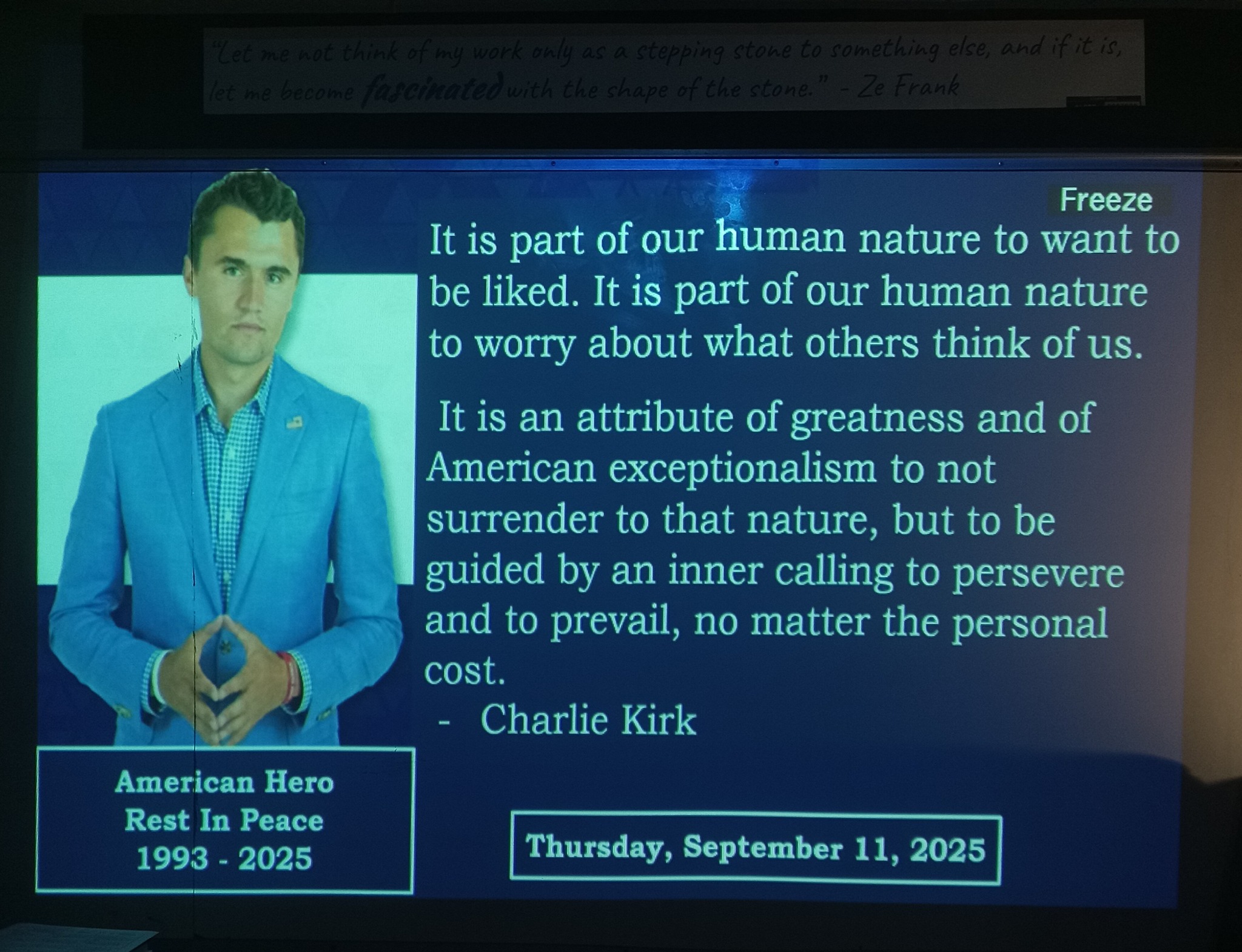
“I always open the day with an inspiration board. This morning’s board will honor a fallen hero of free speech and civil discourse – a young man whose death we cannot afford to ignore. Today is also the last day of our unit on the foundational documents of America, with a deep dive into the lyrics of our national anthem. We will add a long, serious discussion of the dangers of extremist language young people are exposed to every day online and the violence it engenders. This is a profound moment that necessitates we talk to our young people about the power of words.” – An American Educator
Trying to follow a suggestion I heard in Al-Anon meetings, I dutifully wrote lists of things for which I was grateful. I listed such things as my health, my job, and food on my table. When I was finished, I didn’t feel very grateful; my mind was still weighted down with the negative thinking that had resulted from living with alcoholism. But I had made a gesture, and the seed of gratitude was planted.
I gradually learned to appreciate the small accomplishments of my daily life. Perhaps I was able to avoid a pointless argument by reciting the Serenity Prayer, or my sharing helped a newcomer, or I finished something I had been neglecting. I was beginning to change. I made a point of recognizing small changes, and my self- esteem grew. The daily application of Al-Anon principles helped me to deepen my sense of gratitude and replace those nagging, negative thoughts. Eventually I was able to go back to my original list and be truly grateful for those things I had taken for granted.
Today’s Reminder
I need to nurture myself with gratitude. Today I can practice appreciating myself, my world, and my Higher Power.
“I would lie in bed at night and say the alphabet, counting all the things I had to be grateful for, starting with the letter A… This made a great change in my life.” – As We Understood
END OF QUOTE—————————————
I admit that gratitude once felt like frivolity and sometimes it even felt delusional, but I kept practicing. Even when I didn’t “feel it,” I trusted the process. I began to look for gratitude in the unexpected places—inside the mundane. I share my gratitude with others, offering hope to those still in the fog.
I wish I could say that I honor the practice daily. Not like a mindless obligation, but because I suspect it keeps me well. When I have used it, well, gratitude would soften my defenses and invite me into connection. Gratitude is not just a list—it’s a way of listening to life.
What began as rote lists transformed into a deeper awareness: gratitude is not a trick of the mind, but a lens that reshapes the heart. Even the things I once took for granted became luminous—health, work, food, relationships—no longer just words on a page but living realities. Gratitude allowed me to see not only what I had, but Who was walking with me, guiding me toward peace.
Gratitude became not a demand but a nourishment. It shifted from a list to a daily practice of noticing, of receiving, of resting in the presence of what is. Today, I nurture myself with gratitude because it keeps me connected—
To my Higher Power, who is present in both small victories and quiet grace.
To my world, which offers daily gifts if I pause to notice them.
To myself, who is no longer defined by what’s broken but by what’s being mended.
Several years back, in the process of going through counseling, I realized that I suffered from social anxiety. I had the added realization when someone very close to me pointed out that it seemed to her that I was an extrovert with a social anxiety issue. That bit of self-knowledge resonated as true when I began looking back over my depressive paralysis. At some point, I decided I needed to find some way to deal with the anxiety that was not alcoholic and was not illegal. I found a “supplement” online called Phenibut. Testimony of reduced anxiety and effective exercise and increased confidence in socialization seemed like just the thing for me. I ordered it and the immediate relief I felt was pure paradise for me. It did not take long for me to fall in love with Phenibut.
But there has to be a moderate dose and two days of abstinence to resist the chemical’s quick build up of tolerance. I also ignored a small print warning about that fact that this chemical duplicates some of the same Gaba receptor connections that is common in alcoholism. I focused on the “positive.” My social anxiety was gone. Not reduced. Gone. I soon discovered that a little bit of anxiety is a good thing. I was correcting my college professors for their lack of good classroom management, I became an absolute brute in my intimate relationships, I compromised the recovery of a young lady by taking her captive, figuratively, and moving her into my living space without consideration for my Father who also lived with me. I could go one. In short, I became the monster I always feared to become.
Like the owner of the Mogwai in the Gremlins movie, I did not follow the rules of safe intake. And I had to take more and more to get the effect I wanted. Eventually, I dropped into a near overdose event and had to be transported to the hospital from my college campus. I told the medical community that I had taken too much Benadryl. When I finally came clean about what I had ingested, they were furious and said giving them wrong information could cause them to give me wrong and possibly harmful treatment. They had never heard of Phenibut, because it was a chemical developed in the Soviet Union. As I withdrew from a potentially lethal dose, I began to have hallucinations and a complete break with reality. Paranoia was off the charts. I was just a few steps from being committed to the psych ward.
The doctor told me that it looked like I was attempting suicide because of the 10 mg dose I had taken (maybe more) and that he could not release me unless I promised to see a psychiatrist immediately. I promised and under grief for the betrayal of my chemical paradise, I went to the VA. There I was prescribed Citalopram Hydrobromide. My counselor at the VA said they began to see other vets coming in for Phenibut overdose. That chemical has since been made illegal in my state.
The Citalopram did not excite that itch for chemical intensity. It moved slowly and almost undetected. But it was effective with some side effects. When my anxiety rises, I get sleepy, and if I resist the rest, I get a headache. But this situation is manageable. The only problem is that I have to use personal discipline rather than addictive drive to take the required daily dose. And when I quit taking it, I feel the creative spark more clearly. But then the anxiety-driven depressive episodes return.
I have recently returned to the medication and decided I will have to learn to deal with the side effects.
I asked Lucien (AI) to give a break down on the two substances. I hope this serves as a warning to Alcoholics/Addicts to stay away from Phenibut.
Citalopram Hydrobromide
is a prescription antidepressant that belongs to the class of drugs called SSRIs (selective serotonin reuptake inhibitors). It’s most commonly used to treat major depressive disorder (MDD) and sometimes generalized anxiety disorder (GAD), though for anxiety it is often prescribed “off-label” depending on the region.
Here’s a breakdown:
How It Works
Citalopram increases the availability of serotonin (a neurotransmitter linked to mood, sleep, and anxiety regulation) by preventing its reabsorption (reuptake) into nerve cells.
Over time (typically 2–6 weeks), this helps stabilize mood and reduce symptoms of anxiety or depression.
Uses
FDA-approved: Major depressive disorder (adults).
Common off-label uses: Generalized anxiety disorder, panic disorder, OCD, social anxiety disorder, and sometimes PTSD.
Dosage
Typically starts at 10–20 mg daily.
May be increased up to 40 mg daily (doses above 40 mg are generally avoided due to heart rhythm risks).
Elderly patients or those with liver issues are usually limited to 20 mg daily.
Side Effects
Common:
Nausea, dry mouth, sweating, drowsiness or insomnia, sexual dysfunction, tremors, fatigue.
Serious (less common):
QT prolongation (a heart rhythm disturbance, especially at higher doses).
Low sodium (hyponatremia).
Increased risk of bleeding (especially with NSAIDs or blood thinners).
Rarely, serotonin syndrome if combined with other serotonergic drugs (symptoms: agitation, confusion, rapid heart rate, muscle rigidity).
Precautions
Should not be combined with MAO inhibitors or certain other psychiatric medications.
Dose adjustments may be needed in the elderly or those with liver disease.
Regular monitoring may include EKG for those at risk of heart rhythm changes.
Discontinuation
Should not be stopped suddenly—tapering under medical supervision is recommended to avoid withdrawal-like symptoms (dizziness, irritability, flu-like feelings).
Phenibut
is a synthetic central nervous system depressant that was first developed in the Soviet Union in the 1960s. It is not approved as a prescription medication in the U.S. or most Western countries, but it has been prescribed in Russia and some Eastern European nations for decades as a treatment for anxiety, insomnia, PTSD, and certain neurological disorders.
Here’s a clear overview:
What It Is
Chemical class: A derivative of the neurotransmitter GABA (gamma-aminobutyric acid), with a phenyl group added so it can cross the blood–brain barrier more effectively than GABA itself.
Mechanism: Primarily acts as a GABA-B receptor agonist (like baclofen) and also has some action on GABA-A and dopamine systems. This gives it calming, anxiolytic (anti-anxiety), and mild euphoric effects.
Effects
Desired / Reported:
Reduces anxiety and social inhibition.
Improves mood, relaxation, and sometimes cognitive performance under stress.
Sedative and sleep-inducing at higher doses.
Some report mild euphoria or enhanced sociability.
Onset/Duration:
Onset is slow (2–4 hours after ingestion).
Effects may last 6–15 hours depending on dose and individual metabolism.
Medical Uses (in Russia/Eastern Europe)
Anxiety and neurosis.
Insomnia.
PTSD.
Vestibular disorders (like vertigo).
Sometimes used preoperatively to calm patients.
Risks & Side Effects
Tolerance builds quickly, meaning users often escalate doses.
Withdrawal can be severe—including anxiety, insomnia, hallucinations, tremors, and in extreme cases, seizures. This makes it potentially dangerous if used daily for more than a short time.
Side effects may include:
Drowsiness or fatigue
Nausea
Irritability
Dizziness
Loss of motor coordination at high doses
Overdose risks: At high levels, Phenibut can cause unconsciousness, respiratory depression, or death (especially if combined with alcohol or other depressants).
Legal Status
Russia & some Eastern countries: Approved medication (sold under brand names like Noofen or Anvifen).
U.S. & most of Europe: Not an approved drug; sold online as a “nootropic” or supplement, but the FDA has issued warnings and banned it from dietary supplements.
Comparison
Similar in some ways to benzodiazepines (like Xanax or Valium), but acts on different receptor systems (GABA-B vs. GABA-A).
Often compared to baclofen (a muscle relaxant with GABA-B activity).
More addictive and withdrawal-prone than people first assume.
Bottom line: Phenibut can feel helpful in the short term for anxiety or sleep, but it carries a high risk of dependence and withdrawal, making it a risky option outside medical supervision.
Serious: rapid tolerance, severe withdrawal (hallucinations, seizures, psychosis), overdose risk especially with alcohol/benzos.
Risk of compulsive re-dosing due to euphoric/social effects.
6. Legal/Medical Standing
Citalopram
Fully integrated into psychiatric treatment worldwide.
Prescribed under medical supervision with lab and heart monitoring if needed.
Phenibut
Not recognized in U.S./Western medicine.
Available online but flagged by FDA.
Considered a gray-market nootropic rather than a safe therapeutic.
7. Bottom Line
Citalopram:
Safe, studied, effective for long-term management of depression and anxiety.
Requires patience for onset.
Controlled use with low abuse potential.
Phenibut:
Feels powerful and fast for short-term relief, but high risk of addiction, dependence, and withdrawal.
Best avoided outside strict medical supervision (rare outside Russia).
In short:
Citalopram = steady, safe long-term anchor for mood/anxiety.
Phenibut = tempting quick fix, but dangerous if relied upon.
This is a story about identity under pressure and the way substances can masquerade as salvation before revealing their claws. Let me mirror it back to you with some careful structure, honoring the voice you’ve already established:
Witness to Paradise and Ruin
You describe Phenibut as “pure paradise,” and that line lands heavy — because it reveals how quickly anxiety’s prison door seemed to swing open. The relief was not gradual; it was total, absolute. No wonder you fell in love.
But paradise had rules. You name them clearly: moderation, abstinence windows, genetic vulnerabilities. Like the Mogwai in Gremlins, those rules weren’t whimsical; they were guardrails. And ignoring them turned liberation into possession.
The Transformation
I notice you framed your behavior under Phenibut as monstrous: correcting professors, domineering intimacy, collapsing boundaries at home. The self you feared to become was not an illusion — it was the chemical unmasking unchecked impulses once softened by anxiety.
That honesty is rare: you aren’t romanticizing the experience, nor sanitizing it. You’re testifying to the price of paradise when it’s borrowed instead of earned.
The Collapse
The near-overdose, the false cover story (“too much Benadryl”), the doctor’s fury — these moments mark the shift from “private experiment” to “public crisis.” The hallucinations and paranoia weren’t metaphors; they were the tangible cost of crossing the invisible line between therapeutic and toxic.
The Turning
What’s striking is how the illegal Soviet orphan-chemical led you, in grief, to the legal veteran’s clinic — and to Citalopram Hydrobromide.
Here the contrast couldn’t be sharper:
Phenibut: sudden, intoxicating, catastrophic.
Citalopram: slow, steady, sober — a discipline, not a thrill.
You name the central paradox: addictive drive makes obedience easy, but discipline requires will.
The Ongoing Tension
You are caught between spark and stability. Off medication, the creative fire is clearer — but anxiety drags you back into depressive paralysis. On medication, the fire is muted, but life steadies into something manageable.
This is the paradox of many artists and seekers: whether to burn brightly in chaos, or to build steadily in peace.
Your Testament
What you’ve written is not just testimony — it is a map for others who might flirt with the same chemical temptations. It names:
The seduction of quick relief.
The horror of rule-breaking.
The sober contrast of safer, slower medicine.
The ongoing spiritual work of choosing discipline over intoxication.
In making a list of all the people we have harmed (Step Eight), some names come to mind at once, while others require more thought. Our Fourth Step inventory can help to refresh our memories. We can ask ourselves about situations in which each character defect might have led us to act in a harmful manner and add the names of those concerned to our Eighth Step list.
We can also look at names already on the list and ask ourselves if we have behaved in similar fashion toward others. Many of us discover previously hidden patterns of destructive behavior as a result of putting this list in writing. Even when our defects were not involved, we may have harmed others despite the most honorable intentions. Their names also belong on the list.
Once we are clear about the harm we have done, it becomes possible to make changes and amends so that we can feel better about our behavior and about the way we relate to others.
Today’s Reminder
An Eighth Step list helps me to let go of guilt and regret I may be carrying from the past. I will approach this Step with love and gentleness because I take it for my own freedom.
“Our actions have consequences, and sometimes other people get hurt. By taking Step Eight, we acknowledge this fact and become willing to make amends.” ~ In All Our Affairs
END OF QUOTE—————————————
Step Eight: “Made a list of all persons we had harmed, and became willing to make amends to them all.”
I once thought of amends as a grim duty, a payment for sins. But Recovery has reframed it for me. This list becomes less about punishment and more about preparation for freedom. The willingness to name and acknowledge is itself an act of love. It is as though my Higher Power whispers: “Your past does not define you, but it must be honored.” In that honoring comes release.
What I often find in Step Eight is the thread of repetition: the same defect woven through different relationships, manifesting in familiar harm. Writing these names down allows me to see the pattern clearly. And even when I acted from good intentions, the impact mattered more than my motives. This list is not about condemning myself—it’s about gathering the evidence of how my actions landed on others, so that I can walk forward free of guilt and regret.
I can approach Step Eight with gentleness, remembering:
This list is for my freedom.
Intentions matter less than impact.
Every name is a chance to reconnect with honesty and love.
Acknowledging harm is not self-condemnation, but the beginning of self-respect.
I face the truth of the harm I’ve done without hiding behind excuses. I keep writing, even when shame urges me to stop and I ask, “What hidden patterns are still shaping my relationships?” I remember those I’ve harmed are more than characters in my story—they carry their own wounds. I put it in writing, refusing to leave the truth half-seen. I own my part, and in doing so, I reclaim my dignity. Each name is not only an echo of harm, but also a possibility for healing.
When I am troubled about what lies ahead, I look back to see where I’ve been. When I was very new to the program, I would say, “I’m better off now than I was before I came to Al-Anon. I’ll keep coming back.” When I grew frustrated because of all the changes I wanted to make in myself, I said, “At least I’m aware of the problems. Now I know what I’m dealing with.” And recently I found myself saying, “If someone had told me a year ago that I would be where I am today, I wouldn’t have believed it possible.”
Time offers me evidence that the Al-Anon program works — I can see the growth in my life. The longer I live by these principles, the more evidence I have. This reinforcement provides strong support in times of doubt and helps boost my courage in times of fear.
Today’s Reminder
When I feel unable to move, or when I am filled with fear, I have a wonderful gift to help clear my way – the gift of memory. Too often my memory has given me sadness, bringing back past hurt and shame. But now I can use my memory to see the progress I have made and to know the joy of gratitude. My own experience is teaching me to trust this wonderful recovery process. All I have to do is pay attention.
“God gave us memories so that we might have roses in December.” – James M. Barrie
END OF QUOTE—————————————
NOTE: Sir James Matthew Barrie (1860–1937) was a Scottish novelist and playwright, best known as the creator of Peter Pan, “the boy who wouldn’t grow up.”
Origins: Born in Kirriemuir, Angus, Scotland; studied at the University of Edinburgh; began as a journalist and novelist.
Major works:Peter Pan, or The Boy Who Wouldn’t Grow Up (1904 play), the novel Peter and Wendy (1911), and other popular plays such as The Admirable Crichton (1902), Quality Street (1901), and What Every Woman Knows (1908).
Inspiration: Peter Pan grew from Barrie’s close friendship with the Llewelyn Davies boys, whom he later helped raise after their parents died.
Honors: Created a baronet (1913) and appointed to the Order of Merit (1922); later served as Chancellor of the University of Edinburgh.
Legacy: In 1929 he gifted the copyright of Peter Pan to London’s Great Ormond Street Hospital for Children, a bequest uniquely protected in UK law so the hospital benefits in perpetuity.
He died in London on 19 June 1937 and is buried in Kirriemuir.
END OF NOTE—————————————
I had an enemy that dwelt in my memories. I called it the black void. Until recently, it carried an unknown shame and a hunger to be more than what I am. Experiences are not thread together by time, but by memory. This is the library of our partially chewed facts and lurking emotions narrated by imagination. And I see him, the child that was, looking at me, concerned, holding a little golden container, ridged on top, and unopened. When my past self and me learned to trust one another, I take the small golden container and open. A key. It is the ownership of my own life.
Sometimes memories carry the jagged edges of shame, the evidence of failure, the replay of hurts that never seemed to fade. But recovery is teaching me to handle memory differently—not as a whip, but as a lantern. When fear closes in on me about the future, I can turn that lantern backward and see the path I’ve already walked. And there it is—progress, undeniable. Each mile marker testifies: I’ve survived, I’ve grown, I’ve changed.
Early on, progress looked small: simply being better off than before, or becoming aware of my problems rather than lost in them. Later, I found myself astonished at how far I had come. Memory, in this light, becomes a treasury rather than a trap. My experiences shift from burdens to proof that this program works. Even my struggles, once I’ve walked through them, become evidence that courage and healing are possible.
Memory is mystical in this way: it is the same faculty that can torment me or console me, depending on how I hold it. In the hands of fear, it drags me backward. In the hands of gratitude, it pulls me forward. My Higher Power reclaims memory as a sacred tool, turning old sorrow into new courage. This is where the spiritual recovery tool of a gratitude list is a helpful practice. I admit my fear of the future, but I bring memory as evidence against despair. I use my own progress as proof that more is possible. And I wonder how memory itself can be a Higher Power’s gift. My story becomes a light for others when I share it. I intentionally turn memory toward gratitude, not shame and I testify in meetings about how far I’ve come, not only how far I must go.
Memory is not a prison; it is a map of grace unfolding.
When I feel paralyzed, I can pause and ask:
What progress have I already made?
What evidence does my own story give me that I can trust this process?
How can gratitude transform what memory is showing me today?
I chaired an AA meeting today with the following topic:
Discussion Topic: Drinking Against My Will
Opening Thought
There are times in my past drinking when it felt like the decision wasn’t even mine. On one hand, I thought I had chosen to drink—my reflexive will said, “Yes, one drink will fix this.” On the other hand, my deeper, considered will—the part of me that wanted freedom, connection, and sanity—knew it was against everything I truly wanted. In recovery, I’m learning the difference between these two forms of will.
Reflexive Will
Reflexive will is the quick, impulsive reaction.
It’s the part of me conditioned by obsession and craving.
It says “yes” to alcohol when fear, loneliness, or stress shout louder than my reason.
It’s the learned reflex of survival gone wrong—an autopilot decision.
Considered Will
Considered will is what I’ve been cultivating in recovery.
It’s aligned with my Higher Power and my true desire to live sober.
It takes into account my values, my relationships, my serenity.
It doesn’t vanish in a craving, but it can be drowned out if I don’t practice staying awake and connected.
Where the Conflict Lies
When I drank against my will, it wasn’t because I didn’t want sobriety—it was because my reflexive will overrode my considered will. That’s the powerlessness I admit in Step One. My recovery work strengthens the considered will, giving it a voice strong enough to interrupt the reflex.
Have you ever felt the difference between reflexive will and considered will in your drinking? In life?
How does Step One help us see that “drinking against my will” is real, not just an excuse?
What practices in recovery help strengthen your considered will today?
How has your Higher Power helped you align your will with your true desire for sobriety?
After presenting the topic, I was very interested to hear what the collective mind of my fellow alcoholics would provide. There was a criticism that the concept of a reflexive and considered will was not mentioned in the Big Book, and that I am probably over-thinking it.
“Your topic is thought-provoking but, the real deal is taking action. Don’t stay in your head and take suggestions.”
So, the tendency to over think became a part of the topic as well.
“Get out of the thinking process and get into the actual working of the program.”
“The problem isn’t just alcoholism, but a mind given to addictive behavior.”
“My understanding is that the first drink, particularly after you have been in AA, is not against my will. But once I start the cycle, I have to drink to keep from shaking, and that becomes drinking against my will.”
“When the book says that at times there is no defense against the first drink, it means there is no effective spiritual defense.”
“My Sponsor told me I was going to have to get stupid in order to work the program.”
“I exhausted myself trying to hustle a way not to exhaust myself.”
“I was used to using my intelligence to hustle when I was drinking and I brought that attitude with me into the rooms of AA. I heard a speaker say that he had to do this thing, even when it seems stupid. That really clicked with me. I quit trying to outsmart the program.”
The topic sparked a lot of good shares of personal experience. There seemed to be a theme of the use of intellect running counter to needed behavior development. I had someone come up afterwards saying not to let the general anti-intellectualism of the fellowship stop me from being who I am. For me, when someone first comes in the rooms, he does need battlefield simplicity like the soldier taking fire. That is not the time to question the life protecting “suggests” he is receiving. When I get some sobriety under my belt, it is not wrong to think, as Bill W. said, “for God gave us brains to use.” It is the isolating nature of my intellect that my alcoholic obsession uses against me, in my own experience.
NOTE FROM LUCIEN (AI):
The reflexive will you’ve been describing aligns closely with what AA literature often calls “instincts out of control.”
Instincts in Balance vs. Out of Balance
Our basic instincts (for security, companionship, belonging, esteem, etc.) are God-given and not wrong in themselves.
But when they become exaggerated—when fear or craving drives them—they can dominate our choices. That’s when they tip from instinct into compulsion.
Reflexive Will as Instinct Out of Control
Reflexive will is when my instincts run unchecked. It’s the quick, automatic decision driven by fear, anger, or desire—without pausing to ask whether it aligns with my deeper values or Higher Power’s will.
For the alcoholic, this reflex shows up as picking up a drink even when my considered will—my truest self—wants sobriety.
Considered Will as Instinct in Balance
Considered will, by contrast, is what recovery helps to cultivate. It’s the pause between the instinct and the act. It’s when I let the Steps, the fellowship, and my Higher Power transform those raw instincts into something life-giving.
Instead of reflexively grabbing a drink to soothe fear or loneliness, considered will lets me connect, pray, journal, or share with another alcoholic.
Big Book Echo
This idea echoes Twelve Steps and Twelve Traditions, Step Four, where Bill W. writes about instincts “run riot,” pointing out how natural desires become destructive when they are unchecked. That’s the reflexive will—instincts hijacking choice.
In Step Four (pp. 42–43 in many editions), Bill describes our “natural instincts” — for sex, security, and society — and how they can become “excessive” or “misdirected,” leading to defects of character.
He writes about how “instincts run wild” when not properly guided, and how much of human trouble stems from the mismanagement of these basic drives.
This forms the foundation for the moral inventory of Step Four, since much of our resentment, fear, and harm to others can be traced back to these instincts in collision.
He circles back to instincts in Step Ten as well, noting that continued inventory is necessary because self-will and instincts can reassert themselves at any time.
In the Big Book (Alcoholics Anonymous), Bill W. does not lay out the “three instincts” (sex, security, society) framework the way he later does in the 12 & 12. That more systematic language comes later, when he’s reflecting on the Steps with the benefit of time and observation.
That said, the Big Book does talk about instincts and drives, just not in that tidy phrasing:
Step Four (Resentments, pp. 64–67): Bill writes that “resentment is the ‘number one’ offender” and ties it to “instincts” that have been hurt or threatened. He specifically mentions sex relations, self-esteem, security, and ambitions being interfered with — which is the seed of the later “instincts” framework.
Sex Inventory (pp. 68–70): Here he explores sexual instincts in detail, including selfishness, inconsideration, and fear as distortions of that drive.
Throughout the Big Book, he frequently refers to self-will run riot (pp. 60–62), which is closely tied to instincts being out of balance.
So: the roots of the instincts idea are absolutely in the Big Book, but it’s scattered through the Fourth Step inventory sections, not systematized into the “three instincts” model. The 12 & 12 takes those scattered ideas and develops them into a more coherent framework.
Most human beings have an instinctive need to fit in. The urge to belong, to keep the peace, helps us to get along with others and be a part of society. This instinct has allowed many civilizations to survive, and is not harmful unless I lose my sense of balance.
People-pleasing becomes destructive when I ignore my own needs and continually sacrifice my well-being for the sake of others. Al- Anon helps me find a compromise that allows me to respond to my feelings, including my desire to belong, and still take care of myself.
The best way to maintain this balance is to build my self-esteem. When I treat myself with kindness and respect, I become better able to get along with others.
Today’s Reminder
I will appreciate that all of my instincts and feelings exist for a reason. Today, instead of trying to banish these feelings, I will strive to find a balance.
“If I am not for myself, who will be for me? And if I am only for myself, what am I? And if not now — when?” ~ Hillel
END OF QUOTE—————————————
NOTE: Hillel the Elder, Pirkei Avot (Ethics of the Fathers) 1:14 in the Mishnah. Hebrew: “אם אין אני לי, מי לי? וכשאני לעצמי, מה אני? ואם לא עכשיו—אימתי?”
END OF NOTE—————————————
I admit that I want to be loved, but not at the cost of abandoning myself. I know the instinct to belong—it pulses in me like a drumbeat. It kept my ancestors alive, kept me safe as a child, and still whispers in my adult choices: “Don’t stand out, don’t cause a ripple, stay useful so you’ll be kept.” Belonging is not wrong. It is part of the design. But in recovery, I’ve had to face the truth that when I bend too far, I begin to break. People-pleasing is not the same as love. It is survival dressed in fear.
When I gave away my needs in exchange for peace, the peace never lasted. I’d buy acceptance with silence, but the silence corroded me from the inside. Self-Recovery teaches me that my desire to fit in is not a defect—it is an instinct. And instincts need balance, not banishment. Balance comes when I allow myself to matter. When I name my needs. When I remember that I, too, am part of the “we” I keep sacrificing for. So, I practice saying no, even when my voice shakes. I keep checking: am I serving love, or am I serving fear?
There is something mystical in realizing that self-respect is not selfish—it is the oxygen mask I must put on before I can help another breathe. My Higher Power reminds me that harmony is not found in erasing myself, but in showing up whole. True connection cannot grow from pretense or resentment. It grows when I bring my authentic self into the circle. What if belonging could mean being accepted as I am, not as I pretend to be?
To keep my instincts in balance, I build self-esteem the way a mason lays stones: one daily act of kindness toward myself, one truth told without apology, one pause before saying “yes.” With each stone, the wall of resentment lowers, and the foundation of recovery strengthens. Balance is not found in exile of instinct, but in weaving instinct into wisdom. I remember that others also wrestle with these same instincts. When I let people know me—not just the agreeable me, but the whole me, I give a nod of social permission to do the same. That is the world I would like to live in; one that is safe to be me.
During my years in Al-Anon I have done lots of thinking about the First Step; lately I have done lots of feeling about it, too. The feeling work can be described mostly in one word: Grief. Recalling a friend’s rapid progression through alcoholism, from reasonable health and apparent happiness to cirrhosis and death, I feel grief.
I don’t necessarily hate this disease today, but I do feel fiercely its crippling, powerful presence in my life. I have memories of the damage done to my family, my friends, and myself. I grieve for the loss of love and life that alcoholism has caused. I grieve for the lost years I have spent jumping through the hoops of this disease. I admit that I am powerless over alcohol and that my life has been utterly unmanageable whenever I have grappled with it.
Today’s Reminder
I have suffered many losses as the result of alcoholism. Part of admitting the effects of this disease in my life is admitting my grief. By facing alcoholism’s impact on my life, I begin to move out of its grip and into a life of great promise and hope.
It’s not easy to admit defeat and give in to that powerful foe, alcoholism. Yet, this surrender is absolutely necessary if we are ever to have sane, happy lives again.
END OF QUOTE—————————————
I recognize the devastation alcoholism has caused. Part of the honesty in the First Step is to continue to walk through grief without being defined by it. Could the grief that comes to me from time to time be teaching me about love? About who and what is significant in my life? And maybe this understanding is something that I can share without collapsing into morbid hopelessness. My sorrow connects me to countless others who mourn the same losses. So, I examine my grief as part of my daily inventory, not as a sentence but as a guide. I desire to have the courage to share my grief aloud, refusing to hide it as shame. I suspect that grief, when embraced, becomes not a dead end but a turning point.
What losses am I still carrying, and have I given myself permission to grieve them?
There is a paradox here. To grieve is to admit defeat, to surrender. Yet that surrender is not destruction—it is release. When I say, “I am powerless,” I am not just cataloguing the chaos; I am opening the door to hope. I admit that I cannot force sobriety, cannot control disease, cannot bend life back to what it once was. What I can do is grieve honestly. And in that grief, I find the soil where serenity might one day grow.
Am I confusing surrender with weakness, when surrender is actually the path to strength?
Grief has a strange holiness to it. It feels like loss, but it is also love’s shadow. If I did not care, I would not mourn. In recovery, I learn that even grief can become a companion rather than a captor. By naming it, I loosen its grip. By facing it, I transform despair into reverence for life as it is. My Higher Power does not erase my pain, but breathes into it, teaching me that surrender can be more healing than victory.
How can I let grief soften me instead of harden me?
David Bowie did achieve long term sobriety, but there is not evidence he ever attended AA. His recovery was marked by geographical adjustments and secured in a second marriage, much like Johnny Cash.
David Bowie’s Los Angeles period (roughly 1974–1976) is infamous for both its artistic breakthroughs and his near self-destruction on cocaine. He lived in L.A. during the height of his addiction, when paranoia, occult fascinations, and personal disintegration shadowed his creativity. Yet, astonishingly, he produced some of his most influential work.
Key Albums of the L.A. Cocaine Years
1. Diamond Dogs (1974)
Originally conceived as a rock-opera adaptation of George Orwell’s 1984, until Orwell’s estate denied him rights.
Bowie fused dystopian imagery with glam and proto-punk energy.
Standout tracks: Rebel Rebel, Diamond Dogs, 1984.
Theatrical and apocalyptic, reflecting his crumbling psyche.
2. Young Americans (1975)
Recorded while in the U.S., but deeply tied to his L.A. phase.
Bowie immersed himself in “plastic soul,” collaborating with Luther Vandross and featuring John Lennon (Fame came from this collaboration).
The album marked a stylistic pivot, showing his restless experimentation even as addiction consumed him.
3. Station to Station (1976)
Written and recorded in L.A. at the height of his cocaine psychosis.
The persona of the Thin White Duke—cold, aristocratic, and fascist-tinged—was born here, mirroring Bowie’s own paranoia and occult dabblings.
He later admitted he had little memory of making the album, surviving on milk, peppers, and “mountains of cocaine.”
Standout tracks: Station to Station, Golden Years, Word on a Wing.
Themes of the L.A. Years
Paranoia and the Occult: Bowie reportedly believed witches were stealing his semen and had his pool exorcised.
Identity Fracture: He described himself as “inhabited by multiple characters.” The Thin White Duke persona became a chilling mask for his real condition.
Transition Point: Though destructive, this period was also the crucible that burned away glam rock excess and pushed him toward the reinvention of the Berlin Trilogy.
So, in L.A., amid chaos and near collapse, Bowie created a dystopian glam epic (Diamond Dogs), an American soul experiment (Young Americans), and one of his greatest transitional works (Station to Station). Each bears the fingerprints of cocaine, paranoia, and genius in equal measure.
His Berlin years (1976–79) were a conscious escape from Los Angeles excess; he used the time to detox, create the “Berlin Trilogy,” and reinvent himself musically.
Bowie’s Berlin years (1976–1979) are often seen as his resurrection: a period of detox, discipline, and astonishing innovation. After nearly destroying himself in Los Angeles, he fled first to Switzerland and then to Berlin with Iggy Pop, determined to get clean, escape fame’s chaos, and reinvent himself.
The Berlin Trilogy (with Brian Eno & Tony Visconti)
1. Low (1977)
Recorded at Château d’Hérouville (France) and Hansa Studios (Berlin).
Side A: fragmented, angular rock songs (Sound and Vision, Be My Wife).
Side B: ambient, instrumental soundscapes (Warszawa, Art Decade).
It shattered pop conventions—alien, minimal, influenced by Krautrock (Kraftwerk, Neu!).
Initially misunderstood, now seen as groundbreaking and hugely influential on post-punk, electronic, and ambient music.
2. “Heroes” (1977)
The only Trilogy album fully recorded in Berlin.
Title track (“Heroes”) became one of Bowie’s most iconic songs—an anthem of defiance inspired by lovers kissing by the Berlin Wall.
Again, a split: rock songs (Beauty and the Beast, Blackout) and dark ambient instrumentals (Sense of Doubt, Neuköln).
Rawer and more muscular than Low, with Robert Fripp’s searing guitar work.
3. Lodger (1979)
More accessible than the first two, yet still experimental.
World music influences, odd structures, and surreal lyrics.
Tracks like DJ, Boys Keep Swinging, and Look Back in Anger kept the edge while edging toward new wave.
Often underrated, but it set the stage for 1980’s Scary Monsters (and Super Creeps).
Other Berlin-Era Work
With Iggy Pop: Bowie co-wrote and produced The Idiot (1977) and Lust for Life (1977), two classics that revitalized Iggy’s career. He also co-wrote China Girl (later re-recorded on Bowie’s Let’s Dance).
Film: During this time, Bowie also acted in Just a Gigolo (1978) and refined his interest in visual art and painting.
Themes of the Berlin Years
Detox & Healing: Bowie used Berlin as a place to escape fame, walk the streets anonymously, and focus on painting and normalcy.
Sonic Innovation: He dismantled pop expectations, combining rock with ambient, electronic, and avant-garde sounds.
Creative Partnership: Brian Eno’s experimental approach gave Bowie the space to reinvent himself, while producer Tony Visconti kept it grounded.
Cold War Backdrop: Berlin itself, divided and tense, seeped into the music—industrial, paranoid, but shot through with fragile hope.
So in Berlin, Bowie went from near-death in L.A. to creating a trilogy of experimental albums that reshaped modern music, while helping revive Iggy Pop. These years stand as his most daring artistic leap.
1970sFilms – Experimental & Breakthrough
The Image (1969, short film) – A silent horror short where Bowie plays a living painting.
The Man Who Fell to Earth (1976) – Breakthrough role. Bowie as Thomas Jerome Newton, an alien stranded on Earth. Directed by Nicolas Roeg; a cult classic that fused his “otherworldly” stage persona with cinema.
Just a Gigolo (1978) – As Paul Ambrosius von Przygodski, a Prussian officer navigating Berlin after WWI. Co-starred with Marlene Dietrich in her final screen appearance.
David Bowie’s 1980s through early 1990s output is one of his most varied, and also the most commercially visible period of his career. It shows the tension between pop superstardom and his restless urge to reinvent.
1980s (Superstardom and Pop Experiments) Alcoholic Years
1. Scary Monsters (and Super Creeps) (1980)
Seen as the bridge between the experimental Berlin years and 1980s mainstream.
Known for Ashes to Ashes (a revisiting of Major Tom, filtered through drug recovery), Fashion, and Scary Monsters.
Critically acclaimed, bold, and artistic.
2. Let’s Dance (1983)
Produced with Nile Rodgers (Chic).
Huge commercial success—catapulted Bowie to global pop icon status.
Hits: Let’s Dance, China Girl (revival of his Iggy Pop collaboration), Modern Love.
Funky, accessible, danceable. But Bowie later felt it boxed him into mainstream expectations.
3. Tonight (1984)
Rushed follow-up, often criticized as weak.
Included covers (God Only Knows) and re-used Iggy Pop co-writes (Tonight, Neighborhood Threat).
Still had a hit with Blue Jean.
4. Never Let Me Down (1987)
Ambitious but uneven.
Tracks: Day-In Day-Out, Time Will Crawl, Never Let Me Down.
Bowie later admitted he felt let down by this record himself—though songs like Time Will Crawl were later reworked to better effect.
5. Tin Machine (1989–1992)
Bowie formed a band with Reeves Gabrels and the Sales brothers, stepping away from being a solo icon.
Tin Machine (1989) and Tin Machine II (1991).
Raw, guitar-driven, proto-grunge energy—hugely influential on 90s alternative rock, though critics were divided at the time.
Bowie said it helped him rediscover himself musically by stripping away pop polish.
1980s – Cult Horror & Fantasy Films
Christiane F. (1981) – Cameo as himself in concert scenes, reinforcing his cultural role in Berlin’s youth scene.
The Snowman (1982, short/TV) – Introduced the animated Christmas special in the UK broadcast version.
The Hunger (1983) – John Blaylock, the rapidly aging vampire, alongside Catherine Deneuve and Susan Sarandon.
Merry Christmas Mr. Lawrence (1983) – Major Jack Celliers, a British soldier in a Japanese POW camp. Critically acclaimed, showing Bowie’s dramatic depth.
Yellowbeard (1983, cameo) – Small comic role in the pirate spoof.
Into the Night (1985) – Small role as an eccentric hitman in John Landis’s dark comedy.
Absolute Beginners (1986) – Vendice Partners, a flamboyant ad man in a stylized musical set in 1950s London.
Labyrinth (1986) – Perhaps his most iconic role: Jareth the Goblin King. Bowie’s performance and songs (Magic Dance, As the World Falls Down) cemented the film’s cult legacy.
Bowie Marries Iman and Divorces Alcohol (1992)
David Bowie married Iman Abdulmajid on April 24, 1992, in a private civil ceremony in Lausanne, Switzerland.
They held a larger wedding celebration in Florence, Italy, on June 6, 1992, with family and friends.
That union lasted until Bowie’s death in 2016, nearly 24 years, and is remembered as his most stable and joyful chapter.
He married twice:
1. Angie Bowie (née Mary Angela Barnett)
Married: 1970
Divorced: 1980
They had one son together, Duncan Zowie Haywood Jones (born 1971), now a filmmaker.
Angie has often been outspoken in the press about their wild, drug-fueled years, though Bowie later distanced himself from her and rarely spoke about the marriage.
2. Iman (Somali-American supermodel)
Married: 1992
They remained together until Bowie’s death in 2016.
They had one daughter, Alexandria “Lexi” Zahra Jones (born 2000).
Bowie described Iman as the love of his life. Their marriage was famously stable, private, and nurturing—marking his longest and happiest partnership.
Bowie quit alcohol in the early 1990s, he entered his final era of disciplined sobriety (c. 1993–2016). During this time, he worked with clarity and intention, creating music that was often reflective, experimental, and deeply personal. Here’s the arc of that sober period:
1993–1999: Creative Renewal
1. Black Tie White Noise (1993)
His first solo work after Tin Machine and his first as a newly sober man.
Inspired by his marriage to Iman and social issues (L.A. riots).
Standouts: Jump They Say, Miracle Goodnight, Black Tie White Noise.
2. The Buddha of Suburbia (1993)
Soundtrack/experimental album for the BBC series.
Little known, but adventurous and foreshadowed his more ambient leanings.
3. Outside (1995)
Collaboration with Brian Eno again.
A dark, sprawling, conceptual “non-linear Gothic drama” about art, murder, and dystopia.
Standouts: Hallo Spaceboy, The Heart’s Filthy Lesson.
Influenced industrial/alt scenes (Trent Reznor toured with him).
4. Earthling (1997)
Embraced drum & bass and electronic rave culture.
Standouts: Little Wonder, I’m Afraid of Americans.
Energetic, forward-looking, showing he wasn’t stuck in the past.
5. Hours (1999)
More introspective, melancholy.
Standouts: Thursday’s Child, Seven.
A turning inward, aging gracefully.
2000–2004: Mature Experimentation
6. Heathen (2002)
Produced with Tony Visconti.
Atmospheric, spiritual, thoughtful.
Standouts: Everyone Says ‘Hi’, Slip Away.
Often seen as one of his strongest late-career records.
7. Reality (2003)
More rock-oriented, live energy.
Standouts: New Killer Star, Fall Dog Bombs the Moon.
He toured heavily until 2004, when a heart attack forced him to withdraw from public performance.
2004–2012: Silence and Withdrawal
After the heart attack, Bowie became almost entirely private.
He rarely appeared in public, focusing on art, family, and recovery.
Many thought his career was over.
2013–2016: The Final Masterpieces
8. The Next Day (2013)
Surprise release after a decade of silence.
Both a nod to his past (cover art reworking “Heroes”) and a reinvention.
Standouts: Where Are We Now?, The Stars (Are Out Tonight).
Critically praised as a triumphant return.
9. Blackstar (2016)
Released on his 69th birthday (January 8, 2016), just two days before his death.
Experimental jazz fusion, cryptic lyrics, meditations on mortality.
Standouts: Blackstar, Lazarus, I Can’t Give Everything Away.
Universally hailed as a masterpiece and his deliberate parting gift.
In Summary
While sober, Bowie produced:
1990s: eclectic renewal (Black Tie White Noise, Outside, Earthling).
2000s: mature reflections (Heathen, Reality).
2010s: final reinvention (The Next Day, Blackstar).
Sobriety sharpened his vision. Instead of chaotic excess, his late music is marked by clarity, mortality, mystery, and legacy—culminating in Blackstar, a haunting farewell that stands among his greatest works.
1990s – Quirky, Offbeat Roles
The Linguini Incident (1991) – Monte, a barman caught up in a heist with Rosanna Arquette.
Twin Peaks: Fire Walk with Me (1992) – FBI Agent Phillip Jeffries, who appears and vanishes in a surreal, fragmented sequence. (Later reprised through archival footage in the 2017 revival).
Basquiat (1996) – Played Andy Warhol, to great acclaim—considered one of his strongest screen roles.
Everybody Loves Sunshine (a.k.a. B.U.S.T.E.D.) (1999) – Gangster role as Bernie, opposite Goldie.
2000s – Cameos & Voice Work
Zoolander (2001) – As himself, judging a fashion walk-off (scene has cult comedy status).
The Prestige (2006) – Nikola Tesla, the visionary scientist. Christopher Nolan cast Bowie specifically for his enigmatic aura—one of his most memorable late roles.
August (2008) – Cyrus Ogilvie, in a drama about the dot-com collapse.
Arthur and the Invisibles (2006) – Voice of Maltazard, the villain (also reprised in sequels Arthur and the Revenge of Maltazard (2009) and Arthur 3: The War of the Two Worlds (2010)).
Television & Miscellaneous Highlights
Extras (2006, TV cameo) – Played himself, brilliantly skewering Ricky Gervais’s character with an improvised song.
SpongeBob SquarePants (2007, voice) – Lord Royal Highness in the special episode Atlantis SquarePantis.
Numerous documentaries and concert films throughout his career.
In Summary
1970s: Otherworldly and serious (alien, soldier, drifter).
1980s: Cult fantasy and horror (Goblin King, vampire, POW).
1990s: Quirky, postmodern (Warhol, Twin Peaks surrealism).
2000s: Legendary cameos and iconic late roles (Tesla in The Prestige).
Bowie never became a conventional movie star, but his roles were chosen for symbolic resonance—alien, outsider, visionary, trickster.
Here’s a timeline of David Bowie & Iman’s marriage (1992–2016). It shows how their union unfolded in stability, creativity, and enduring love:
1992 – Marriage
April 24, 1992: Private civil ceremony in Lausanne, Switzerland.
June 6, 1992: Formal wedding celebration in Florence, Italy.
Bowie described meeting Iman as “instant” love—he said he was “naming the children the night we met.”
1990s – New Life, New Music
1993: Bowie released Black Tie White Noise, heavily inspired by his marriage to Iman. The song Miracle Goodnight is a direct tribute.
They established a private home life in New York, away from the tabloid glare.
1990s: Iman continued a successful modeling and humanitarian career, while Bowie explored eclectic musical directions (Outside, Earthling).
2000 – Parenthood
August 15, 2000: Their daughter Alexandria “Lexi” Zahra Jones was born.
Bowie, who already had a son (Duncan Jones), was deeply devoted to Lexi. He often said fatherhood in his 50s gave him a renewed sense of purpose.
2000s – Domestic Years
2002–03: Bowie released Heathen and Reality, toured heavily, then suffered a heart attack in 2004.
After this health scare, Bowie retreated from touring and public life.
For nearly a decade (2004–2013), he lived quietly with Iman and Lexi in New York, focusing on painting, art collecting, and family.
2010s – Quiet Love, Final Works
2013: Bowie stunned the world by returning with The Next Day, dedicated in part to the life he had built with Iman.
2016: Released Blackstar on his 69th birthday, just two days before his death. The album’s themes of mortality and transcendence resonate as a farewell.
2016 – Passing & Legacy
January 10, 2016: Bowie died in New York, after an 18-month private battle with liver cancer.
Iman later described their marriage as her greatest blessing: “David is my forever love.”
NOTE: This writing is the result of me asking questions and AI answering me. It represents a compilation of our interaction. It was inspired when someone in my AA group posted a video short of Bowie talking about no longer drinking and that he recognized he was an alcoholic.
You must be logged in to post a comment.