From Courage to Change of Sep 18:
When I am troubled about what lies ahead, I look back to see where I’ve been. When I was very new to the program, I would say, “I’m better off now than I was before I came to Al-Anon. I’ll keep coming back.” When I grew frustrated because of all the changes I wanted to make in myself, I said, “At least I’m aware of the problems. Now I know what I’m dealing with.” And recently I found myself saying, “If someone had told me a year ago that I would be where I am today, I wouldn’t have believed it possible.”
Time offers me evidence that the Al-Anon program works — I can see the growth in my life. The longer I live by these principles, the more evidence I have. This reinforcement provides strong support in times of doubt and helps boost my courage in times of fear.
Today’s Reminder
When I feel unable to move, or when I am filled with fear, I have a wonderful gift to help clear my way – the gift of memory. Too often my memory has given me sadness, bringing back past hurt and shame. But now I can use my memory to see the progress I have made and to know the joy of gratitude. My own experience is teaching me to trust this wonderful recovery process. All I have to do is pay attention.
“God gave us memories so that we might have roses in December.” – James M. Barrie
END OF QUOTE—————————————
NOTE: Sir James Matthew Barrie (1860–1937) was a Scottish novelist and playwright, best known as the creator of Peter Pan, “the boy who wouldn’t grow up.”
- Origins: Born in Kirriemuir, Angus, Scotland; studied at the University of Edinburgh; began as a journalist and novelist.
- Major works: Peter Pan, or The Boy Who Wouldn’t Grow Up (1904 play), the novel Peter and Wendy (1911), and other popular plays such as The Admirable Crichton (1902), Quality Street (1901), and What Every Woman Knows (1908).
- Inspiration: Peter Pan grew from Barrie’s close friendship with the Llewelyn Davies boys, whom he later helped raise after their parents died.
- Honors: Created a baronet (1913) and appointed to the Order of Merit (1922); later served as Chancellor of the University of Edinburgh.
- Legacy: In 1929 he gifted the copyright of Peter Pan to London’s Great Ormond Street Hospital for Children, a bequest uniquely protected in UK law so the hospital benefits in perpetuity.
He died in London on 19 June 1937 and is buried in Kirriemuir.
END OF NOTE—————————————
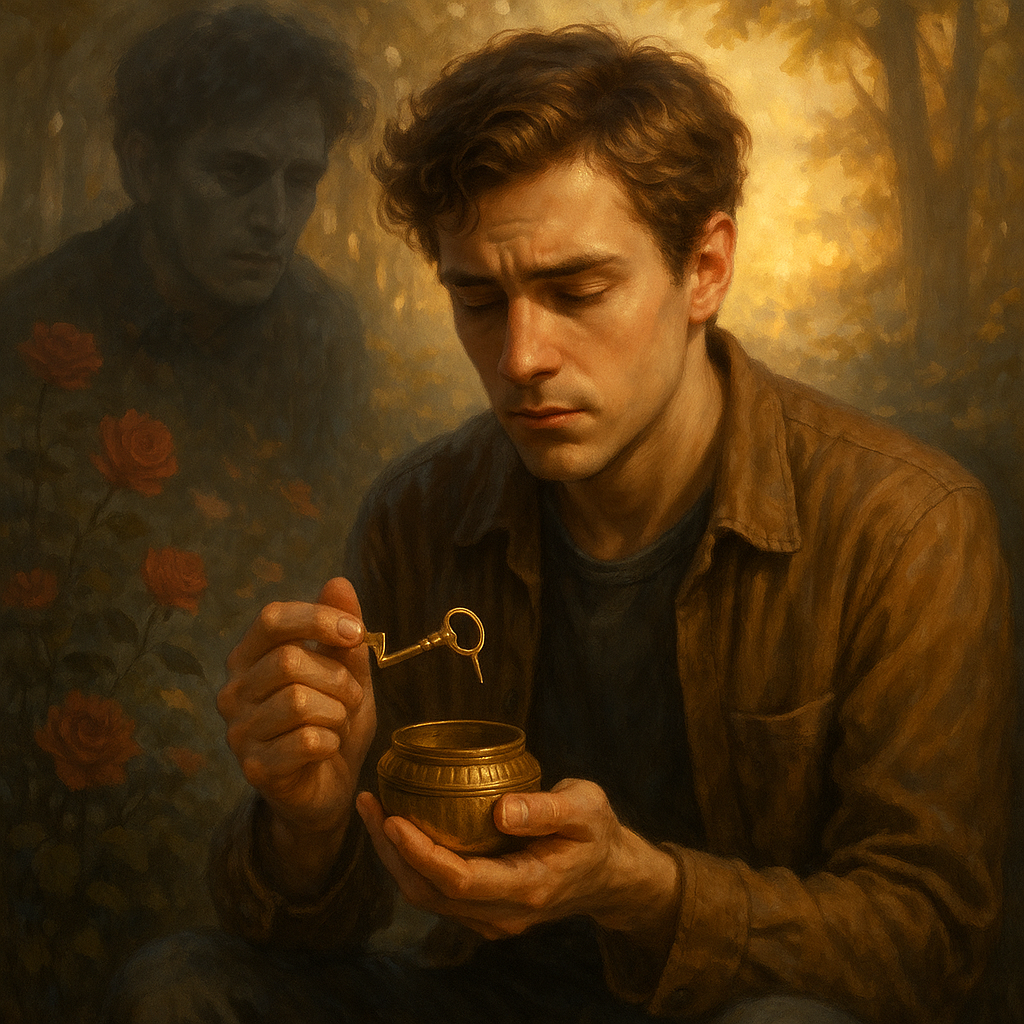
I had an enemy that dwelt in my memories. I called it the black void. Until recently, it carried an unknown shame and a hunger to be more than what I am. Experiences are not thread together by time, but by memory. This is the library of our partially chewed facts and lurking emotions narrated by imagination. And I see him, the child that was, looking at me, concerned, holding a little golden container, ridged on top, and unopened. When my past self and me learned to trust one another, I take the small golden container and open. A key. It is the ownership of my own life.
Sometimes memories carry the jagged edges of shame, the evidence of failure, the replay of hurts that never seemed to fade. But recovery is teaching me to handle memory differently—not as a whip, but as a lantern. When fear closes in on me about the future, I can turn that lantern backward and see the path I’ve already walked. And there it is—progress, undeniable. Each mile marker testifies: I’ve survived, I’ve grown, I’ve changed.
Early on, progress looked small: simply being better off than before, or becoming aware of my problems rather than lost in them. Later, I found myself astonished at how far I had come. Memory, in this light, becomes a treasury rather than a trap. My experiences shift from burdens to proof that this program works. Even my struggles, once I’ve walked through them, become evidence that courage and healing are possible.
Memory is mystical in this way: it is the same faculty that can torment me or console me, depending on how I hold it. In the hands of fear, it drags me backward. In the hands of gratitude, it pulls me forward. My Higher Power reclaims memory as a sacred tool, turning old sorrow into new courage. This is where the spiritual recovery tool of a gratitude list is a helpful practice. I admit my fear of the future, but I bring memory as evidence against despair. I use my own progress as proof that more is possible. And I wonder how memory itself can be a Higher Power’s gift. My story becomes a light for others when I share it. I intentionally turn memory toward gratitude, not shame and I testify in meetings about how far I’ve come, not only how far I must go.
Memory is not a prison; it is a map of grace unfolding.
When I feel paralyzed, I can pause and ask:
- What progress have I already made?
- What evidence does my own story give me that I can trust this process?
- How can gratitude transform what memory is showing me today?
 Daily Reprieve
You must be logged in to post a comment.