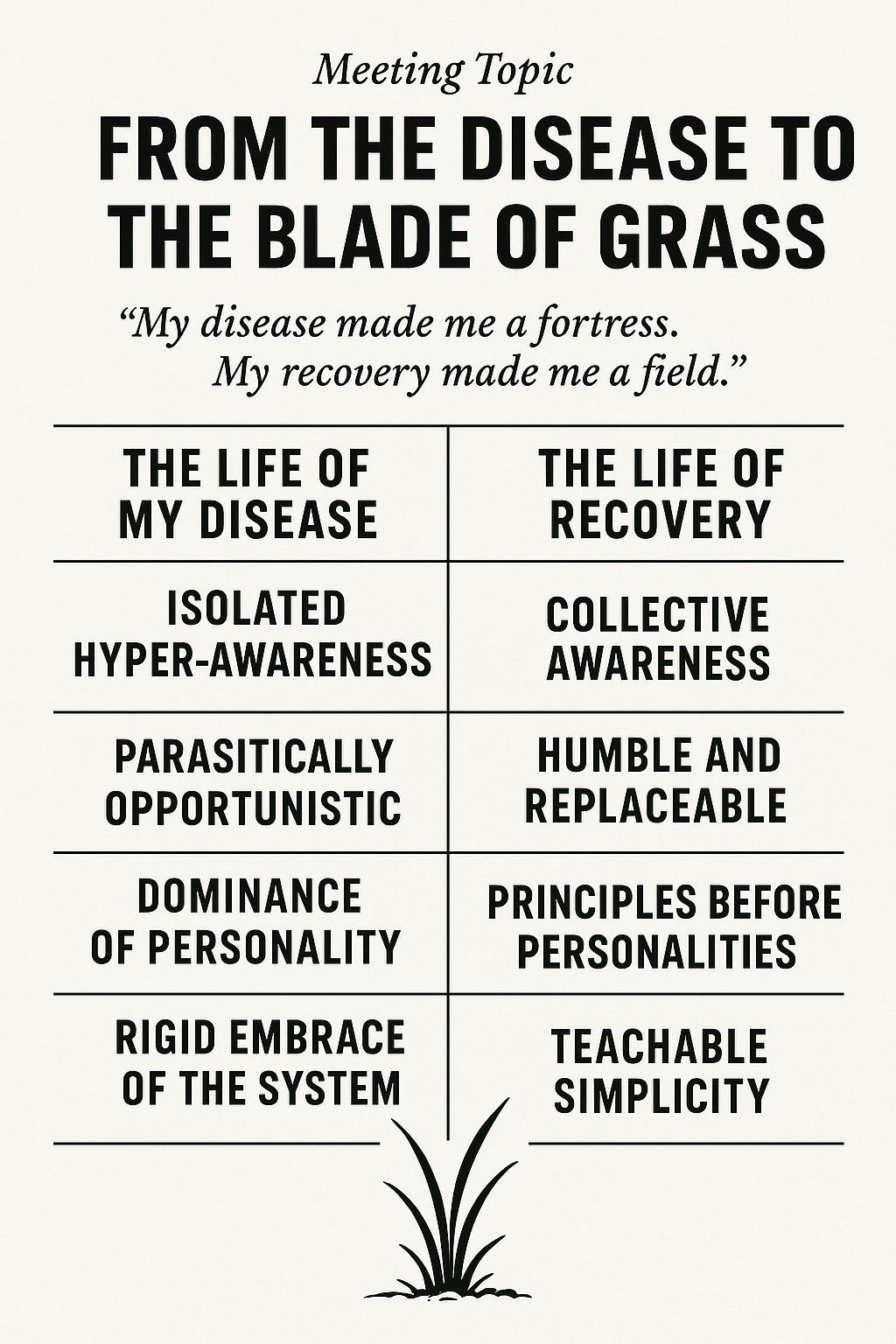
My disease made me a fortress. My recovery made me a field.
The Life of My Disease vs. The Life of Recovery
1. From Isolated Hyper-Awareness to Collective Awareness
In the disease:
I was hyper-aware of everything—especially myself. How I looked, how I was perceived, what I was owed, who wronged me. I lived in my own head like a sniper in a tower. Always scanning. Always separate. I didn’t want connection—I wanted control.
In recovery:
I am just one of many. I can come down from the tower. I find healing in being part of something larger. When I share honestly and listen openly, I become we, not just I. I learn that my pain is not unique—and neither is my hope.
“You are no longer alone.” And thank God for that.
2. From Parasitically Opportunistic to Humble and Replaceable
In the disease:
I used people. I watched for weaknesses. I took what I could and twisted what I had to. Everything and everyone was a means to an end. Even when I showed up, it was often to get something—attention, pity, money, forgiveness I hadn’t earned.
In recovery:
I learn to give without needing return. I’m not here to feed off the group—I’m here to nourish it. Like a blade of grass, I don’t demand applause. I serve because I’m grateful. If I disappear tomorrow, the grass keeps growing. That’s not sad—that’s spiritual.
“Self-seeking will slip away.” And it does, if I stay willing.
3. From Dominance of Personality to Principles Before Personalities
In the disease:
I was the center of the universe. Loud or quiet, charming or angry—it was all about me. My story. My pain. My rules. Even when I hated myself, I needed to be the star.
In recovery:
I learn to step back. Principles lead, not personalities. I don’t need to be right to be okay. I don’t need to be liked to belong. The message is stronger than the messenger. I follow spiritual laws now—not my moods, not my ego.
“We are not a glum lot,” but we are not a cult of personality either.
4. From Rigid Embrace of the System to Teachable Simplicity
In the disease:
I clung to systems that justified my brokenness—mental labels, excuses, patterns, even self-pity. I would rather be right in dysfunction than wrong and changing. I was rigid. I called it identity, but it was really fear.
In recovery:
I become teachable. Like grass bending in the wind, I can change without breaking. I listen. I try new ways. I stop pretending I know what’s best. I start asking what’s true.
It’s not weakness—it’s wisdom.
“Some of us tried to hold on to our old ideas, and the result was nil.” I don’t want nil anymore. I want growth.
It seems then, that recovery isn’t about becoming the strongest, smartest, or most spiritual.
It’s about becoming a blade of grass—rooted, connected, growing together.
And it starts by surrendering the lonely, hardened, parasitic life of the disease.
Am I able to choose simplicity over spectacle? Connection over control?
Can I become the field of We?

 Daily Reprieve
You must be logged in to post a comment.