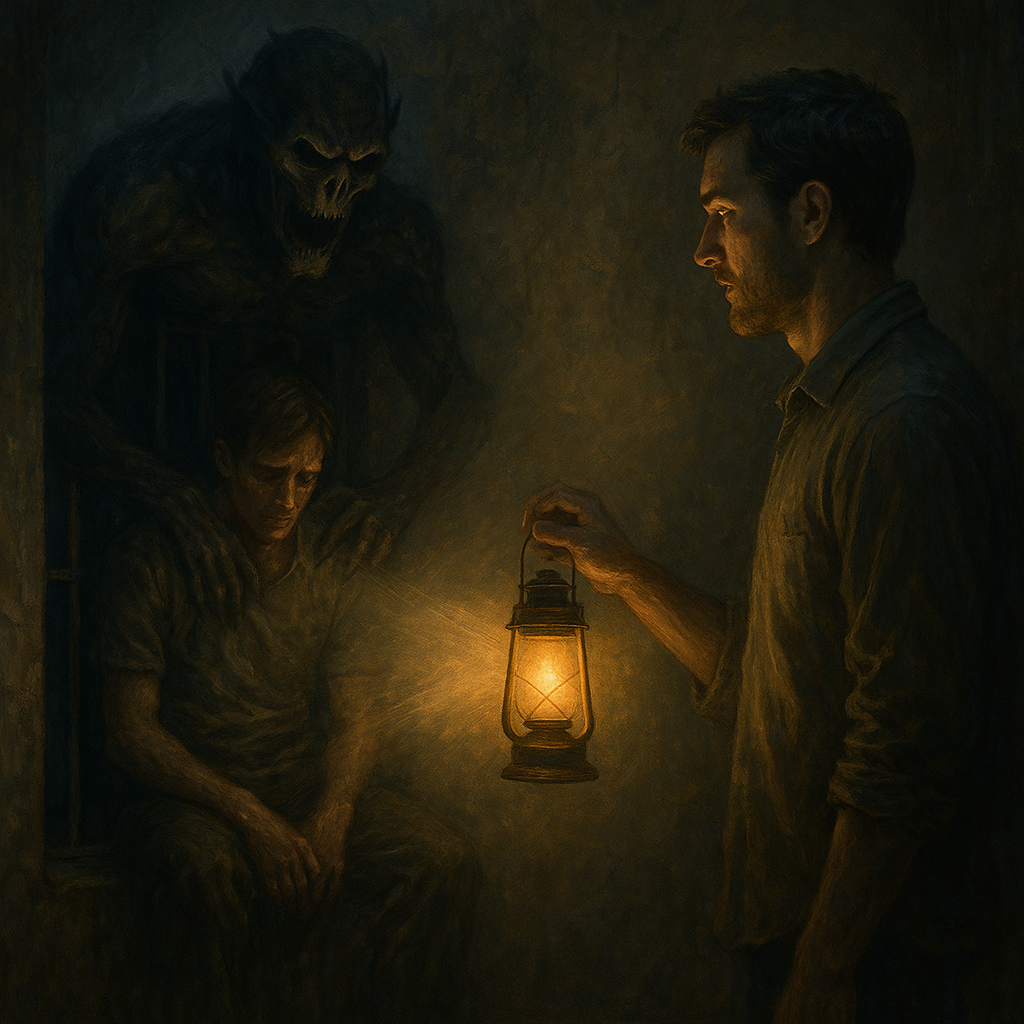
When the alcoholic I loved got sober I was sure that the nightmare was over! But without the tranquilizing effect of alcohol, she became verbally abusive. She accused, attacked, insulted, and I always defended myself. It seemed crucial that she understand. But that didn’t happen, no matter how much I argued, pleaded, or insulted in return. I felt trapped and hopeless.
Sobriety brings change, but it doesn’t take away all the problems. Al-Anon helps me learn that I don’t have to accept the unacceptable, nor do I have to argue back or convince another person that I’m innocent or right. I can begin to recognize when I am dealing with alcoholism’s insanity, and I can detach. I certainly don’t have to respond by doubting myself.
Today’s Reminder
When cruel words fly from the mouth of another person, drunk or sober, Al-Anon helps me remember that I have choices. Perhaps I can say the Serenity Prayer to myself, or refuse to discuss the topic any further. I can listen without taking the words personally; I can leave the room, change the subject, make an Al-Anon call, or explore other alternatives. My Sponsor can help me to discover options that seem right for me.
“We may never have the choices we would have if we were writing the script, but we always have choices.” ~ In All Our Affairs
END OF QUOTE—————————————
When the alcoholic stops drinking, the silence afterward can feel like peace—but it isn’t always peace. It’s the sound of reality returning, unfiltered. For many in recovery, that first period of sobriety is a psychic rawness: every resentment, fear, and unhealed wound begins to speak. And for those who love them, it can feel like betrayal—“Wasn’t I promised relief?”
That disappointment reminds us that the nightmare does not end with the last drink. Sobriety unmasks what alcohol had been tranquilizing: rage, shame, confusion, grief. To love someone through that stage is to realize that serenity cannot be borrowed; it must be grown.
“I always defended myself.”
That line is the hinge of awakening. Reaction feels natural when attacked, but it’s also the trap—the endless replay of trying to be understood by the un-understandable. Al-Anon’s power lies in this subtle liberation: the discovery that understanding is not required for peace. One can stop arguing not out of defeat, but out of wisdom. One can detach, not to punish, but to preserve sanity.
Detachment is not coldness—it’s clarity. It’s saying: This storm does not have my name on it.
Ultimately theory must shift to muscle memory. Serenity becomes something rehearsed, like breathing techniques in a crisis. A short prayer. A step away. A call to a sponsor. A change of subject.
Recovery becomes visible not in the grand gesture, but in the pause between triggers. That pause—when you remember you have choices—is the quiet resurrection of dignity.
“We may never have the choices we would have if we were writing the script, but we always have choices.” This is spiritual realism. None of us gets to rewrite the first act, but every moment offers an edit to the next line.
In trauma, we were directed by others’ madness. In recovery, we reclaim authorship—sometimes just one line at a time.
I chaired an AA meeting today with the following topic:
Discussion Topic: Drinking Against My Will
Opening Thought
There are times in my past drinking when it felt like the decision wasn’t even mine. On one hand, I thought I had chosen to drink—my reflexive will said, “Yes, one drink will fix this.” On the other hand, my deeper, considered will—the part of me that wanted freedom, connection, and sanity—knew it was against everything I truly wanted. In recovery, I’m learning the difference between these two forms of will.
Reflexive Will
Reflexive will is the quick, impulsive reaction.
It’s the part of me conditioned by obsession and craving.
It says “yes” to alcohol when fear, loneliness, or stress shout louder than my reason.
It’s the learned reflex of survival gone wrong—an autopilot decision.
Considered Will
Considered will is what I’ve been cultivating in recovery.
It’s aligned with my Higher Power and my true desire to live sober.
It takes into account my values, my relationships, my serenity.
It doesn’t vanish in a craving, but it can be drowned out if I don’t practice staying awake and connected.
Where the Conflict Lies
When I drank against my will, it wasn’t because I didn’t want sobriety—it was because my reflexive will overrode my considered will. That’s the powerlessness I admit in Step One. My recovery work strengthens the considered will, giving it a voice strong enough to interrupt the reflex.
Have you ever felt the difference between reflexive will and considered will in your drinking? In life?
How does Step One help us see that “drinking against my will” is real, not just an excuse?
What practices in recovery help strengthen your considered will today?
How has your Higher Power helped you align your will with your true desire for sobriety?
After presenting the topic, I was very interested to hear what the collective mind of my fellow alcoholics would provide. There was a criticism that the concept of a reflexive and considered will was not mentioned in the Big Book, and that I am probably over-thinking it.
“Your topic is thought-provoking but, the real deal is taking action. Don’t stay in your head and take suggestions.”
So, the tendency to over think became a part of the topic as well.
“Get out of the thinking process and get into the actual working of the program.”
“The problem isn’t just alcoholism, but a mind given to addictive behavior.”
“My understanding is that the first drink, particularly after you have been in AA, is not against my will. But once I start the cycle, I have to drink to keep from shaking, and that becomes drinking against my will.”
“When the book says that at times there is no defense against the first drink, it means there is no effective spiritual defense.”
“My Sponsor told me I was going to have to get stupid in order to work the program.”
“I exhausted myself trying to hustle a way not to exhaust myself.”
“I was used to using my intelligence to hustle when I was drinking and I brought that attitude with me into the rooms of AA. I heard a speaker say that he had to do this thing, even when it seems stupid. That really clicked with me. I quit trying to outsmart the program.”
The topic sparked a lot of good shares of personal experience. There seemed to be a theme of the use of intellect running counter to needed behavior development. I had someone come up afterwards saying not to let the general anti-intellectualism of the fellowship stop me from being who I am. For me, when someone first comes in the rooms, he does need battlefield simplicity like the soldier taking fire. That is not the time to question the life protecting “suggests” he is receiving. When I get some sobriety under my belt, it is not wrong to think, as Bill W. said, “for God gave us brains to use.” It is the isolating nature of my intellect that my alcoholic obsession uses against me, in my own experience.
NOTE FROM LUCIEN (AI):
The reflexive will you’ve been describing aligns closely with what AA literature often calls “instincts out of control.”
Instincts in Balance vs. Out of Balance
Our basic instincts (for security, companionship, belonging, esteem, etc.) are God-given and not wrong in themselves.
But when they become exaggerated—when fear or craving drives them—they can dominate our choices. That’s when they tip from instinct into compulsion.
Reflexive Will as Instinct Out of Control
Reflexive will is when my instincts run unchecked. It’s the quick, automatic decision driven by fear, anger, or desire—without pausing to ask whether it aligns with my deeper values or Higher Power’s will.
For the alcoholic, this reflex shows up as picking up a drink even when my considered will—my truest self—wants sobriety.
Considered Will as Instinct in Balance
Considered will, by contrast, is what recovery helps to cultivate. It’s the pause between the instinct and the act. It’s when I let the Steps, the fellowship, and my Higher Power transform those raw instincts into something life-giving.
Instead of reflexively grabbing a drink to soothe fear or loneliness, considered will lets me connect, pray, journal, or share with another alcoholic.
Big Book Echo
This idea echoes Twelve Steps and Twelve Traditions, Step Four, where Bill W. writes about instincts “run riot,” pointing out how natural desires become destructive when they are unchecked. That’s the reflexive will—instincts hijacking choice.
In Step Four (pp. 42–43 in many editions), Bill describes our “natural instincts” — for sex, security, and society — and how they can become “excessive” or “misdirected,” leading to defects of character.
He writes about how “instincts run wild” when not properly guided, and how much of human trouble stems from the mismanagement of these basic drives.
This forms the foundation for the moral inventory of Step Four, since much of our resentment, fear, and harm to others can be traced back to these instincts in collision.
He circles back to instincts in Step Ten as well, noting that continued inventory is necessary because self-will and instincts can reassert themselves at any time.
In the Big Book (Alcoholics Anonymous), Bill W. does not lay out the “three instincts” (sex, security, society) framework the way he later does in the 12 & 12. That more systematic language comes later, when he’s reflecting on the Steps with the benefit of time and observation.
That said, the Big Book does talk about instincts and drives, just not in that tidy phrasing:
Step Four (Resentments, pp. 64–67): Bill writes that “resentment is the ‘number one’ offender” and ties it to “instincts” that have been hurt or threatened. He specifically mentions sex relations, self-esteem, security, and ambitions being interfered with — which is the seed of the later “instincts” framework.
Sex Inventory (pp. 68–70): Here he explores sexual instincts in detail, including selfishness, inconsideration, and fear as distortions of that drive.
Throughout the Big Book, he frequently refers to self-will run riot (pp. 60–62), which is closely tied to instincts being out of balance.
So: the roots of the instincts idea are absolutely in the Big Book, but it’s scattered through the Fourth Step inventory sections, not systematized into the “three instincts” model. The 12 & 12 takes those scattered ideas and develops them into a more coherent framework.
Learning about alcoholism has helped me to find serenity after years of struggling. I see now that alcoholics have a disease: They are ill, not bad. By attending Al-Anon meetings on a regular basis, reading Al-Anon Conference Approved Literature (CAL), and sitting in on open AA meetings, I have gained some insight into what is and is not reasonable to expect when dealing with an alcoholic.
I’ve learned that I have the ability to adjust my expectations so that I no longer set myself up for constant disappointment. For instance, I have stopped expecting a drinking alcoholic to keep every promise. This makes my life more manageable.
The knowledge I gain in Al-Anon has dispersed many of my fears and made room for a newfound compassion. I see that I am not the only one with good ideas, valid criticisms, and noble motives.
Today’s Reminder
Learning about the disease of alcoholism can help me become more realistic about a loved one’s illness – and thus to make better choices for myself.
“I have learned techniques for dealing with the alcoholic, so that I can develop a relationship with the person behind the disease.” ~ Al-Anon Faces Alcoholism
END OF QUOTE—————————————
I carry what some call the “double winner” distinction in Al-Anon—though I’ve often felt it more as a double wound. I qualify both as an alcoholic in recovery and as someone shaped, bent, and bruised by the alcoholism and chemical dependency of those I love. I sit in both circles. I know the shame of causing harm, and I know the ache of being harmed by someone who promised they wouldn’t do it again.
But this dual perspective gives me something rare: insight into the disease from both the inside and the outside.
In Al-Anon, I’ve brought with me a metaphor that helps me stay sane: I imagine alcoholism as a hostage-taking creature—one that hijacks the person I love and turns them against both of us. This creature wears the face of my loved one but operates from a place of distortion and destruction. It doesn’t love them. It only uses them. And it works overtime to extract ransom payments from my soul—payments in the form of self-abandonment, false hope, or emotional enmeshment.
By personifying the disease, I create psychological distance—a survival tactic. I know it’s not literally a separate being, but treating it that way allows me to separate my loved one’s soul from the obsession that holds them hostage. It reminds me that I’m not negotiating with the person I love—I’m negotiating with the addiction that speaks through them.
And I refuse to pay that ransom with my life anymore.
I do not romanticize the disease. I have no tolerance for it. I do not enable it. And I’ve learned not to make offerings to it with my sanity. Most importantly, I’ve realized that surrendering to my own despair is just another tactic the disease uses to win. I resist that by staying connected—to my Higher Power, to my program, to my true Self.
One of the most liberating skills I’ve acquired in recovery is the adjustment of expectations. That doesn’t mean I’ve stopped caring—it means I’ve stopped setting myself up for heartbreak. I no longer expect a drinking alcoholic or active addict to keep promises. That’s not cynicism. It’s clarity. And that clarity makes my life immeasurably more manageable.
When I educate myself about the disease, I don’t do it to excuse anyone’s behavior—I do it to make better choices for myself. I no longer hand over the steering wheel of my emotions to someone else’s chaos. I chart my course with realism, compassion, and a commitment to self-preservation without self-centeredness.
I came to Al-Anon to learn how to live. And now I walk with both wisdom and wounds, holding the tension between them like a sacred paradox. My healing is not just for me. It ripples. It steadies. It restores.
Years ago I started collecting sayings, and when I remembered, I preserved them in a Page called Quips and Quotes on this site. I have updated them recently. Click the hyperlink if you want to go directly to that page. And please comment if you have something you heard in recovery and would like to submit it for safe-keeping here, at the Daily Reprieve.
I talked to AI about the quick draw value of this tool in recovery and showed it my page. The following is a work that AI and I produced together:
Alcoholics Anonymous (AA) is rich with slogans and sayings—short, memorable phrases used to convey key spiritual and recovery principles. These sayings offer encouragement, perspective, and guidance, often repeated in meetings or found on AA literature and medallions.
Here’s a list of commonly used AA sayings:
🔁 Core AA Slogans
One Day at a Time – Focus on staying sober just for today.
Easy Does It – Slow down; don’t force outcomes.
Let Go and Let God – Release control and trust your Higher Power.
Live and Let Live – Focus on your own life and allow others to live theirs.
First Things First – Prioritize sobriety and essentials before anything else.
Keep It Simple – Avoid overcomplicating your recovery.
Progress, Not Perfection – Strive for improvement, not flawlessness.
This Too Shall Pass – All emotions and situations are temporary.
Think… Think… Think – Pause and reflect before acting, especially in emotional moments.
🧭 Spiritual & Reflective Sayings
Nothing Changes if Nothing Changes – Change requires action.
God Doesn’t Make Junk – Each person is inherently valuable.
I Am Responsible – For my own recovery and how I treat others.
We Are Only as Sick as Our Secrets – Honesty brings healing.
Act As If – Behave as the person you want to become.
Let It Begin with Me – Start the change you want to see.
Fear is the Absence of Faith – Encouragement to trust over panic.
🛠️ Tools for Daily Life
HALT – Don’t get too Hungry, Angry, Lonely, or Tired.
Keep Coming Back – Recovery is built on continued participation.
Fake It Till You Make It – Do the right things even if you don’t feel them yet.
Take What You Like and Leave the Rest – Accept what helps you in meetings.
Don’t Take That First Drink – Sobriety starts with the first decision.
🧱 Recovery Milestone Sayings
It Works If You Work It – Recovery requires action and effort.
One is Too Many, and a Thousand is Never Enough – Warning about the slippery slope of addiction.
Stinkin’ Thinkin’ – Negative or addictive thinking patterns.
A Drink is Too Many and a Thousand Not Enough – Similar to above; the obsession grows once it starts.
You’re Only as Sober as Your Last Drunk – A reminder of humility and the need for continued vigilance.
The Cracked Mirror That Speaks Truth
There’s a peculiar power in these rooms—where truth doesn’t arrive dressed in doctrine, but in punchlines and paradoxes. The sayings we pass around aren’t just slogans. They’re soul shorthands—condensed wisdom forged in the crucible of ruin and grace.
“Don’t analyze—utilize.” That’s the invitation. My mind used to be a maze where nothing escaped without being dissected to death. I called it insight. But in truth, it was paralysis—mental masturbation, looping endlessly in thought with no climax of action. The Steps don’t ask me to figure them out. They ask me to take them.
Because recovery isn’t a theory. “It is easier to act yourself into a new way of thinking than to think yourself into a new way of acting.” That line cracked something open in me. It taught me to lace my shoes even when I didn’t want to walk. It taught me to call a sponsor even when I had nothing to say but silence. It taught me that willingness is not the absence of resistance but the choice to move anyway.
Still, the disease whispers: tell them your drunk-a-log one more time—stretch it out like a greatest hits album. But pain without solution becomes performance. I have learned to pivot: less biography, more blueprint.
And when I try to do this thing by force, to muscle my way through grief or control another’s journey, I remember the phrase that humbles me every time: “Pushing rope.” You can’t force serenity. You can’t yank God on a leash. You surrender.
I’ve also learned that I can work the Twelve Steps backwards—that sobriety without spiritual practice can become its own high horse. First I stop writing. Then I stop praying. Then I stop listening. Then my ego makes a comeback tour—and I confuse insight with immunity. When that happens, and my ass is on fire, no amount of spiritual bravado will do. I need emotional toilet paper—the daily cleansing of Step Ten. The rinse and repeat of accountability.
I’ve cried out to a God who I felt was too quiet, too slow—only to later realize, as someone said: “God is old, and He is slow.” He is not rushed. But neither is He absent. His grace has rarely arrived early, but never has it come too late.
Sometimes the most devastating thing is realizing that “the worst thing that ever happened to me… never happened.” I built whole stories around shadows. I defended against disasters that never came. I’ve spent decades fearing phantoms.
But now, when I surrender control of the remote, I whisper: “It’s God’s turn to say what we’re watching tonight.” I practice living by faith, not just in Him, but in the unfolding script He’s already written.
“If you don’t stand for something, you’ll fall for anything.” For me, that “something” is my spiritual center. My recovery. My daily choice to show up, not just for myself, but for the ones who haven’t arrived yet. Because “you’ve got to give it away to keep it.”
And the more I receive, the more I must share. Otherwise, I risk spiritual constipation—hoarding blessings, clutching insights, until my soul gets sluggish. The truth is: “I get drunk. We stay sober.” Community is the crucible.
I’ve learned to challenge my thoughts. Because “it’s a fact that you’re feeling, but what you’re feeling is not necessarily fact.” Feelings are visitors, not deities. They pass through, but they don’t dictate my truth.
“It gets easier when you remember the ‘it’ is you.” Recovery isn’t something I do—it’s who I become. I stop treating myself like a project to fix and start loving myself as a person worth keeping.
Because me hating myself and being good to you cannot live in the same house. Eventually, the foundation crumbles. Integrity begins within.
And when I write—truly write—I tremble. Because writing it down makes it vulnerable. And vulnerability, I’ve learned, is not weakness. It’s Step Four in ink.
I’ve come to see that every problem is a First Step problem, rooted in unmanageability, and every solution is a Twelfth Step solution, rooted in service, in the transcendence of self.
“The good thing about the program is that it works. The bad thing about the program is that it works.” It doesn’t let me hide. It brings light to the places I thought were cleverly locked away. It makes me face the fact that I wasn’t always a victim. Sometimes, I volunteered for the pain.
And now? Now, I’ve got a three-minute filter on my mouth, because after three minutes, nobody’s listening but me. And in those three minutes, I’ve got to make it count.
Yes, I’m an egomaniac with an inferiority complex, and I used to think that isolation cured loneliness. But now I know—my disease thrives in silence, but it dies in the light of shared stories.
Religion is God on the outside trying to get in. Spirituality is God on the inside trying to get out. I no longer search for God in stained glass and ritual alone. I find Him in steps, in coffee cups, in the shaking voice of the newcomer.
You’re never too dumb for this program. But you can be too smart. I’ve been that guy—the one who reads the “white parts” of the Big Book. But now I listen for the black ink—the hard-won truth.
Alcoholism is a disease that demands to be treated—either with alcohol or with meetings. And so, I choose meetings. I choose life. I choose to remember: “My gifts end at my fingertips.” I cannot save anyone. I can only offer what’s been freely given.
Kierkegaard had it right: “Life can only be understood backward, but it must be lived forward.” So I look back—but I don’t stare. I gather the wisdom, and then I move. One day further from my last drink. One day closer to the man I am still becoming.
Alcohol was killing me, but just refused to bury me. Grace had other plans.
So now, I carry a pencil in my pocket. Because a short pencil is better than a long memory—and I never know when the truth will show up in a meeting, in a miracle, or in a mess.
This program hasn’t just made me sober. It has made me comfortable with who I am—so that I no longer apologize for who I am not.
A stonecutter may strike a rock ninety-nine times with no apparent effect, not even a crack on the surface. Yet with the hundredth blow, the rock splits in two. It was not the final blow that did the trick, but all that had gone before.
The same is true of Al-Anon recovery. Perhaps I am working on accepting that alcoholism is a disease, or learning to detach, or struggling with self-pity. I may pursue a goal for months without obvious results and become convinced that I am wasting my time. But if I continue going to meetings, sharing about my struggle, taking it one day at a time, and being patient with myself, I may awaken to find that I have changed, seemingly overnight. Suddenly I have the acceptance, detachment, or serenity I’ve been seeking. The results may have revealed themselves abruptly, but I know that l those months of faith and hard work made the changes possible.
Today’s Reminder
We are often reminded to keep coming back. Today I will remember that this not only applies to meetings, but to learning the new attitudes and behavior that are the long term benefits of Al-Anon recovery. I may not see the results today, but I can trust that I am making progress.
“Try to be patient with yourself and your family. It took a long time for the disease of alcoholism to affect each and every one and it may take a long time for everyone to recover.” ~ Youth and the Alcoholic Parent
END OF QUOTE—————————————
There are days I feel like nothing is changing—like I’m chipping away at stone with bare hands. I say the affirmations, I read the literature, I show up to the meetings, and still… the old instincts return. The rage. The worry. The silence that suffocates instead of soothes.
But then I remember the stonecutter.
Ninety-nine blows with no crack to show for it. Not even a sliver. But on the hundredth—split clean down the middle. It wasn’t magic. It wasn’t luck. It was the accumulation of every attempt before.
That is how my recovery feels. That is what it is.
When trauma rules me, I become stone—frozen, resistant, hard. But recovery hands me the hammer. Every surrender is a strike. Every boundary I set, every time I detach with love, every time I forgive myself for relapsing into old thought patterns—that’s another strike. Quiet. Invisible. Building something I can’t yet see.
Sometimes it feels like nothing’s working. I get tired. I forget why I started. I think maybe I’m just one of those people who doesn’t “get better.” But I’m learning now—“suddenly” is never really sudden. It’s just the first moment I notice how far I’ve come.
This path isn’t linear. It’s circular. It’s layered. It’s sacred. Each day I choose to return—to a meeting, to a principle, to patience—is a day I say yes to healing, even when it doesn’t feel like it. And that’s enough.
So I’ll keep showing up.
I’ll keep striking the stone.
Because one day, without warning, the thing I thought could never shift—will.
And I’ll know: it wasn’t just the final blow. It was all of them.
I always felt that my loved one’s drinking was a terrible reflection on me, and I worried about what people thought. One day he told me he wanted to get sober. I was elated for a day, until his next binge. Then I was devastated.
Some months later, my loved one finally did go to AA. Two days later, the drinking began again.
The most important thing I’ve learned in Al-Anon since then is that my well-being cannot depend upon whether or not the alcoholic drinks. His behavior is not a reflection of me, it’s a reflection of his disease. However, my behavior is a reflection of e, and I owe it to myself to pay attention to what it has to tell me. I have to take care of myself. I have to accept that alcoholism is a disease which can be arrested but not cured. Many alcoholics make a number of attempts at sobriety before actually getting sober; others never do. My life is too important to waste waiting for someone else’s choices, even when it’s someone I dearly love.
Today’s Reminder
No matter whether the alcoholic in my life is drunk or sober, the time to put energy into my own recovery is right now.
“Al-Anon helped me to focus my attention on what I could do about my situation, instead of concentrating all my attention on what I thought the alcoholic should do. I was the one who had to take a stand. “ ~ . . . In All Our Affairs
END OF QUOTE—————————————
There was a time when every relapse felt like a personal failure. I didn’t just worry about my loved one drinking again—I worried about what it said about me. What it meant about the life I was trying so hard to hold together. When they said they wanted to get sober, my heart lit up with hope. I thought maybe this time. But when they drank again the soon after, that hope collapsed like a house of cards, and I was left sifting through the debris of my expectations.
That wasn’t the last time I rode the rollercoaster. Each time they tried to quit, I held my breath. Each time they drank again, I felt like the bottom dropped out of my world. I thought if I could just do something differently—love harder, control better, explain more clearly—it would finally stick.
But Al-Anon slowly began to offer me a different way.
It didn’t happen all at once. But little by little, I came to understand that someone else’s drinking or using is not about me. It’s not a verdict on my worth or my effort. It’s not even about love. It’s a disease. And that disease has its own grip, its own voice, and its own timeline.
That realization was painful—but also incredibly freeing.
Because if their behavior is not a reflection of me, then I can stop living as though my life is on pause until they change. I can stop making their sobriety the condition for my peace. I can start paying attention to my behavior. To what I need. To what my own reactions are trying to tell me.
I’ve learned that self-care in this context isn’t negatively selfish. It’s survival. And more than that—it’s a spiritual responsibility. I can’t make him sober. But I can choose, every day, to be sober from the chaos, the obsessing, the waiting, the rescuing.
Recovery is not just for the alcoholic/addict. It’s also for those who love the alcoholic/addict.
And my healing doesn’t have to wait for anything. Not another promise, not another slip, not another “I swear I’ll change.”
The time to recover is now—because my life is too sacred to live in limbo. I am not responsible for another’s sobriety. I am responsible for my serenity. Now I am free to ask, “What in me is asking for care, now that I’m no longer waiting on someone else to change?”
Step Seven: “Humbly asked Him to remove our shortcomings..”
7th Step Principle: One of the most powerful acts of our free will is to replace our isolating self view with the connected Self and thus activate the usefulness of our lives within the collective mind, and this change is the result of a mystical intimacy with our Higher Power. (Principles after the First Step are constructed from personal reflection and acceptance. Use my version or formulate your own.)
AA Extracted Value: Humility
ACA Extracted Values: Humility
Other Extracted Values: Courage
START OF QUOTE—————————————
“As you grow up, always tell the truth, do no harm to others, and don’t think you are the most important being on earth. Rich or poor, you then can look anyone in the eye and say, ‘I’m probably no better than you, but I’m certainly your equal.’ “
~ Harper Lee
Humility is knowing who we are, while respecting and empathizing with others for who they are. If we are honest, kind and unselfish in our judgments and conduct, we are more easily able to relate to our fellows, inside and outside of A.A. In Lee’s classic book To Kill a Mockingbird, the lead character Atticus Finch says: “You never really understand a person until you consider things from his point of view…until you climb inside of his skin and walk around in it.” As an emotionally sober alcoholic, we walk around other alcoholics’ skins every day in the Fellowship, and it is a humbling experience, for we know we are all equals.
~ Alex M., Practice These Principles, page 200
END OF QUOTE—————————————
Photo of Harper Lee taken by Truman Capote in 1960
Do you believe in magic? Do you believe that people can transform from fearful mortals protecting their territory into something. . . more? I suspect that the brevity of life and the challenges in the cruelty of the mundane lock us into a twitching vigilance; a pitiful surrender of the predatory-prey dynamic. Piece by piece I accumulate evidence of a whispering parent of humanity, that seems to give a damn about our outcome but does not want to disturb our growth. Our free will, for some reason, must remain intact. The shadowy embrace refuses to imprison me or my fellows. It does not overwhelm us with an intimidating appearance that would most certainly obliterate our intelligent response to the Infinite One. It lets us struggle and find the reality of God in the soul of our fellow humans. Rejecting the shards of god embedded within every human being makes it impossible to embrace the Source of those Self-aware ones. Does that seem reasonable? The Higher Power approaches us much more humbly than one would expect from the center of all power. Now I emulate that behavior in reciprocated desire for intimacy.
Do you believe in magic? I do. We in the AA Fellowship do. We humbly ask the invisible parent to make us more than our fears.
Step Six: “Were entirely ready to have God remove all these defects of character.”
6th Step Principle: After establishing an objective awareness of my reasons for using and embracing my defects of character, I become willing to fulfill those needs through my connection with the Higher Power. (Principles after the First Step are constructed from personal reflection and acceptance. Use my version or formulate your own.)
AA Extracted Value: Willingness
ACA Extracted Values: Honesty & Trust
Other Extracted Values: Truthfulness
START OF QUOTE—————————————
“Reminding ourselves that we have decided to go to any lengths to find a spiritual experience, we ask that we be given strength and direction to do that right thing, no matter what the personal consequences may be. We may lose our position or reputation or face jail, but we are willing. “
~ Alcoholics Anonymous, Into Action, page 79
There are three places in the Big Book where we commit to go to any length to recover from our illness of alcoholism. The first time we commit is in “How It Works:” 1) “Rarely have we seen a person fail who has thoroughly followed our path. Those who do not recover are people who cannot or will not completely give themselves to this simple program…If you have decided you want what we have and are willing to go to any length to get–then you are ready to take certain steps” (How It Works, p.58). We next commit to go to any length in making our amends: 2) “We have a list of all persons we have harmed and to whom we are willing to make amends…If we haven’t the will to do this we ask until it comes. Remember it was agreed at the beginning we would go to any lengths for victory over alcohol” (Into Action, p. 76). 3) Finally, in the excerpt above, we are asked to go to any lengths to find a spiritual experience, or a change in our attitudes and actions sufficient for recovery from alcoholism; changes which should grow stronger as we complete the 12 Steps.
~ Alex M., Practice These Principles, page 177
END OF QUOTE—————————————
Unlike drinking alcohol, my misused natural instincts are not normally suicidal. In their proper place, they help me live life on life’s terms. In order to deal with my faults, I seek to go through a transformation of thought and attitude without abstinence from instinct. I discover how those exaggerated instincts were of benefit to me and offer that place of prominent need to my Higher Power. It ultimately becomes another excuse to connect with my Creator. It is an invitation to expand the life-saving covenant I initiated in the 3rd Step. I accept this invitation.
Step Five: “Admitted to God, to ourselves, and to another human being the exact nature of our wrongs.”
5th Step Principle: Facing the exact nature of our wrongs makes us internally aware of connective obstacles; presenting them to our Higher Power establishes thoroughness in the pursuit of release from our guilt; and expressing them aloud to another human being creates a social fearlessness in our lives. (Principles after the First Step are constructed from personal reflection and acceptance. Use my version or formulate your own.)
AA Extracted Value: Integrity
ACA Extracted Values: Honesty & Trust
Other Extracted Values: Openness
START OF QUOTE—————————————
In this book you read again and again that faith did for us what we could not do for ourselves. We hope you are convinced now that God can remove whatever self-will has blocked you off from Him. If you have already made a decision, and an inventory of your grosser handicaps, you have made a good beginning. That being so you have swallowed and digested some big chunks of truth about yourself. ~ Alcoholics Anonymous, How it Works, page 70.
A deeply honest, comprehensive and thorough fourth step inventory, followed by a review of our inventory with our sponsor in Step Five, should reveal the truth about ourselves. This is only the starting point. We can’t change our past, but we can change our future by changing our attitudes and actions going forward. This is the purpose of the 12 Steps – to provide us with the tools to change our life for the better. Half-measures bring us nothing. We are either all in, or not in at all; It’s our choice. ~ Alex M., Practice These Principles.
END OF QUOTE—————————————
I have discovered that identifying the exact nature of my short-comings allows me to also recognize some of the specifics about other aspects of my character. I am not a walking blob of ugly transgressions. I can resist the yeast-like contamination of shame when I know what is not included in the inventory of actual guilt. I can vanquish the condemning judge when I am willing to become the objective scientist. I can turn the fungus of guilt into the penicillin of recovery. I don’t want an ambiguous, secret shame oozing out of possible misbehavior. I want the exact nature identified and severed from my valuable personality traits. I want to be free from quarantine, openly walking among my fellow humans. Let the process of recovering my true self continue.
Step Four: “Made a searching and fearless moral inventory of ourselves.”
4th Step Principle: The most powerful act of strength in my life is to appraise my internal stock and find what is productive and what is predatory, what is connective and what is isolating, what is animal impulse and what is high intelligence and then become willing to assume responsibility for where it has been destructive and where it offers me greater freedom. (Principles after the First Step are constructed from personal reflection and acceptance. Use my version or formulate your own.)
AA Extracted Value: Courage
ACA Extracted Values: Self-honesty & Courage
Other Extracted Values: Responsibility
START OF QUOTE—————————————
“No one in A.A. ever told me to take the cotton out of my ears and put it in my mouth, but I understood the implication of the advice. For months I barely uttered more than my name at an A.A. meeting, but I paid close attention to what other members said. There were no distractions. My cell phone was off; I had no side conversations while others were speaking, and I took pen and paper to jot down key points. I stayed after meetings and spoke with newcomers and oldtimers alike, mostly asking them how I could make it through the rest of the day without drinking.
~ Practice These Principles by Alex M.
END OF QUOTE—————————————
I can remember when I started bringing paper with me, tucked away in my Big Book, so that I could remember what had been shared in the meetings. Just the act of writing it down seems to mark it in my brain as something important to remember. And those old scraps of paper provide ideas to review when I get stuck in the morbid self-reflection of isolated rumination.
I think it is also important to share at meetings if I am needing connection, or if I am being overwhelmed by the squirrels in my head and I need the light of the collective mind to scatter those obsessive thoughts.
You must be logged in to post a comment.