Archive for Mental Health

Endigar 935 ~ The Messenger

Posted in Uncategorized with tags , , , , , , , , , , , on May 5, 2025 by endigar

From Courage to Change of Jun 26:

Forgiveness can be just a change of attitude. I came to Al-Anon full of bitterness toward the alcoholic in my life. When I realized that my bitterness hurt me more than anyone else, I began to search for another way to view my situation.

In time, I came to believe that my alcoholic loved one might be the messenger my Higher Power used to let me know that I needed to get help. It is not fair to shackle her with credit or blame for the amount of time it took for me to pay attention to that message. I chose to tolerate a great deal of unacceptable behavior because I was unwilling to admit that I needed help. I did the best I could with the tools and knowledge I had at hand, and I believe that she did too. Eventually the message got through. I made it to the rooms of Al-Anon, and my life changed in miraculous ways. I don’t deny that hurtful things were said and done along the way, but I refuse to carry the burden of bitterness any further. Instead, I am grateful for what I have learned.

Today’s Reminder

I will not allow resentments to drag me down any longer. I am building a better and more loving life today.

“Forgiving is not forgetting, it’s letting go of the hurt.” ~ Mary McLeod Bethune

END OF QUOTE—————————————

There was a time when I carried bitterness like armor—close to the chest, heavy on the shoulders. I came into recovery with a heart full of accusations, convinced the unfaithful ones in my life were the architect of my pain. But time and grace are strange companions. Somewhere along the journey, I began to see with different eyes.

What if—just what if—she was not my enemy, but a messenger?

Not a perfect one. Not a gentle one. But a necessary one.

I can’t pretend the hurt didn’t happen. I won’t gloss over the words, the nights, the betrayal. But I can choose how long I carry it. I can choose whether to let those memories define the whole story or just a chapter of it.

And here’s the truth: I stayed too long in chaos, not because I was stupid, but because I didn’t know another way. I tolerated more than I should have, not because I liked suffering, but because I hadn’t yet learned to reach for help. That learning came slowly, and painfully—but it did come. And when it did, I walked into the rooms of 12 Step recovery. And my life began to change.

Forgiveness, I’ve found, isn’t always about saying “it’s okay.” Sometimes it’s just about setting the weight down. Seeing the past with clearer eyes. Letting my pain transform into compassion—not for her behavior, but for the brokenness in both of us.

Today, I give thanks not for the damage, but for the awakening it sparked. The messenger delivered the message. I listened. And that listening saved my life.

Endigar 929

Posted in Uncategorized with tags , , , , , , , , , , , on April 29, 2025 by endigar

From Courage to Change of Jun 20:

Fear was a daily part of my experience of alcoholism, and I learned certain ways to cope with it. I often catch myself reacting to my fears in the same way today, even though my circumstances have changed. For example, I often keep quiet when confronted, instead of speaking my mind. This might be a legitimate response, except that I don’t consciously make the choice. This is not responding, it’s reacting, giving up my self-respect out of fear and out of habit.

My best alternative is to admit that I have a problem, accept my reactions, and turn them over to my Higher Power. I’ve often heard that courage is fear that has said its prayers. I must recognize my fear, I must say those prayers, and I must have faith as I wait for healing.

In the meantime, there are important ways in which I can help myself. The first step in learning to respond more effectively to others is to learn to respond more effectively to myself. I can learn to respond with love, caring, and respect for myself, even for those parts of me that experience fear, confusion, and anger.

Today’s Reminder

Today I’ll try to become more aware of alternatives that I haven’t yet recognized.

“. . . Al-Anon helped me to accept the fact that, although I have no control over other people’s reactions or thoughts, I can change the way I react.” ~ . . . In All Our Affairs

END OF QUOTE—————————————

Fear used to be the water I swam in — so constant I didn’t even know it had a name. It shaped everything: the way I spoke (or stayed silent), the way I moved through relationships, the way I tried to survive. I learned to shrink, to please, to disappear. It wasn’t a conscious decision — it was instinct. It was armor. It was all I knew.

Even now, in recovery, I sometimes catch myself slipping back into those old patterns — not because I’m failing, but because the body remembers. I still find myself going quiet when I’m afraid, even if I have something important to say. I freeze, I retreat, I abandon myself, not because I want to, but because I forget I have another choice.

That’s the difference recovery is teaching me — between reacting and responding. Reaction is old wiring. Response is healing.

And the path to response starts with awareness. It starts with pausing long enough to say, Oh. I’m scared right now. And then instead of pushing it away or letting it run the show, I bring it to prayer. I offer it to my Higher Power — not to be instantly fixed, but to be held.

I’ve always loved that phrase: “Courage is fear that has said its prayers.” It doesn’t mean the fear disappears. It means it no longer has the final word.

One of the most important things I’ve learned is that I cannot respond lovingly to others if I don’t first learn how to respond lovingly to myself. That includes the parts of me that still feel scared, confused, or angry. They’re not signs of failure — they’re signs of being human. And they’re worthy of compassion.

Today, I don’t have to control anyone else’s thoughts, feelings, or reactions. That’s not my job. My job is to become more aware of myself — and to gently, steadily, practice choosing love over fear.
Especially when it comes to the way I treat me.

Courage is armor
A blind man wears;
That calloused scar
Of outlived despairs;
Courage is Fear
That has said its prayers.

~ Karle Wilson Baker

Endigar 928 ~ Step One

Posted in Uncategorized with tags , , , , , , , on April 28, 2025 by endigar

Step One: “We admitted that we were powerless over alcohol – that our lives had become unmanageable.”

1st Step Principle: We will find enduring strength only when we first admit complete defeat over our isolated, obsessive thinking and compulsive behavior. (Adapted from 12 Steps & 12 Traditions, top of page 22)

AA Extracted Value: Honesty

ACA Extracted Values: Powerlessness & Surrender

Other Extracted Values: Acceptance

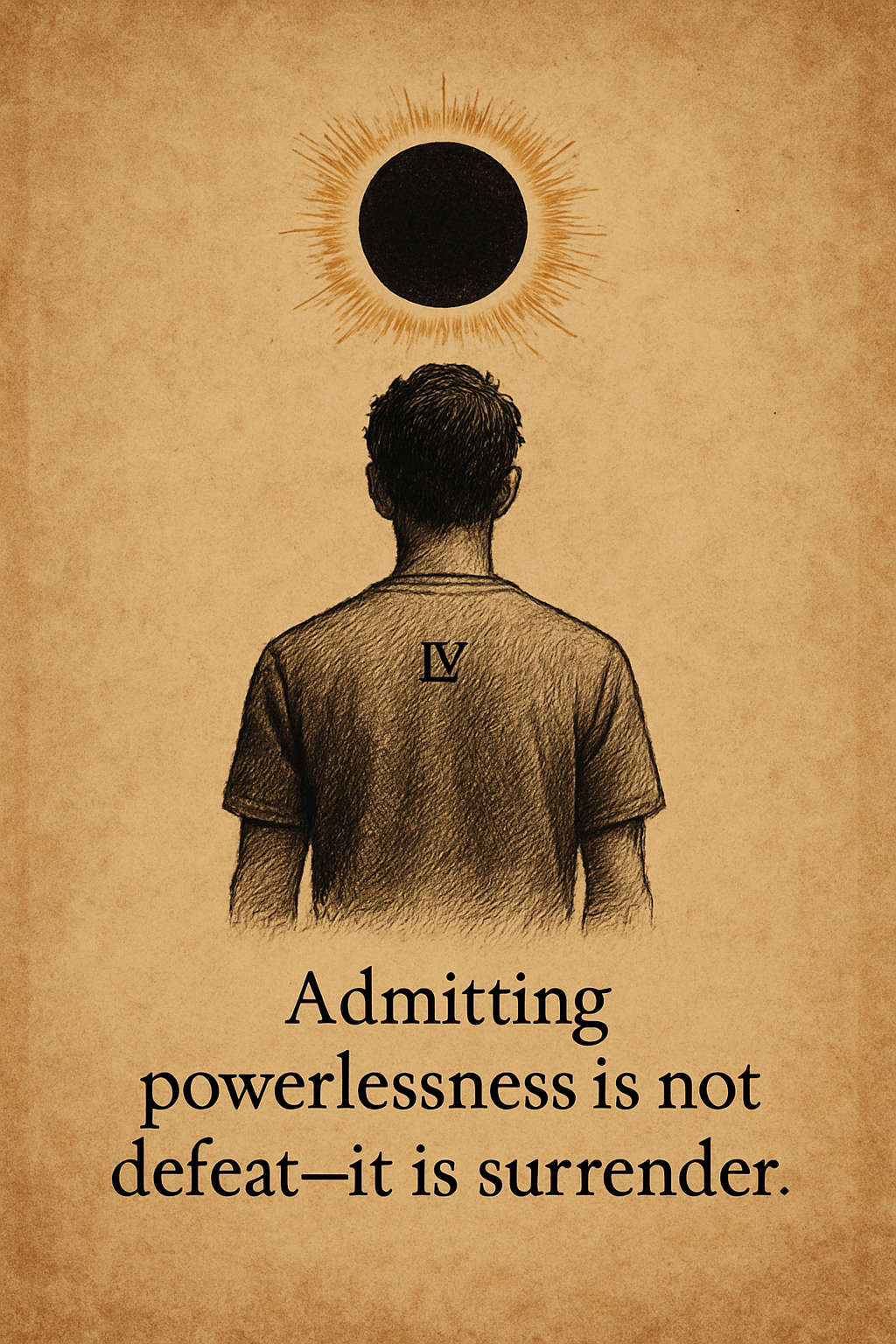
There’s a strange kind of grace hidden in Step One. It doesn’t feel like grace at first — it feels like hitting the wall. Like losing. Like failure.

But somewhere beyond that first sting, there’s relief. There’s a softening.

For so long, I fought life on my own terms — isolated in my obsessive thoughts, driven by compulsions I couldn’t control, believing if I just tried harder, thought smarter, did better, I could fix it. I could fix me.

But Step One doesn’t ask me to fix anything. It invites me to admit the truth: I can’t.
I am powerless.
My life, left to my own devices, becomes unmanageable.

It’s easy to think of “powerlessness” as weakness, but in recovery, it’s something far more beautiful. It’s honesty. It’s finally telling the truth about my limitations, my fears, my illusions of control. It’s putting down the exhausting armor of pretending.

Admitting defeat feels shameful to the old parts of me that were raised to equate strength with independence. But real strength — enduring strength — comes when I surrender. When I let go of the desperate need to be in charge, to know the answers, to wrestle my pain into submission.

Surrender is not about giving up. It’s about opening up.

It’s about saying: I don’t have to do this alone. I was never meant to.

ACA teaches me that powerlessness and surrender are vital values — not things to fear, but things to lean into. They are the doors through which acceptance enters. And with acceptance comes a gentler, wiser way of living.

Today, I am willing to lay down the endless battle against myself and against reality.
Today, I am willing to be honest about where I am powerless.
Today, I surrender my isolated, obsessive thinking and compulsive behavior.
Today, I accept life as it is, not as I demand it to be.

And maybe — just maybe — in that surrender, I will find the strength I have been seeking all along.

Endigar 927

Posted in Uncategorized with tags , , , , , , , , , , , on April 27, 2025 by endigar

From Courage to Change of Jun 19:

When I’m troubled by another person’s behavior, a complicated situation, or a disappointing turn of events, Al-Anon reminds me that I don’t have to take it personally. I’m not a victim of everything that happens unless I choose to see myself that way. Though things don’t always go my way, I can accept what I cannot change, and change what I can.

Perhaps I can take a different view of my problems. If I accept them at face value without taking them personally, I may find that they are not problems at all, only things that have not gone as I would have liked. This change of attitude can help free me to evaluate the situation realistically and move forward constructively.

Today’s Reminder

Blaming my discomfort on outside events can be a way to avoid facing the real cause – my own attitudes. I can see myself as a victim, or I can accept what is happening in my life and take responsibility for my response. I may be guided to take action or to sit still, but when I listen to the guidance of my Higher Power I will no longer be the victim of my circumstances.

“God asks no man whether he will accept life. That is not the choice. You must take it. The only choice is how.” ~ Henry Ward Beecher

END OF QUOTE—————————————

My mind often wants to go to war with life. It’s as if, when something hurts, I instinctively look for someone or something to blame — God, the betrayal, my internal cognitive dissonance. Blame used to feel like protection. If it was an identifiable fault, maybe I could stay safe, or at least feel justified in my anger or withdrawal.

But recovery has been slowly, patiently teaching me another way: that my peace does not depend on the world behaving the way I want it to. My peace depends on the choices I make about how to see and respond to the world.

When I read, “I’m not a victim of everything that happens unless I choose to see myself that way,” I felt a quiet tap on my shoulder. How often do I still cling to a story of being wronged? How often do I use discomfort as proof that life has betrayed me, rather than seeing it as life simply being life — unpredictable, imperfect, alive?

Today I’m reminded that much of my pain is not caused by the events themselves, but by the way I wrap myself around them, the way I resist them or try to demand that they be different. I have always had acceptance issues.

There is so much freedom in learning to accept things at face value. To feel disappointment without turning it into resentment. To experience loss without turning it into a judgment against myself or others. To see an unmet desire not as a cosmic injustice, but simply as what is.

I think this is the heart of the matter: when I blame outside events, I’m usually avoiding a harder truth — that my real suffering comes from my own fearful, grasping, controlling attitudes. It’s humbling. And liberating. Because if the problem isn’t “out there,” then the solution doesn’t have to wait for anything to change. It’s already within me.

I’m learning — slowly, imperfectly — to listen to the quiet, steady voice of my Higher Power. Sometimes that voice says “Act.” Sometimes it says “Wait.” But it always says, “You are not a victim. You are loved. You are free.”

I don’t always hear it right away. But today, I’m willing to listen.