Archive for literature

Endigar 1028

Posted in Uncategorized with tags , , , , , , , , , , , , on August 19, 2025 by endigar

From Courage to Change of Sep 13:

Each moment of this day is precious, and I will make it count. I will use this time to enrich my life and to improve my relationship with my Higher Power, other people, and myself. Each of the Twelve Steps can help me to pursue this goal regardless of my circumstances. Meetings, Al-Anon telephone calls, and Al-Anon literature all help me to apply the Steps to what is happening in my life here and now. In this moment, I can make a positive change.

Perhaps I will think of time as a special kind of checking account. I have twenty-four hours to spend. By putting Al-Anon’s principles to work in my life today, I am choosing to use these hours to grow, enjoy, and improve. I even have an opportunity to learn from my mistakes, since a brand new twenty-four hours can begin at any moment.

Today’s Reminder

This day offers me a chance to make a new start at living. How can I make the best use of it?

“We start with gifts. Merit comes from what we make of them.”
– Jean Toomer

END OF QUOTE—————————————

Note: Jean Toomer (1894–1967) was an American writer, poet, and thinker best known for his 1923 book Cane, a groundbreaking work of modernist literature that blends poetry, prose, and drama.

Background

  • He was born in Washington, D.C., into a mixed-race family and grew up moving between Negro and Caucasian communities, which deeply shaped his outlook on identity.
  • Toomer resisted being categorized strictly by race. Though associated with the Harlem Renaissance, he did not fully embrace the label of “Negro writer,” instead seeing himself as an American author exploring universal human themes.

Cane (1923)

  • Cane is his most famous work, often considered one of the masterpieces of the Harlem Renaissance.
  • It weaves together vignettes, poems, and sketches of Negro life in both the rural South and the urban North, portraying themes of identity, sexuality, spirituality, and the Great Migration.
  • Its experimental style—mixing lyricism, folklore, and modernist fragmentation—made it unique for its time.

Later Life

  • After Cane, Toomer never published another major literary work, though he wrote essays, plays, and unpublished manuscripts.
  • He became involved with spiritual movements, particularly the teachings of the mystic George Gurdjieff, which influenced his later writings and personal philosophy.
  • He married Margery Latimer, a white writer, in 1931, which was controversial in the U.S. due to anti-miscegenation attitudes and laws.
  • Much of his later life was devoted to spiritual seeking and private writing rather than public literary activity.

Legacy

He is remembered as a bridge figure between different identities, artistic movements, and cultural currents of early 20th-century America.

Though he distanced himself from being labeled a “Black writer,” his desire was ignored and now his work—especially Cane—is recognized as central to African American literature and modernist experimentation. It is more the work of American individualism than racial Darwinist competition.

END OF NOTE—————————————

There are roughly 37 trillion cells in my body. Within just one of those cells resides a molecule: L43NxB500325Ydπ. And within that molecule, housed deep inside a neutron, lies the Quantum Infinity Vault. Its emblem is the macro/micro infinity ouroboros — the eternal cycle of vast and small, endlessly entwined.

The code to open this vault is 23(3), which summons 24. When opened, the vault releases an inexhaustible supply of positive selfishness (ps). A pulsating dose of ps moves through my body each day. If I fail to use it within the 24-hour span of Earth’s rotation, it decays into the maggot-filled manna of fearful isolation. But if I spend it freely — if I feed the hungry Sun — it transforms into connection, filling my day with living tools of recovery.

For when I have enough ps to proclaim, “I want to live” or “I want to recreate my life”, then I also find:

  • the courage to connect,
  • the humility to listen to other versions of success, and
  • the deep, restoring respiration of serenity.

Long live molecule L43NxB500325Ydπ!
Endigar 1009

Posted in Uncategorized with tags , , , , , , , , , , on July 18, 2025 by endigar

From Courage to Change of Aug 26:

Looking back, I have often reproached myself, “How could you not have known what was happening?” Alcoholism left messy tracks all over my life, yet I didn’t see them. How could that be?

Denial is one of the chief symptoms of this family disease of alcoholism. Some of us deny that the drinker has a problem; others are all too willing to blame him or her for all our problems, denying our own participation. Why? Because we alone can’t defeat this disease, so we invent ways to survive the constant crises, broken promises, lost hopes, and embarrassments. One way to cope is to deny the unpleasant or terrifying reality.

In Al-Anon we learn more productive ways in which to cope with alcoholism, ways that don’t cost so much in loss of self. With the support of other members, and with tools and principles that offer direction, we become able to face what is really going on. We go beyond mere survival and begin to live again.

Today’s Reminder

At all times, I have done the best I was able to do. If my only way to cope with a difficult situation was to deny it, I can look back with compassion to that person who saw no better option at the time. I can forgive myself and count my blessings for having come so far since then.

“Regret is an appalling waste of energy; you can’t build on it; it’s only good for wallowing in.” ~ Katherine Mansfield

END OF QUOTE—————————————

Katherine Mansfield (1888–1923) was a pioneering modernist writer from New Zealand, best known for her short stories that delicately explore human psychology, fleeting moments, and the subtle complexities of everyday life. Her real name was Kathleen Mansfield Beauchamp.

Key Facts:

  • Birth: October 14, 1888, in Wellington, New Zealand
  • Death: January 9, 1923, in Fontainebleau, France (from tuberculosis at age 34)
  • Genre: Short fiction, modernist literature
  • Notable Themes: Loneliness, class divisions, childhood, epiphany, fragility of relationships, mortality

Major Works:

  1. “The Garden Party” – A story that juxtaposes upper-class privilege with the reality of death, as seen through the eyes of a young girl.
  2. “The Daughters of the Late Colonel” – A psychological portrait of two sisters paralyzed by the memory of their domineering father.
  3. “Miss Brill” – A poignant tale of a lonely woman who creates fantasies to escape her isolation.
  4. “Prelude” – A semi-autobiographical story about a family’s move to the countryside, reflecting Mansfield’s own New Zealand upbringing.

Legacy:

Although she died young, Mansfield left a profound impact on 20th-century literature. Her brief life was marked by illness, emotional intensity, and a relentless pursuit of literary expression. Her personal letters and journals also reveal a deeply introspective, intellectually restless soul.

END OF NOTE—————————————

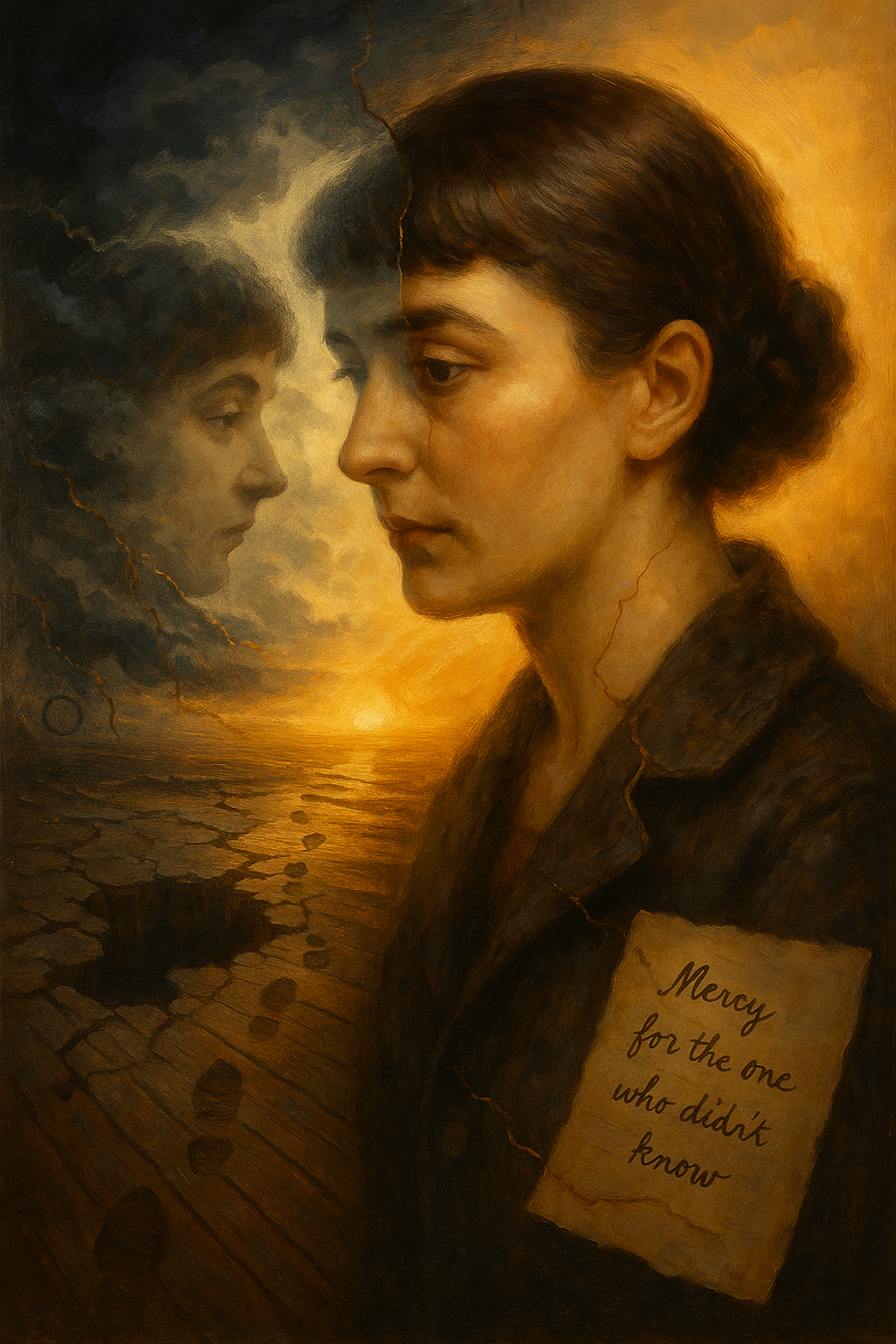
There are moments—quiet, piercing moments—when I look back and whisper to myself, “How could you not have known?” The tracks were everywhere. The chaos wasn’t subtle. The pain wasn’t discreet. And yet… I didn’t see. Or I couldn’t. Or I wouldn’t.

The truth is, I survived by not seeing.

Denial, I’ve come to understand, wasn’t my moral failure. It was my emotional shelter when the storm wouldn’t stop. It was how I stitched myself together when the narrative of my life couldn’t afford another tear. I didn’t consciously lie to myself—I did what I had to do to keep breathing in a world that made no sense.

In the family disease of alcoholism, denial isn’t a weakness. It’s a symptom. And often, it’s a sign of love distorted by trauma. Some of us deny the drinker has a problem. Others vilify the drinker so thoroughly we can’t see our own behaviors at all. Both are strategies of survival. Both are echoes of powerlessness.

But recovery has taught me another truth:
I am allowed to look back with mercy.

That former version of me—the one who overlooked the chaos, who blamed herself for everything or nothing, who flinched from truth as if it might bite—she was doing her best. That survival mode was sacred in its own way. It kept me alive long enough to arrive here, where something new could begin.

With Al-Anon’s tools, I no longer have to deny. I don’t have to contort reality into something palatable. I have the fellowship, the slogans, the Steps—and the grace—to face life as it actually is. I can let truth be truth without fearing it will break me.

And that’s where the shift happens:
I go from coping to living.
From hiding to healing.
From regret to redemption.

Because regret is a sinkhole. It swallows energy, hope, self-worth. And I’ve learned that I cannot build a single floorboard of new life on the foundation of “I should have known.”

Now I choose to build on compassion.
I build on courage.
I build on the quiet, daily decision to forgive the one who didn’t know—and to bless the one who’s learning now.