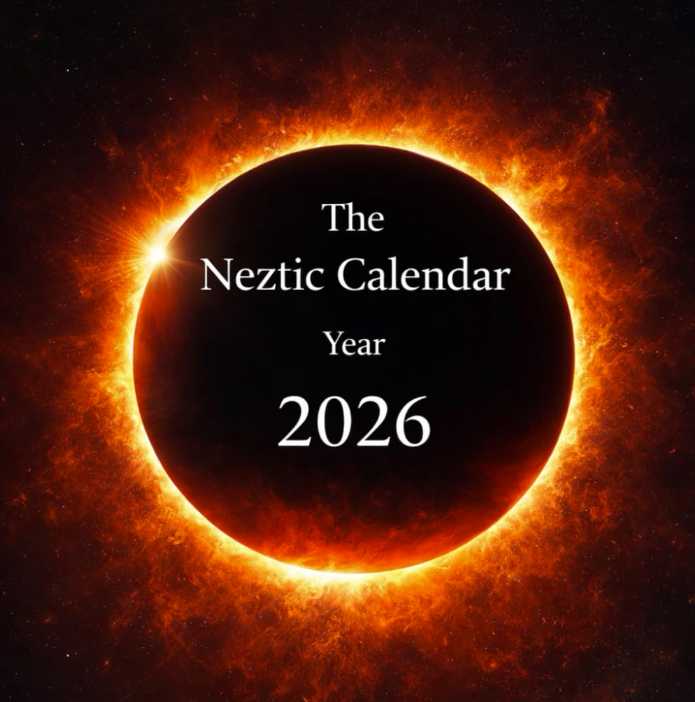
The Neztic Calendar: Year 2026 is a contemplative alternative to the modern Gregorian calendar—designed for readers who wish to experience time as a living, reflective structure rather than a purely mechanical one.
Rooted in seasonal cycles, solstices, equinoxes, and lunar rhythms, the Neztic Calendar invites the reader into a year-long practice of observation, meaning-making, and personal orientation. Each cycle is accompanied by thoughtful prose and symbolic imagery that encourage reflection without prescribing belief. This is not a religious calendar, nor a planner in the conventional sense, but a meditative companion that allows individuals to engage time through their own philosophical, spiritual, or psychological lens.
The calendar opens with a foundational orientation that explains its structure and intent, followed by a unique framing of the year anchored by a five-day (or six-day in leap years) Week of Infinities aligned with the Winter Solstice. Each lunar cycle thereafter is presented with spacious layouts, visual symbolism, and short reflective texts that explore themes such as endurance, balance, creativity, discipline, renewal, and inner responsibility.
Throughout the calendar, readers are encouraged to pause, record insights, and consider how natural rhythms intersect with personal experience. Blank pages and prompts are intentionally included to support journaling, quiet observation, and individual interpretation.
The Neztic Calendar is for:
Readers interested in alternative calendar systems
Those drawn to seasonal, lunar, or symbolic approaches to time
Individuals seeking a reflective or contemplative practice across the year
Artists, writers, thinkers, and spiritual explorers who value openness over doctrine
It is not a planner, a devotional, or a manifesto. It does not demand adherence, belief, or affiliation.
Instead, it offers a structured yet open framework—one that honors the dignity of the individual and the enduring human impulse to find meaning within time itself.
Printed in a 6 x 9 format, The Neztic Calendar: Year 2026 is intended to be lived with slowly, revisited often, and shaped by the reader’s own engagement.
I have recently been reminded that I am not responsible for the workings of the entire universe. An unexpected transfer at my job sent me to a new city, and I had only one week to find a place for my family to live. After three unsuccessful days, I grew frantic. I had been in Al-Anon long enough to know that I needed a meeting. Listening to others share about taking care of our responsibilities and trusting a Higher Power with the rest, I was reminded that I could only do my best. I could do the footwork, but I couldn’t force the house to appear. I had to let go and let God. On the last day of my search, I found a wonderful place to live.
Struggling and worrying didn’t help me to solve my problem. Doing my part and trusting my Higher Power with the rest did.
Today’s Reminder
What I can’t do, my Higher Power can. When I let go and let God, I am free to take risks and to make mistakes. I know that I am powerless over many things. Today I can take comfort in knowing that I don’t have the power to ruin God’s plans.
“Have courage for the great sorrows of life and patience for the small ones; and when you have laboriously accomplished your daily task, go to sleep in peace. God is awake.” ~ Victor Hugo
END OF QUOTE—————————————
NOTE: Victor Hugo (1802–1885) was a French writer, poet, playwright, and political activist, widely regarded as one of the greatest and most influential authors in the French language. His works helped shape 19th-century literature, politics, and art — bridging Romanticism, social justice, and the human condition.
Literary Achievements
Hugo’s writing spanned poetry, drama, and novels. His most famous works include:
Les Misérables (1862): A sweeping novel about redemption, justice, and the struggle of the poor in post-revolutionary France. Its central figure, Jean Valjean, became an archetype of moral transformation.
The Hunchback of Notre-Dame (Notre-Dame de Paris, 1831): A Gothic masterpiece that revived interest in medieval architecture and led to the preservation of the actual cathedral.
Poetry Collections: Such as Les Contemplations (1856) and La Légende des siècles (1859–1883), which reveal Hugo’s deep spiritual, philosophical, and moral preoccupations.
Political & Social Vision
Hugo was not just a writer but a moral force and reformer.
He opposed the death penalty, championed free education, and advocated for the poor.
As a political figure, he served in France’s National Assembly but went into exile for nearly 20 years after opposing Napoleon III’s coup (1851).
During exile on the island of Guernsey, he wrote some of his most powerful works, using literature as an instrument of resistance and hope.
Philosophy & Spirituality
Hugo saw the universe as a living expression of divine order and viewed humanity’s progress as a spiritual ascent toward enlightenment. He believed that love, conscience, and imagination were sacred forces driving human evolution — ideas visible in his blend of mysticism, humanism, and compassion for outcasts.
Legacy
Victor Hugo’s influence extended far beyond literature:
He’s entombed in the Panthéon in Paris, among France’s most revered figures.
He inspired social reforms in France.
His works continue to be adapted into stage and screen productions worldwide.
END OF NOTE—————————————
There’s a peculiar kind of arrogance hidden in panic. When the writer says they were “frantic” after three days, it isn’t just exhaustion; it’s the ego imagining itself to be the hinge on which destiny turns. The fear underneath is: if I don’t make this happen, no one will.
Recovery interrupts that illusion. It replaces the desperate driver with a humble traveler who can finally rest at the window and let the scenery pass. “Let go and let God” is not passivity — it’s the shift from anxious control to sacred cooperation.
There are two essential movements in my life: doing the footwork and surrendering the outcome. This is not a split between effort and faith but a rhythm between them — inhale and exhale, action and release.
The act of searching for housing was the doing, but the discovery of “a wonderful place to live” was the gift. Recovery trains us to stay available to both — discipline in motion, surrender in heart.
The line “I don’t have the power to ruin God’s plans” is one of those truths that frees the soul from self-importance. Once I know I cannot destroy the divine architecture, I am free to take risks, to experiment, even to fail. Mistakes become material for grace rather than evidence of doom. It’s as if the Higher Power whispers: “You are not fragile to Me. You are part of My experiment in courage.”
I felt my life was on hold. I wanted change; I expected it; I even tried to make it happen. But it was not within my power to make any of the changes I wanted. I was frustrated. I’m an action-taker, so I feel better when I am busy and industrious. There is a time to act. But in Al-Anon I learned that there is also a time to not act — to stop and wait. As my Sponsor puts it, “Don’t just do something, sit there.” How often I still find myself impatient with the pace of life. But today, when things don’t happen according to my schedule, I can accept that there may be a reason, and I can learn to adjust to what is. I may be experiencing great change on the inside even though I see little evidence on the outside. I can keep in mind that waiting time doesn’t have to mean wasted time. Even times of stillness have lessons to teach me.
Today’s Reminder
The invitation to live life fully is offered to me each day. I can accept the pace of change today, knowing it will bring both times of active involvement and periods of quiet waiting. I will let the surprises of the day open up before me.
“Besides the noble art of getting things done; there is the noble art of leaving things undone. The wisdom of life consists in the elimination of nonessentials.” ~ Lin Yutang
END OF QUOTE—————————————
NOTE:
Lin Yutang (1895 – 1976) was a Chinese scholar, writer, translator, and inventor whose life bridged the worlds of East and West with unusual humor and grace.
Intellectual & Literary Contributions
Humanistic Bridge: Lin sought to reconcile Chinese philosophy—particularly Taoism and Confucianism—with Western rationalism and Christian thought.
Major Works: His best-known books in English include My Country and My People (1935) and The Importance of Living (1937). Both helped Western readers appreciate Chinese culture not as exotic, but as profoundly human.
Style: Lin’s prose was witty, relaxed, and conversational, often celebrating the art of idleness, simplicity, and joy in daily life—virtues he found in Taoist and Confucian traditions.
Cultural & Linguistic Influence
Language Innovator: He designed a Chinese typewriter and an early Chinese word processor, motivated by his fascination with the written word and cross-cultural communication.
Translator & Mediator: Lin translated works of Chinese literature into English and vice versa, introducing Western readers to classical Chinese poets and philosophers.
Philosophy & Personality
Lin advocated what he called “the wisdom of the East with the comfort of the West.” He resisted both political dogma and missionary rigidity, emphasizing individual freedom, humor, and compassion. He once quipped that the ideal person is “half saint, half rascal.”
The Civil War (1927–1949)
The war was fought between the Chinese Nationalist Party (Kuomintang, or KMT) led by Chiang Kai-shek, and the Chinese Communist Party (CCP) led by Mao Zedong.
It began intermittently in the late 1920s, paused during the Japanese invasion (1937–1945), and resumed in full force after World War II.
The Final Conquest (1948–1949)
The Communists gained momentum in 1948, winning decisive battles such as Huaihai, Liaoshen, and Pingjin.
By October 1, 1949, Mao Zedong stood atop Tiananmen Gate in Beijing and proclaimed the founding of the People’s Republic of China (PRC).
The Nationalists retreated to Taiwan, where they maintained the Republic of China (ROC) government.
Aftermath
Mainland China came under Communist control, marking the end of centuries of dynastic and nationalist rule. Communism, as a Western brainchild, squashed, once more, the Chinese cultural empire.
Taiwan, under Chiang Kai-shek, remained outside Communist control and became a separate political entity — a division that persists to this day.
Early Japanese Encroachments (1931–1936)
1931 – Invasion of Manchuria: Japan staged the Mukden Incident as a pretext to seize Manchuria, creating the puppet state of Manchukuo under the deposed Qing emperor Puyi.
1933 – Great Wall Battles: Japan extended its control to Jehol and parts of northern China.
1935–1936 – Northern China Buffer Zones: Japan pressured the Chinese Nationalist government into demilitarizing several northern provinces, effectively turning them into Japanese spheres of influence.
Full-Scale War with Japan (1937–1945)
July 7, 1937 – Marco Polo Bridge Incident: A skirmish near Beijing spiraled into a full invasion.
1937–1938 – Rapid Conquest: Japan captured major cities including Beijing, Shanghai, and Nanjing.
The Nanjing Massacre (Dec 1937 – early 1938) saw mass killings and atrocities that remain one of the darkest chapters in modern history.
1938–1940 – Occupation and Resistance: Japan controlled most coastal and eastern China, but Chinese Nationalist and Communist forces continued guerrilla resistance inland.
1941–1945 – Integration into World War II: After Japan’s attack on Pearl Harbor, the Sino-Japanese conflict became part of the wider Pacific War. The U.S., Britain, and others began supporting Chiang Kai-shek’s Nationalist government.
1945 – Defeat of Japan: Japan’s surrender in August 1945 ended its occupation of China.
Aftermath
The war left 20 to 25 million Chinese dead, cities destroyed, and China internally divided.
The temporary alliance between the Nationalists and Communists collapsed soon after the Japanese defeat, reigniting the Chinese Civil War, which the Communists ultimately won in 1949.
After the Communist takeover of China in 1949, Lin Yutang—like many intellectuals who valued freedom of expression—did not remain under Communist rule. His postwar life reflected his lifelong balancing act between East and West. Here’s the sequence:
Hong Kong (Late 1940s – Early 1950s)
When the Communists seized mainland China, Lin moved to Hong Kong, then still under British rule.
There he resumed writing in both English and Chinese, publishing essays critical of totalitarianism and advocating personal liberty.
His skepticism toward ideological rigidity—both Communist and Western—kept him at odds with dominant political movements.
United States (1950s–1960s)
Lin spent significant time in the United States, teaching, lecturing, and writing.
He was already well known in the U.S. because of his prewar bestsellers My Country and My People and The Importance of Living.
He became a U.S. citizen in 1948, just before the Communist victory in China.
He lived primarily in New York, where he continued to write in English and remain an informal cultural ambassador for Chinese humanism.
Taiwan (1960s–1976)
In the 1960s, Lin accepted invitations from Chiang Kai-shek’s Republic of China government to work and live in Taiwan.
He founded the Chinese Cultural Renaissance Movement, seeking to preserve traditional Chinese culture in the face of the Communist “Cultural Revolution” on the mainland.
He established his residence in Yangmingshan, near Taipei—a quiet, mountainous area. His home there is now the Lin Yutang House Museum.
Death and Legacy
Lin Yutang died in 1976 in Hong Kong, the same year Mao Zedong died on the mainland.
His life came full circle between cultures and ideologies, remaining loyal to neither nationalism nor communism, but to a deeply humane philosophy that saw freedom, humor, and compassion as the essence of civilization.
END OF NOTE—————————————
There was a season when waiting felt like punishment — a holding pattern before real life resumed. I mistook stillness for failure. In those times, I would pace the cage of my own impatience, confusing motion with meaning. Al-Anon has shown me a gentler rhythm: the truth that spiritual change germinates in the soil of surrender.
When I stop forcing outcomes, I start hearing the subtle movements within me. The Spirit does not rush to satisfy my calendar. It ripens me. While my eyes search for proof of progress, my roots may be deepening unseen. I learn, over and over, that waiting is not wasted — it is womb time.
To live fully means to embrace both the seed and the sprout, both the silence and the song. There are days for decisive action, and days when the only act is to breathe and trust the unseen choreography of grace.
Today I will let the day unfold at its own pace. I will release the tyranny of my timetable and let life reveal its timing — not mine.
 Daily Reprieve
You must be logged in to post a comment.