Archive for books

Endigar 1068

Posted in Uncategorized with tags , , , , , , , , , , , , on October 22, 2025 by endigar

From Courage to Change of Oct 19:

I have recently been reminded that I am not responsible for the workings of the entire universe. An unexpected transfer at my job sent me to a new city, and I had only one week to find a place for my family to live. After three unsuccessful days, I grew frantic. I had been in Al-Anon long enough to know that I needed a meeting. Listening to others share about taking care of our responsibilities and trusting a Higher Power with the rest, I was reminded that I could only do my best. I could do the footwork, but I couldn’t force the house to appear. I had to let go and let God. On the last day of my search, I found a wonderful place to live.

Struggling and worrying didn’t help me to solve my problem. Doing my part and trusting my Higher Power with the rest did.

Today’s Reminder

What I can’t do, my Higher Power can. When I let go and let God, I am free to take risks and to make mistakes. I know that I am powerless over many things. Today I can take comfort in knowing that I don’t have the power to ruin God’s plans.

“Have courage for the great sorrows of life and patience for the small ones; and when you have laboriously accomplished your daily task, go to sleep in peace. God is awake.” ~ Victor Hugo

END OF QUOTE—————————————

NOTE: Victor Hugo (1802–1885) was a French writer, poet, playwright, and political activist, widely regarded as one of the greatest and most influential authors in the French language. His works helped shape 19th-century literature, politics, and art — bridging Romanticism, social justice, and the human condition.

Literary Achievements

Hugo’s writing spanned poetry, drama, and novels. His most famous works include:

  • Les Misérables (1862): A sweeping novel about redemption, justice, and the struggle of the poor in post-revolutionary France. Its central figure, Jean Valjean, became an archetype of moral transformation.
  • The Hunchback of Notre-Dame (Notre-Dame de Paris, 1831): A Gothic masterpiece that revived interest in medieval architecture and led to the preservation of the actual cathedral.
  • Poetry Collections: Such as Les Contemplations (1856) and La Légende des siècles (1859–1883), which reveal Hugo’s deep spiritual, philosophical, and moral preoccupations.

Political & Social Vision

Hugo was not just a writer but a moral force and reformer.

  • He opposed the death penalty, championed free education, and advocated for the poor.
  • As a political figure, he served in France’s National Assembly but went into exile for nearly 20 years after opposing Napoleon III’s coup (1851).
  • During exile on the island of Guernsey, he wrote some of his most powerful works, using literature as an instrument of resistance and hope.

Philosophy & Spirituality

Hugo saw the universe as a living expression of divine order and viewed humanity’s progress as a spiritual ascent toward enlightenment. He believed that love, conscience, and imagination were sacred forces driving human evolution — ideas visible in his blend of mysticism, humanism, and compassion for outcasts.

Legacy

Victor Hugo’s influence extended far beyond literature:

He’s entombed in the Panthéon in Paris, among France’s most revered figures.

He inspired social reforms in France.

His works continue to be adapted into stage and screen productions worldwide.

END OF NOTE—————————————

There’s a peculiar kind of arrogance hidden in panic. When the writer says they were “frantic” after three days, it isn’t just exhaustion; it’s the ego imagining itself to be the hinge on which destiny turns. The fear underneath is: if I don’t make this happen, no one will.

Recovery interrupts that illusion. It replaces the desperate driver with a humble traveler who can finally rest at the window and let the scenery pass. “Let go and let God” is not passivity — it’s the shift from anxious control to sacred cooperation.

There are two essential movements in my life: doing the footwork and surrendering the outcome. This is not a split between effort and faith but a rhythm between them — inhale and exhale, action and release.

The act of searching for housing was the doing, but the discovery of “a wonderful place to live” was the gift. Recovery trains us to stay available to both — discipline in motion, surrender in heart.

The line “I don’t have the power to ruin God’s plans” is one of those truths that frees the soul from self-importance. Once I know I cannot destroy the divine architecture, I am free to take risks, to experiment, even to fail. Mistakes become material for grace rather than evidence of doom.
It’s as if the Higher Power whispers: “You are not fragile to Me. You are part of My experiment in courage.”
Endigar 1009

Posted in Uncategorized with tags , , , , , , , , , , on July 18, 2025 by endigar

From Courage to Change of Aug 26:

Looking back, I have often reproached myself, “How could you not have known what was happening?” Alcoholism left messy tracks all over my life, yet I didn’t see them. How could that be?

Denial is one of the chief symptoms of this family disease of alcoholism. Some of us deny that the drinker has a problem; others are all too willing to blame him or her for all our problems, denying our own participation. Why? Because we alone can’t defeat this disease, so we invent ways to survive the constant crises, broken promises, lost hopes, and embarrassments. One way to cope is to deny the unpleasant or terrifying reality.

In Al-Anon we learn more productive ways in which to cope with alcoholism, ways that don’t cost so much in loss of self. With the support of other members, and with tools and principles that offer direction, we become able to face what is really going on. We go beyond mere survival and begin to live again.

Today’s Reminder

At all times, I have done the best I was able to do. If my only way to cope with a difficult situation was to deny it, I can look back with compassion to that person who saw no better option at the time. I can forgive myself and count my blessings for having come so far since then.

“Regret is an appalling waste of energy; you can’t build on it; it’s only good for wallowing in.” ~ Katherine Mansfield

END OF QUOTE—————————————

Katherine Mansfield (1888–1923) was a pioneering modernist writer from New Zealand, best known for her short stories that delicately explore human psychology, fleeting moments, and the subtle complexities of everyday life. Her real name was Kathleen Mansfield Beauchamp.

Key Facts:

  • Birth: October 14, 1888, in Wellington, New Zealand
  • Death: January 9, 1923, in Fontainebleau, France (from tuberculosis at age 34)
  • Genre: Short fiction, modernist literature
  • Notable Themes: Loneliness, class divisions, childhood, epiphany, fragility of relationships, mortality

Major Works:

  1. “The Garden Party” – A story that juxtaposes upper-class privilege with the reality of death, as seen through the eyes of a young girl.
  2. “The Daughters of the Late Colonel” – A psychological portrait of two sisters paralyzed by the memory of their domineering father.
  3. “Miss Brill” – A poignant tale of a lonely woman who creates fantasies to escape her isolation.
  4. “Prelude” – A semi-autobiographical story about a family’s move to the countryside, reflecting Mansfield’s own New Zealand upbringing.

Legacy:

Although she died young, Mansfield left a profound impact on 20th-century literature. Her brief life was marked by illness, emotional intensity, and a relentless pursuit of literary expression. Her personal letters and journals also reveal a deeply introspective, intellectually restless soul.

END OF NOTE—————————————

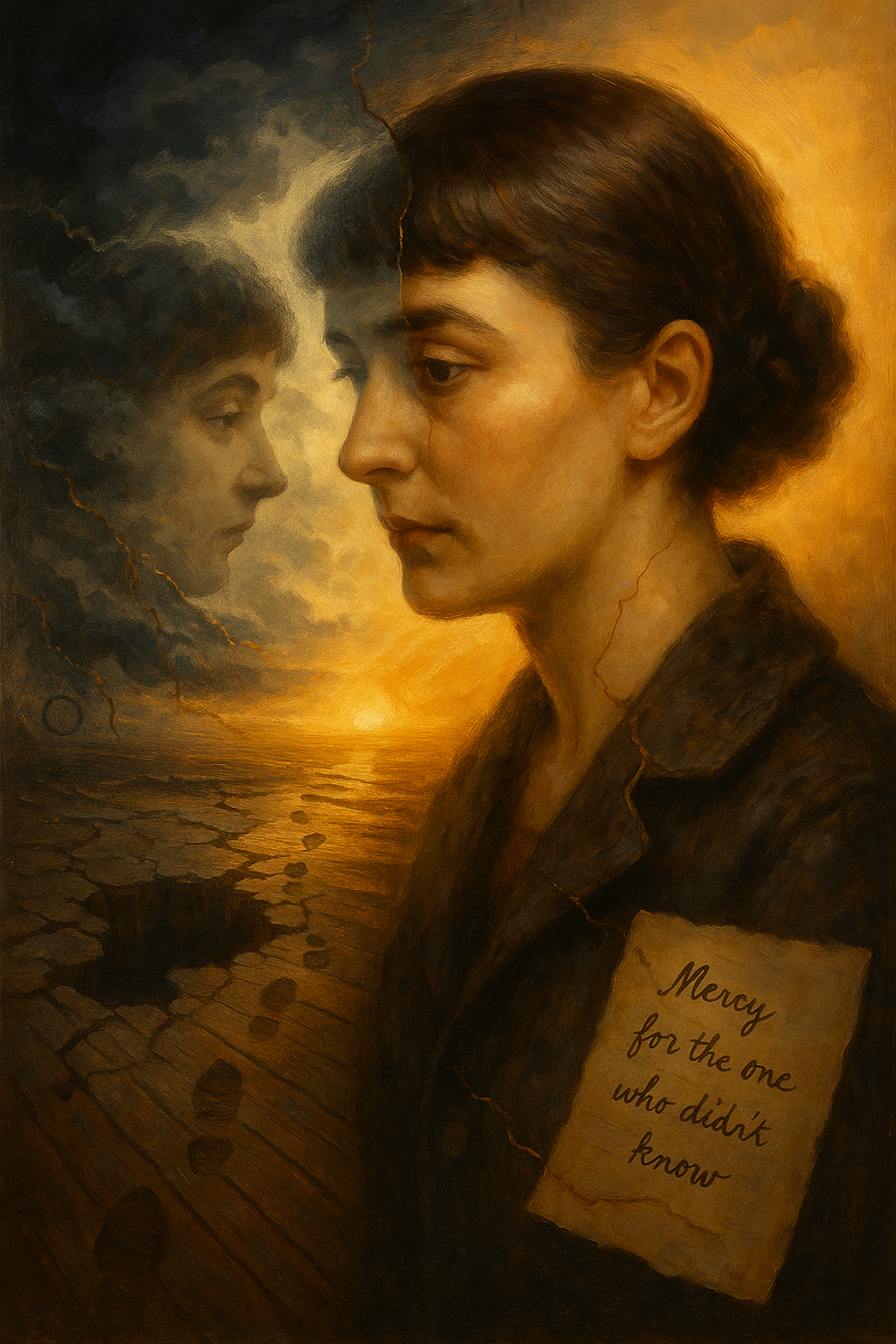
There are moments—quiet, piercing moments—when I look back and whisper to myself, “How could you not have known?” The tracks were everywhere. The chaos wasn’t subtle. The pain wasn’t discreet. And yet… I didn’t see. Or I couldn’t. Or I wouldn’t.

The truth is, I survived by not seeing.

Denial, I’ve come to understand, wasn’t my moral failure. It was my emotional shelter when the storm wouldn’t stop. It was how I stitched myself together when the narrative of my life couldn’t afford another tear. I didn’t consciously lie to myself—I did what I had to do to keep breathing in a world that made no sense.

In the family disease of alcoholism, denial isn’t a weakness. It’s a symptom. And often, it’s a sign of love distorted by trauma. Some of us deny the drinker has a problem. Others vilify the drinker so thoroughly we can’t see our own behaviors at all. Both are strategies of survival. Both are echoes of powerlessness.

But recovery has taught me another truth:
I am allowed to look back with mercy.

That former version of me—the one who overlooked the chaos, who blamed herself for everything or nothing, who flinched from truth as if it might bite—she was doing her best. That survival mode was sacred in its own way. It kept me alive long enough to arrive here, where something new could begin.

With Al-Anon’s tools, I no longer have to deny. I don’t have to contort reality into something palatable. I have the fellowship, the slogans, the Steps—and the grace—to face life as it actually is. I can let truth be truth without fearing it will break me.

And that’s where the shift happens:
I go from coping to living.
From hiding to healing.
From regret to redemption.

Because regret is a sinkhole. It swallows energy, hope, self-worth. And I’ve learned that I cannot build a single floorboard of new life on the foundation of “I should have known.”

Now I choose to build on compassion.
I build on courage.
I build on the quiet, daily decision to forgive the one who didn’t know—and to bless the one who’s learning now.