Archive for May 26, 2025

Endigar 960 ~ Step Three

Posted in Uncategorized with tags , , , , , , , , , on May 26, 2025 by endigar

Step Three: “Made a decision to turn our will and our lives over to the care of God as we understood Him.”

3rd Step Principle: Our free will must be activated in trust for our Higher Power to channel Its creative life force through us. (Principles after the First Step are constructed from personal reflection and acceptance. Use my version or formulate your own.)

AA Extracted Value: Faith

ACA Extracted Values: Willingness & Accepting Help

Other Extracted Values: Spirituality

I used to think surrender meant weakness—like giving up, backing down, or losing control. But Step Three isn’t about giving up—it’s about handing over. Not in fear, but in faith. It’s the first time I truly tested the idea that something greater than me might actually want what’s best for me.

This step asked me to decide—not to fully understand, not to perfect a belief system, not even to feel spiritual, but simply to activate my free will in the direction of trust. That was enough to begin.

My will had been running the show for so long—driven by fear, ego, shame, and the desperate need to protect myself from pain. I thought I was strong because I was in charge. But what I really was… was exhausted. I wasn’t free. I was trapped in my own survival mechanisms. Step Three invited me to consider another possibility: that there might be a Life Force, a God, a Higher Power—not only bigger than me, but also kinder than I could imagine.

The principle behind this step hits home: Our free will must be activated in trust for our Higher Power to channel Its creative life force through us. That truth rearranged something inside me. My will isn’t the problem—it’s the isolation in which I tried to use it that caused the pain. Step Three offers a path where my will doesn’t have to be erased, only aligned. That means I still get to show up. I still get to choose. But now, my choices are made in partnership, not panic.

Faith is the AA value, and it’s the word that probably scared me the most when I got here. It sounded abstract, soft, maybe even naive. But in practice, faith became something simple: a willingness to keep walking even when I didn’t know the way.

In ACA, the values extracted are Willingness and Accepting Help—both of which were muscles I hadn’t used in years. Willingness meant being open to change, to guidance, to not knowing. Accepting help meant admitting I couldn’t heal alone—and trusting that help wouldn’t humiliate me. That felt revolutionary.

And Spirituality—the value that quietly hums beneath all of this—isn’t about religion or doctrine. It’s about connection. It’s about believing that my life has meaning beyond my mistakes. That there is something alive in me that’s worth protecting, nurturing, and guiding.

Step Three is a decision—a quiet but powerful one. A shift from fear to faith. From control to connection. From surviving alone to living in relationship with a Source greater than myself. I don’t always do it perfectly. But every time I choose trust over terror, even for a moment, something holy happens.

And I keep deciding. One day, one step, one surrender at a time.
Endigar 959

Posted in Uncategorized with tags , , , , , , , , , , , on May 26, 2025 by endigar

From Courage to Change of Jul 19:

Al-Anon taught me the difference between walls and boundaries. Walls are solid and rigid; they keep others out, and they keep me trapped inside. Boundaries are flexible, changeable, removeable, so it’s up to me how open or closed I’ll be at any given time. They let me decide what behavior is acceptable, not only from others but from myself. Today I can say, “No,” with love instead of hostility, so it doesn’t put an end to my relationships.

I’ve learned about boundaries from Al-Anon’s own set of boundaries: the Twelve Traditions. Although their purpose is to protect Al-Anon, they actually encourage the growth of the fellowship. This is true of my personal boundaries as well. As I decide what is and isn’t acceptable for me, I learn to live protected without walls.

Today’s Reminder

Do my defenses keep me safe, or do they isolate me? Today I can love myself enough to look for healthier ways to protect myself, ways that don’t close everyone out.

“People are lonely because they build walls instead of bridges.” ~ Joseph Fort Newton

END OF QUOTE—————————————

Note: Joseph Fort Newton (1880–1950) was an American Protestant minister and a prominent Masonic author. Newton authored a number of Masonic books, including his best-known works, The Builders, published in 1914, and The Men’s House, published in 1923. Does anyone else sense the irony of a Mason speaking on the problems with “building walls” while finding fulfillment in the closed and often secretive society of Freemasonry? Hmm…

Perhaps there is some validity to Oscar Wilde’s words;  “Man is least himself when he talks in his own person. Give him a mask, and he will tell you the truth.”

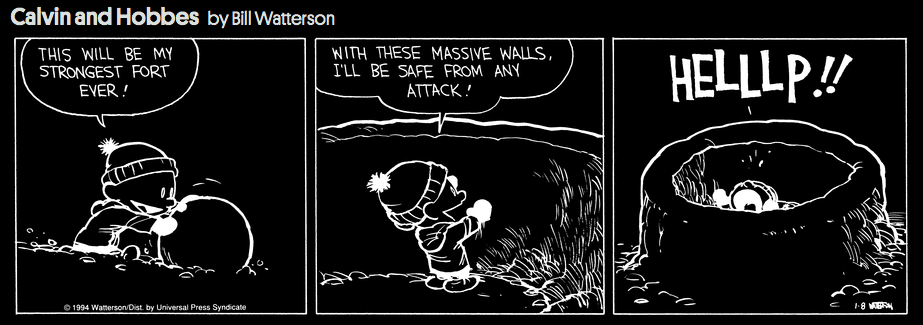
How often have I desire to build a safe fortress and found I was locked into a self-made prison. There was a time when I thought strength meant building walls—thick ones. Emotional, relational, even spiritual walls. I thought they would keep me safe. But what they really did was isolate me, cut me off not just from others but from myself. I couldn’t breathe behind those bricks. Couldn’t feel. Couldn’t trust. And I mistook that numbness for safety.

Al-Anon helped me see another way. It didn’t tear the walls down for me—it showed me the door. The path to boundaries instead of barricades. I can see that boundaries are different. They’re alive. They breathe with me. They give me the dignity of choice: how open I want to be, how much to let in, how much to let go. Boundaries don’t shut down connection; they make it possible.

Learning to say “No” without rage or shame has changed my relationships—and not just with others. My relationship with myself has opened. I don’t have to punish others to protect myself, and I don’t have to punish myself to keep others close. That’s grace in action.

I agree that there is hard earned wisdom in the Twelve Traditions. They can model what healthy boundaries look like in community. They’re not there to limit love—they’re there to hold it. In the same way, when I honor my personal boundaries, I’m not making myself smaller. I’m making space for who I really am to grow. I’m not building a fortress. I’m building a home.

Today, I live protected—not walled in.