Endigar 1013
From Courage to Change of Aug 30:
Normally my Sponsor would recommend a gratitude list when I felt low, but one day, when I complained about a family situation, he suggested that I list all the things I was unhappy about. Several days later my depression had passed, and when I told my Sponsor about the terrific day I was having, he suggested a gratitude list. He thought it might help me to refer to it the next time I felt blue. That made sense to me, so I complied.
When I went to put this new list in the drawer where I keep my papers, I noticed the earlier list and read it once more. To my surprise, my list of grievances was almost identical to my gratitude list — the same people, same house, same life. Nothing about my circumstances had changed except the way I felt about them. For the first time I truly understood how much my attitude dictates the way I experience the world.
Today’s Reminder
Today I recognize how powerful my mind can be. I can’t always feel good, and I have no interest in whitewashing my difficulties by pasting a smile on my face. But I can recognize that I am constantly making choices about how I perceive my world. With the help of Al- Anon and my friends in the fellowship, I can make those choices more consciously and more actively than ever before.
“Change your thoughts and you change your world.” – Norman Vincent Peale
END OF QUOTE—————————————
Norman Vincent Peale (1898–1993) was a Christian minister, author, and influential figure in American religious life, best known for popularizing the concept of “positive thinking” through his landmark 1952 book, The Power of Positive Thinking. A Methodist-turned-Reformed pastor, Peale served for more than half a century at Marble Collegiate Church in New York City.
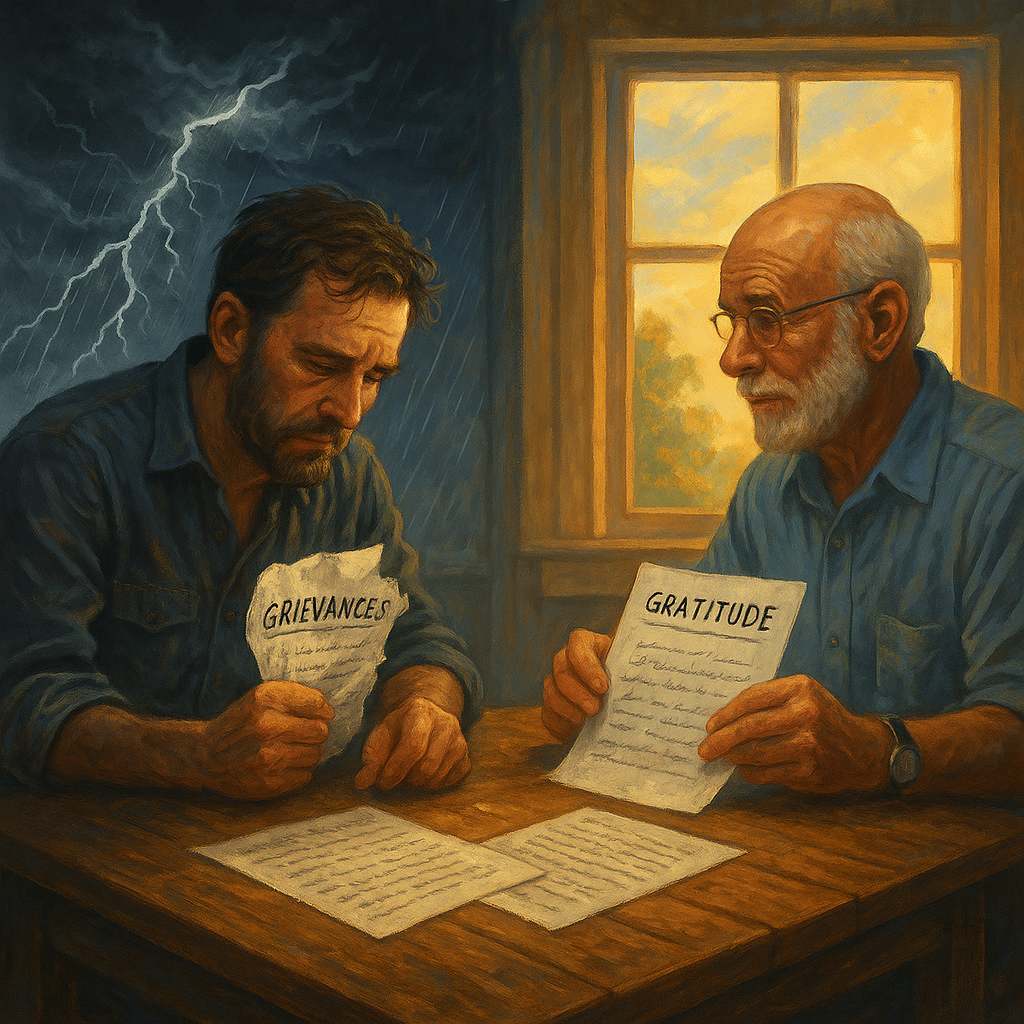
There was a time in my life when the storm inside me felt louder than any peace I could muster. I’d sit with my Sponsor and bring him the scraps of my spirit—my grief, my discontent, my twisted thoughts—and he’d thoughtfully hand me back a tool. Sometimes it was a gratitude list, sometimes a question, and once—he told me that in my observations, my journaling, look for the patterns in my pain and resentment.
I have indeed found that my gratitude lists and my painful patterns dance in the same neighborhoods. It is true that sometimes, it is a matter of perspective.
This is where the real work of the program lives for me: not just in inventorying my defects, but in inventorying my perceptions. My attitude isn’t just the lens through which I see the world—it’s often the author of my experience. The same facts can tell wildly different stories depending on whether I’m rooted in fear or in faith.
I no longer see gratitude as a forced smile or a way to gaslight myself into feeling better. I see it as a recalibration of my spiritual compass. It reminds me that the story isn’t over, and I get to choose the tone of the next chapter. I still allow space for grief, anger, confusion—but I don’t build my home there. I let those feelings pass through like weather. And when I forget, my lists are there. Both of them. To remind me how much power I truly hold—not over people or outcomes, but over my own way of seeing.
 Daily Reprieve
Leave a comment