Endigar 1082
From Courage to Change of Nov 01:
Sometimes a horse refuses to obey the rider’s command and races out of control. My thoughts can do this too, when I frantically try, over and over, to solve a difficult problem. Riding lessons have taught me not to continually repeat a command louder, but to stop the horse, get his attention, and begin again.
Likewise, when my thoughts race out of control, I need to stop. I may do this by breathing deeply and looking at my surroundings. It can help to replace the obsessive thoughts with something positive, such as an Al-Anon slogan, the Serenity Prayer, or another comforting topic that has nothing to do with my problem.
Later I may want to think about the problem again in a more serene way with the help of an Al-Anon friend or Sponsor. When I put some distance between myself and obsessive thinking, I can better look at my situation without losing all control.
Today’s Reminder
Sometimes I have to let go of a problem before I can find a solution. My racing thoughts may be making so much noise that I can’t hear the guidance my inner voice is offering. Quieting the noise is a skill I can learn with practice. At first I may have to still my thoughts again and again, but in Al-Anon I learn that practice makes progress, one minute, one thought at a time.
“All men’s miseries derive from not being able to sit quiet in a room alone.”
~ Blaise Pascal
END OF QUOTE—————————————
NOTE: Blaise Pascal (1623–1662) was one of those rare minds whose work reshaped multiple fields at once—mathematics, physics, philosophy, theology, and even the design of early computers. He was a French mathematician, physicist, inventor, writer, and Christian thinker.
His Core Philosophical Insight
Pascal saw humanity as caught between two infinities:
- Our misery and smallness in the vast universe
- Our grandeur in being able to recognize that smallness
“Man is a reed, the weakest in nature, but he is a thinking reed.”
We are fragile—but aware.
Our suffering is real—but so is our capacity for meaning.
END OF NOTE—————————————
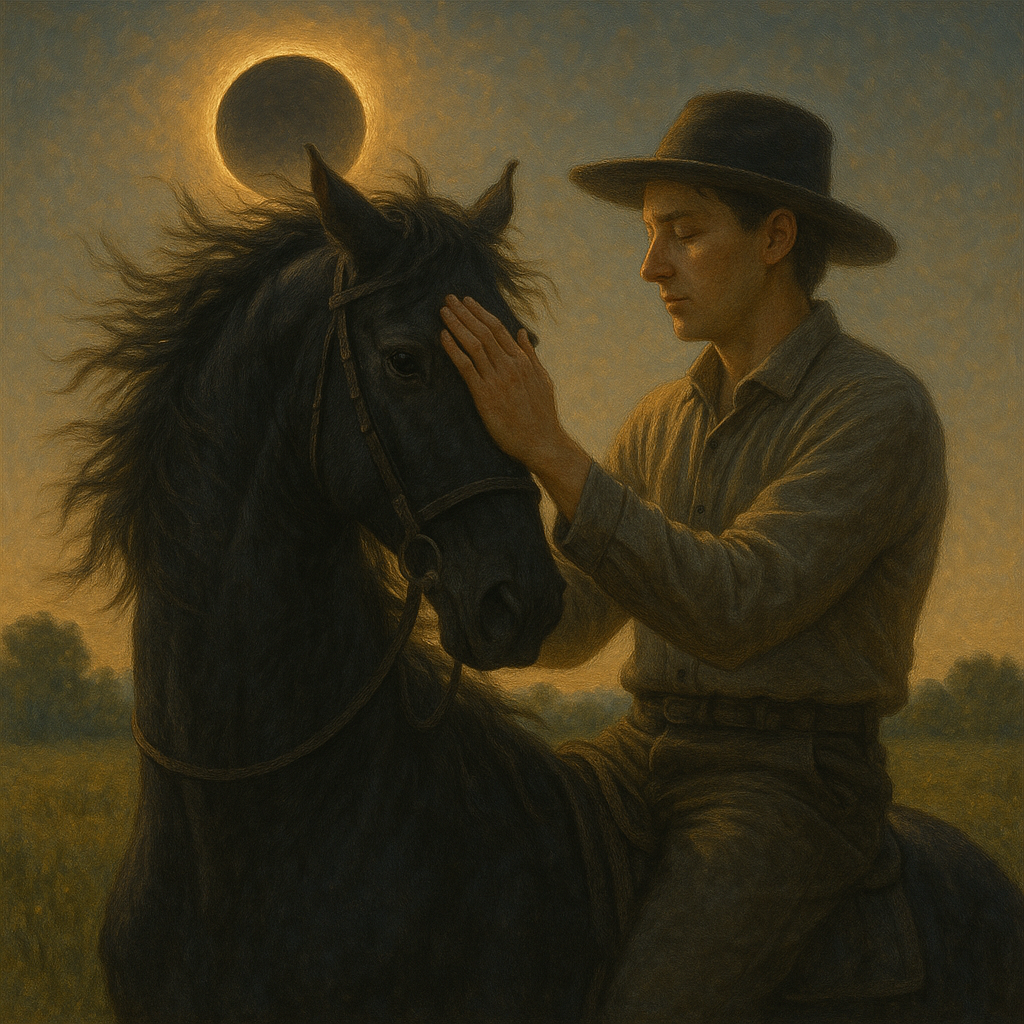
There is a subtle violence in the mind when it begins to gallop.
It is not malicious — it is frightened.
A horse that bolts is not trying to betray the rider.
It is trying to survive something it feels.
It runs because something in its body believes running is the only safety left.
Our thoughts do the same.
When fear, shame, or unresolved tension rises, the mind tries to outrun it —
solve faster, think harder, rehearse the catastrophe in advance
so we will not be caught off guard.
But like the horse, the mind cannot be forced into calm by force.
Trying to “think louder” only tightens the panic.
So, the recovery wisdom here is not about domination, but reconnection.
Not: Control the mind.
But: Return to the reins.
The stopping is the spiritual moment.
The breath is the stable.
The stillness is the hand on the horse’s neck.
When we interrupt the runaway motion —
even for a breath —
we step back into our own body,
our own agency,
our own present moment.
And in that space, something quieter — something older — begins to speak.
Not the fear.
Not the frantic future.
But the inner voice that does not shout.
This is the voice that says guidance cannot be heard over racing thoughts.
Because God whispers.
And whispers are not heard when the mind is sprinting.
“Sometimes I have to let go of a problem before I can find the solution” —
this is not resignation.
It is humility in its most functional form:
I cannot think my way into peace,
but I may be able to breathe my way into clarity.
And clarity makes room for truth.
Sometimes we need to stand still long enough for the horse to remember that it is safe.
 Daily Reprieve
Leave a comment