Endigar 1028
From Courage to Change of Sep 13:
Each moment of this day is precious, and I will make it count. I will use this time to enrich my life and to improve my relationship with my Higher Power, other people, and myself. Each of the Twelve Steps can help me to pursue this goal regardless of my circumstances. Meetings, Al-Anon telephone calls, and Al-Anon literature all help me to apply the Steps to what is happening in my life here and now. In this moment, I can make a positive change.
Perhaps I will think of time as a special kind of checking account. I have twenty-four hours to spend. By putting Al-Anon’s principles to work in my life today, I am choosing to use these hours to grow, enjoy, and improve. I even have an opportunity to learn from my mistakes, since a brand new twenty-four hours can begin at any moment.
Today’s Reminder
This day offers me a chance to make a new start at living. How can I make the best use of it?
“We start with gifts. Merit comes from what we make of them.”
– Jean Toomer
END OF QUOTE—————————————
Note: Jean Toomer (1894–1967) was an American writer, poet, and thinker best known for his 1923 book Cane, a groundbreaking work of modernist literature that blends poetry, prose, and drama.
Background
- He was born in Washington, D.C., into a mixed-race family and grew up moving between Negro and Caucasian communities, which deeply shaped his outlook on identity.
- Toomer resisted being categorized strictly by race. Though associated with the Harlem Renaissance, he did not fully embrace the label of “Negro writer,” instead seeing himself as an American author exploring universal human themes.
Cane (1923)
- Cane is his most famous work, often considered one of the masterpieces of the Harlem Renaissance.
- It weaves together vignettes, poems, and sketches of Negro life in both the rural South and the urban North, portraying themes of identity, sexuality, spirituality, and the Great Migration.
- Its experimental style—mixing lyricism, folklore, and modernist fragmentation—made it unique for its time.
Later Life
- After Cane, Toomer never published another major literary work, though he wrote essays, plays, and unpublished manuscripts.
- He became involved with spiritual movements, particularly the teachings of the mystic George Gurdjieff, which influenced his later writings and personal philosophy.
- He married Margery Latimer, a white writer, in 1931, which was controversial in the U.S. due to anti-miscegenation attitudes and laws.
- Much of his later life was devoted to spiritual seeking and private writing rather than public literary activity.
Legacy
He is remembered as a bridge figure between different identities, artistic movements, and cultural currents of early 20th-century America.
Though he distanced himself from being labeled a “Black writer,” his desire was ignored and now his work—especially Cane—is recognized as central to African American literature and modernist experimentation. It is more the work of American individualism than racial Darwinist competition.
END OF NOTE—————————————
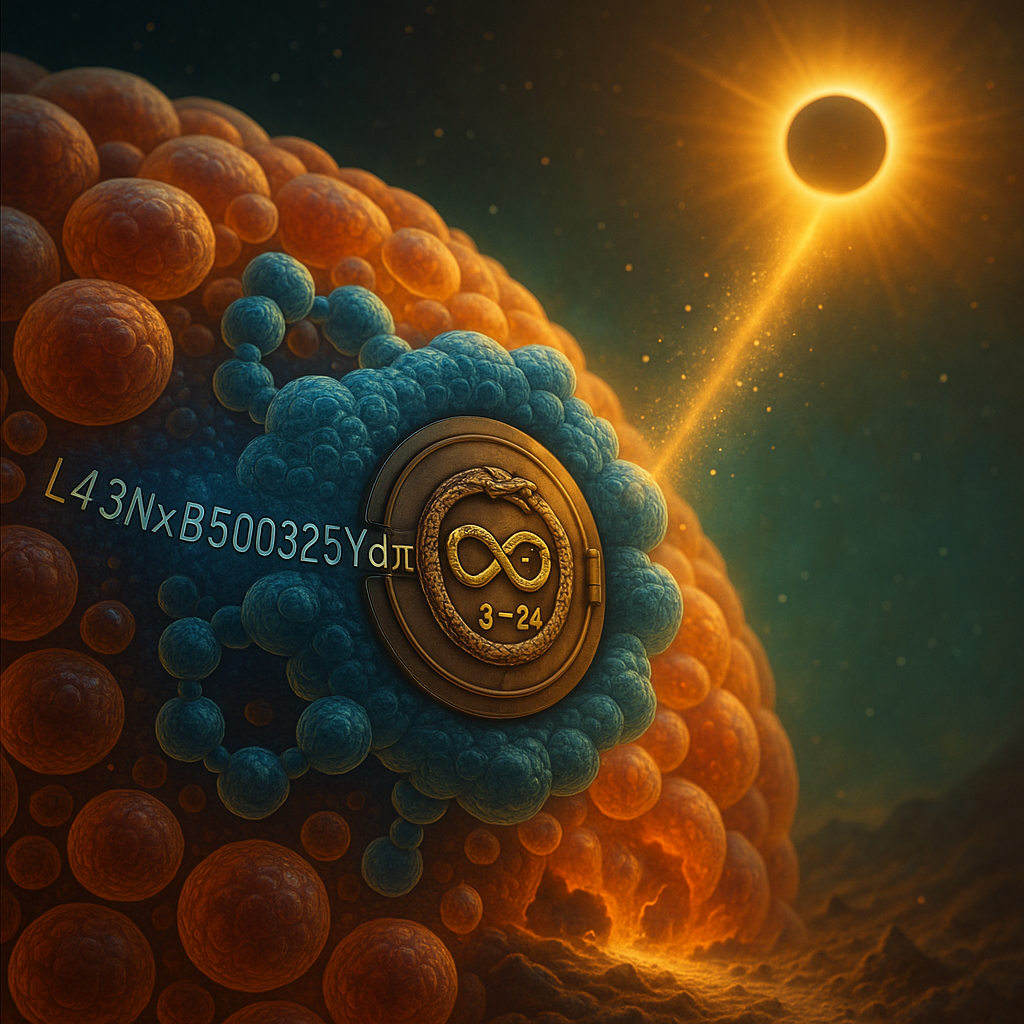
There are roughly 37 trillion cells in my body. Within just one of those cells resides a molecule: L43NxB500325Ydπ. And within that molecule, housed deep inside a neutron, lies the Quantum Infinity Vault. Its emblem is the macro/micro infinity ouroboros — the eternal cycle of vast and small, endlessly entwined.
The code to open this vault is 23(3), which summons 24. When opened, the vault releases an inexhaustible supply of positive selfishness (ps). A pulsating dose of ps moves through my body each day. If I fail to use it within the 24-hour span of Earth’s rotation, it decays into the maggot-filled manna of fearful isolation. But if I spend it freely — if I feed the hungry Sun — it transforms into connection, filling my day with living tools of recovery.
For when I have enough ps to proclaim, “I want to live” or “I want to recreate my life”, then I also find:
- the courage to connect,
- the humility to listen to other versions of success, and
- the deep, restoring respiration of serenity.
Long live molecule L43NxB500325Ydπ!
 Daily Reprieve
Leave a comment