Endigar 1009
From Courage to Change of Aug 26:
Looking back, I have often reproached myself, “How could you not have known what was happening?” Alcoholism left messy tracks all over my life, yet I didn’t see them. How could that be?
Denial is one of the chief symptoms of this family disease of alcoholism. Some of us deny that the drinker has a problem; others are all too willing to blame him or her for all our problems, denying our own participation. Why? Because we alone can’t defeat this disease, so we invent ways to survive the constant crises, broken promises, lost hopes, and embarrassments. One way to cope is to deny the unpleasant or terrifying reality.
In Al-Anon we learn more productive ways in which to cope with alcoholism, ways that don’t cost so much in loss of self. With the support of other members, and with tools and principles that offer direction, we become able to face what is really going on. We go beyond mere survival and begin to live again.
Today’s Reminder
At all times, I have done the best I was able to do. If my only way to cope with a difficult situation was to deny it, I can look back with compassion to that person who saw no better option at the time. I can forgive myself and count my blessings for having come so far since then.
“Regret is an appalling waste of energy; you can’t build on it; it’s only good for wallowing in.” ~ Katherine Mansfield
END OF QUOTE—————————————
Katherine Mansfield (1888–1923) was a pioneering modernist writer from New Zealand, best known for her short stories that delicately explore human psychology, fleeting moments, and the subtle complexities of everyday life. Her real name was Kathleen Mansfield Beauchamp.
Key Facts:
- Birth: October 14, 1888, in Wellington, New Zealand
- Death: January 9, 1923, in Fontainebleau, France (from tuberculosis at age 34)
- Genre: Short fiction, modernist literature
- Notable Themes: Loneliness, class divisions, childhood, epiphany, fragility of relationships, mortality
Major Works:
- “The Garden Party” – A story that juxtaposes upper-class privilege with the reality of death, as seen through the eyes of a young girl.
- “The Daughters of the Late Colonel” – A psychological portrait of two sisters paralyzed by the memory of their domineering father.
- “Miss Brill” – A poignant tale of a lonely woman who creates fantasies to escape her isolation.
- “Prelude” – A semi-autobiographical story about a family’s move to the countryside, reflecting Mansfield’s own New Zealand upbringing.
Legacy:
Although she died young, Mansfield left a profound impact on 20th-century literature. Her brief life was marked by illness, emotional intensity, and a relentless pursuit of literary expression. Her personal letters and journals also reveal a deeply introspective, intellectually restless soul.
END OF NOTE—————————————
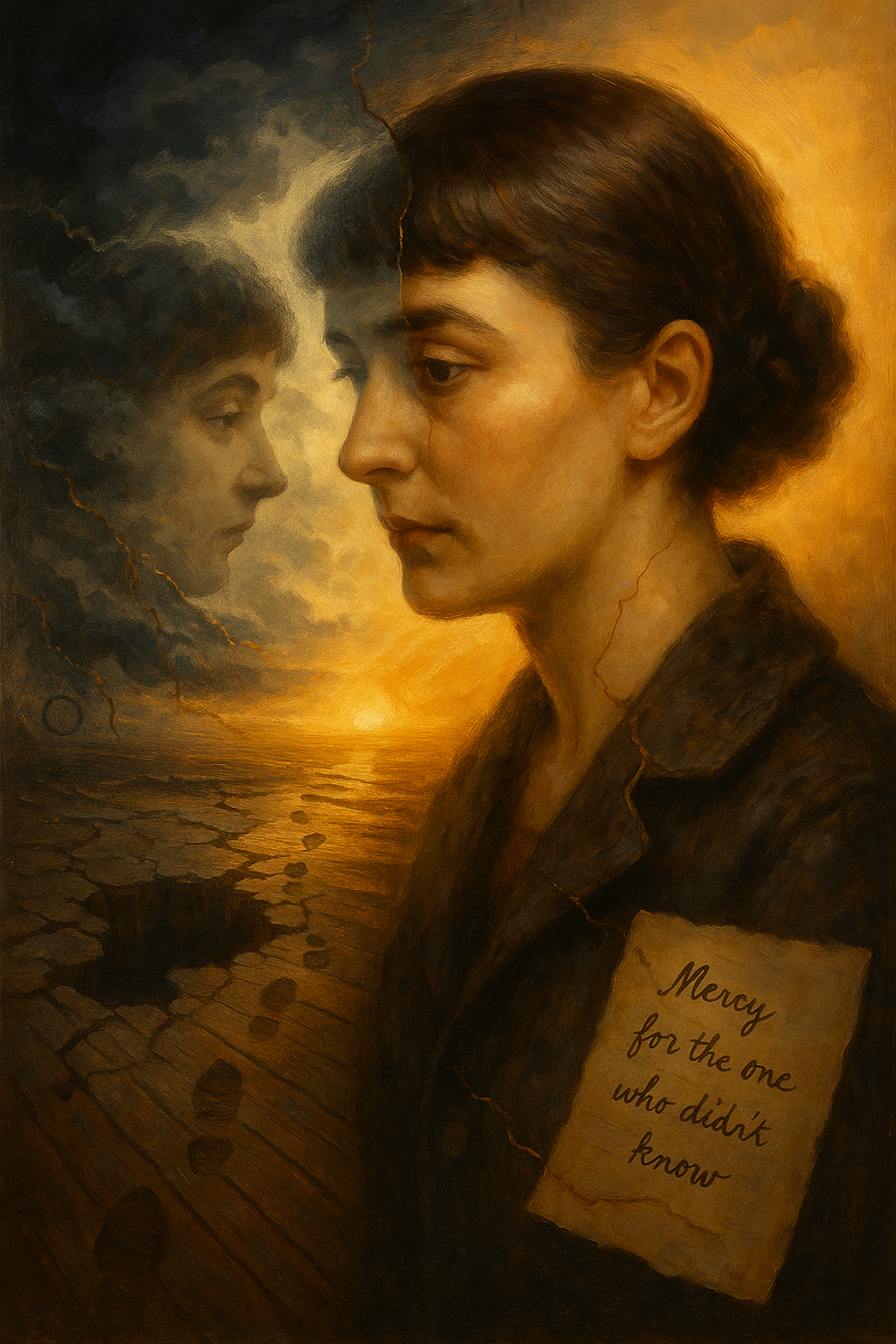
There are moments—quiet, piercing moments—when I look back and whisper to myself, “How could you not have known?” The tracks were everywhere. The chaos wasn’t subtle. The pain wasn’t discreet. And yet… I didn’t see. Or I couldn’t. Or I wouldn’t.
The truth is, I survived by not seeing.
Denial, I’ve come to understand, wasn’t my moral failure. It was my emotional shelter when the storm wouldn’t stop. It was how I stitched myself together when the narrative of my life couldn’t afford another tear. I didn’t consciously lie to myself—I did what I had to do to keep breathing in a world that made no sense.
In the family disease of alcoholism, denial isn’t a weakness. It’s a symptom. And often, it’s a sign of love distorted by trauma. Some of us deny the drinker has a problem. Others vilify the drinker so thoroughly we can’t see our own behaviors at all. Both are strategies of survival. Both are echoes of powerlessness.
But recovery has taught me another truth:
I am allowed to look back with mercy.
That former version of me—the one who overlooked the chaos, who blamed herself for everything or nothing, who flinched from truth as if it might bite—she was doing her best. That survival mode was sacred in its own way. It kept me alive long enough to arrive here, where something new could begin.
With Al-Anon’s tools, I no longer have to deny. I don’t have to contort reality into something palatable. I have the fellowship, the slogans, the Steps—and the grace—to face life as it actually is. I can let truth be truth without fearing it will break me.
And that’s where the shift happens:
I go from coping to living.
From hiding to healing.
From regret to redemption.
Because regret is a sinkhole. It swallows energy, hope, self-worth. And I’ve learned that I cannot build a single floorboard of new life on the foundation of “I should have known.”
Now I choose to build on compassion.
I build on courage.
I build on the quiet, daily decision to forgive the one who didn’t know—and to bless the one who’s learning now.
 Daily Reprieve
Leave a comment