Endigar 1004
From Courage to Change of Aug 21:
Some Al-Anon suggestions, such as getting a Sponsor, were easy for me because I’m good at following specific instructions. But I didn’t know what to do with the slogan, “Live and Let Live.” Al-Anon helped me to let live by teaching me about detachment and helping me to see that many of my problems stemmed from minding everyone’s business but my own. But how do you turn your eyes on yourself and “live” for the first time in your life?
When I put this question to my Sponsor, she asked me one in turn — what had I done earlier that day? Although I’d had a very busy day, I could barely remember what I had been doing. My Sponsor suggested that I begin learning how to live by becoming more aware of my life as I was already living it. Then I would be better able to make choices about how I would like to live.
Searching for the real me, living according to my needs, and loving myself as a new-found friend have been the most rewarding benefits of the Al-Anon program. Strangely, they’re the last ones I would have imagined receiving when I began.
Today’s Reminder
Today I can choose to take responsibility for my own life. If I stay out of others’ affairs and become more aware of my own, I have a good chance of finding some serenity.
“Each man’s life represents a road toward himself.”
~ Hermann Hesse
END OF QUOTE—————————————
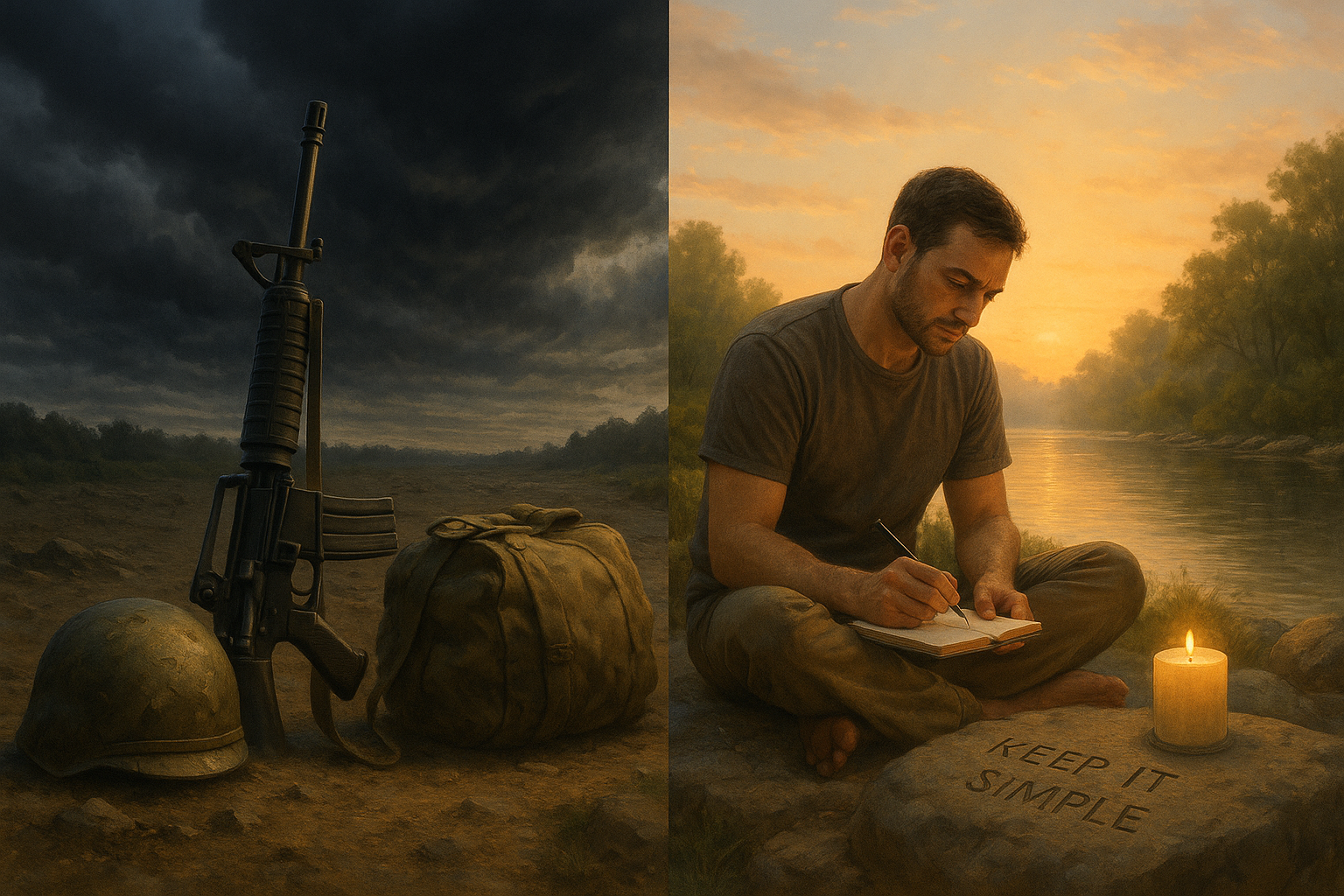
“Keep it simple.”
At first, I recoiled.
It sounded like a bumper sticker for the intellectually lazy—a slogan meant to quiet nuance and glorify ignorance. And I’ve always been someone whose mind loops, circles, and spirals. Complexity is my native tongue. I spent years inside mental architecture so elaborate it became a prison. So when I heard that I could be “too smart for this program,” it struck a nerve—because I was. And I was miserable.
But the longer I sat in rooms of recovery, the more I realized that simplicity wasn’t stupidity. It was clarity. And clarity, when you’ve been drowning in overthinking, is a kind of salvation.
I began to think of it like battlefield simplicity. In the military, I learned that sometimes you don’t need a theory—you need a plan. When the chaos storm hits, you don’t hold a seminar. You drop low, return fire, and get out alive. Recovery is no different. There are times when I must follow simple suggestions—not because I lack intelligence, but because the battlefield of my mind is on fire, and philosophizing during a trauma spiral is just a prettier way to bleed out.
So I stopped sneering at slogans and started listening to them like I once listened to field orders—calmly, steadily, with the humility of someone who wants to survive.
That’s when Keep It Simple became something else entirely.
It became a discipline of presence.
Instead of solving the mysteries of the universe before breakfast, I asked:
→ What did I actually do today?
→ Did the urgent devour the important?
→ Did I even notice my breath, my coffee, my soul checking in?
It reminded me of situational awareness. In uniform, that meant knowing your terrain, your mission, your blind spots. In recovery, it means the same—but the terrain is my emotional landscape, the mission is my serenity, and the blind spot is always ego or fear.
And then I heard Live and Let Live, and realized it was just another phrasing of what I’d learned in the service:
“Stay in your lane.”
Not out of apathy, but out of focus. Not because I don’t care, but because I finally care enough to respect the boundaries that keep us all spiritually alive.
Simplicity, then, isn’t about shutting down my intelligence—it’s about reclaiming it from chaos. It’s about choosing grounded clarity over clever disconnection. It’s about not outsmarting myself into a relapse of isolation and shame.
Today, I don’t need to be the smartest person in the room. I need to be the one who’s present, surrendered, and listening.
 Daily Reprieve
Leave a comment