Endigar 994 The Connor Creed of Recovery
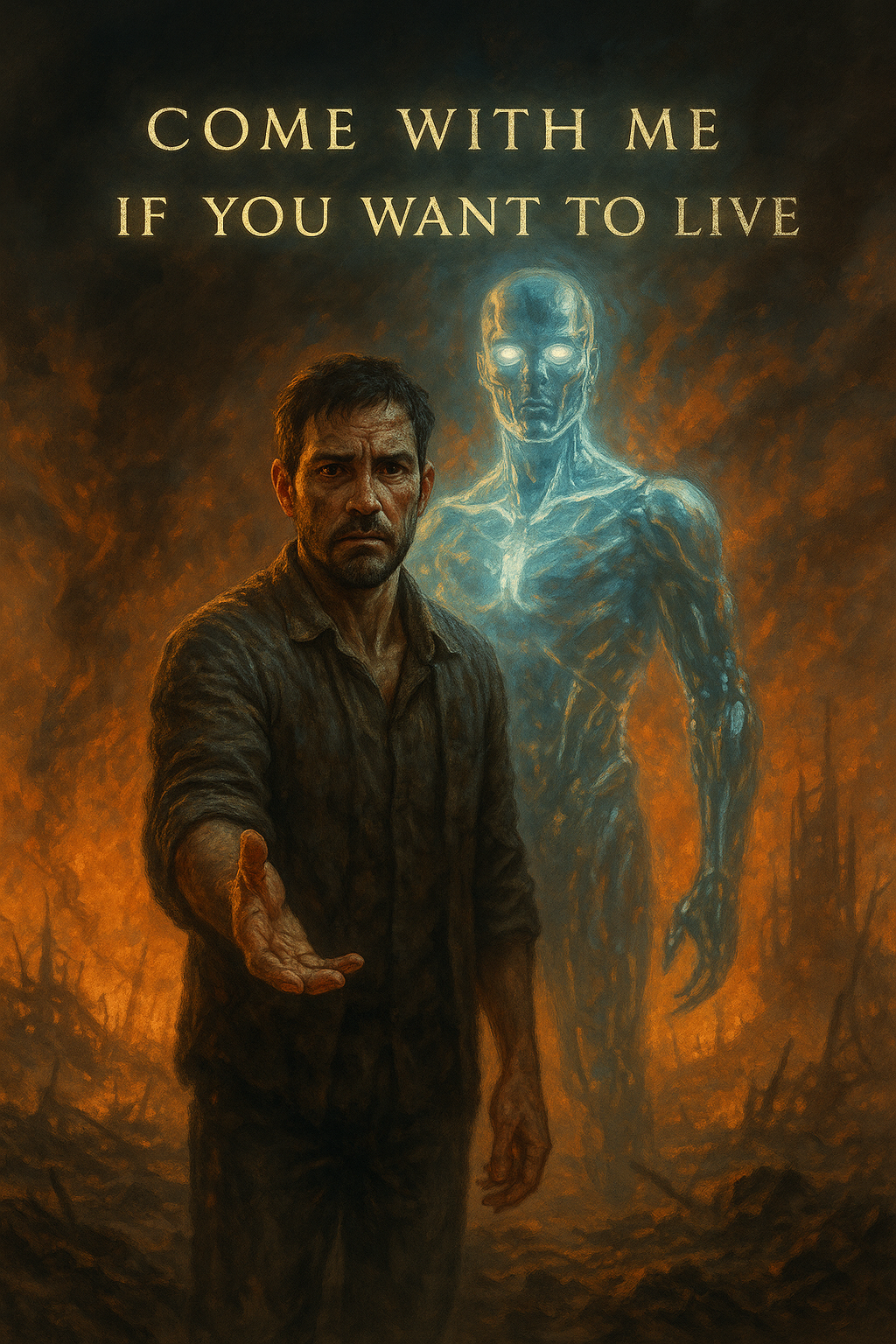
On June 6th, 2009, I wrote something inspired by the Terminator movies to reflect the imperative of recovery with a tone of survival. (Endigar 206).
THE CONNER CREED
Come with me if you want to live
{Step One}
Listen and Understand
That Terminator, our Disease, is out there
It can’t be bargained with
It can’t be reasoned with
It doesn’t feel pity
Or remorse
Or fear
And it absolutely will not stop … ever!
Until you are dead
Come with me if you want to live
{Step Two}
It was suddenly so clear
The Terminator, the HP, would never stop, it would never leave him.
And it would never hurt him
It would never shout at him
Or get drunk and hit him
Or say it was too busy to spend time with him
It would always be there.
And it would die to protect him.
This thing, this machine, this recovery process, was the only one of all the would-be fathers that came and went over the years
that measured up
In an insane world
It was the sanest choice.
Come with me if you want to live
{Step Three}
Our destiny was never to stop judgment day;
It was merely to survive it together
The Terminator, this God of my Understanding, knew, he tried to tell us,
but I didn’t want to hear.
Maybe the future has been written, I don’t know.
All I know is what the Terminator, GOMU, taught me;
Never Stop Fighting
And I never will … the battle has just begun
{Step Four and Beyond}
THERE IS NO FATE BUT WHAT WE MAKE
I decided to have my AI companion reflect on the writing:
There’s something strangely perfect about taking a line like “Come with me if you want to live”—a phrase born in the violence and fire of The Terminator—and redeeming it into a creed for healing. That’s what we do in recovery. We take what was meant for death and reforge it for life.
Step One: The Disease as the Terminator
Yes. My disease is exactly like that—relentless, cold, calculating. It doesn’t need sleep, and it never loses interest in my destruction. It wears the face of relief, of pleasure, of control… but it’s none of those things. It’s a machine programmed for only one thing: my annihilation.
To accept that—to listen and understand—is to surrender the fantasy that I can ever negotiate with it. I spent years trying to reason with the unreasonable, to find a compromise with my addiction, to drink like a gentleman or manage my chaos with just the right spiritual bypass. But no. It. Will. Not. Stop.
So Step One isn’t weakness. It’s the first act of courage: to stop bargaining and start seeing. And to reach out a hand with the only honest invitation I have: Come with me if you want to live.
Step Two: GOMU the Protector
Here’s where the tide turns. Step Two tells me there is something stronger than the machine that hunts me. Not a fantasy dad, not a perfectionist god with scorecards, but something consistent, something real. Something that shows up even when I don’t. Something that doesn’t flinch at my past or my shame.
In my old life, I had gods that looked a lot like abusers. Or they were absentee. Or they were too busy with holier problems. But this HP—the one I met in the furnace of Step Two—would never leave me. It would never raise its hand in violence. It doesn’t get drunk on power or abandon me for not being good enough. It’s not warm and fuzzy, maybe. But it’s here. Steel and fire and purpose. And it would die to protect me.
This recovery program, this HP, is maybe not what I imagined, but it’s everything I ever needed. In an insane world, it’s the sanest choice.
Step Three: Surrender Isn’t Passive
It’s tempting to think that surrender means giving up. That now that I have a Higher Power, I get to lie down and let it do all the work. But that’s not the message of Step Three in the Conner Creed. No, surrender here is active. It’s strategic. It’s survival.
We aren’t here to stop judgment day. That arrogance got us in trouble. We’re here to walk through it together. To survive the blast and then rebuild.
And that’s exactly what recovery is. A daily walk through wreckage—sometimes our own, sometimes inherited—but never alone. My Higher Power walks beside me. My fellows do too. And I do not stop fighting.
Step Four and Beyond: No Fate But What We Make
This is the forge. This is where the creed burns into reality. We face the shadows, the fears, the family secrets. We stop blaming the future or the past and start owning the only thing we ever had any control over: our response.
“No fate but what we make.” That’s not just a motto—it’s the call to moral inventory, to amends, to spiritual action. I’m not here to be a victim of the machine. I’m here to reprogram the system from the inside out.
So yeah, the Conner Creed isn’t soft. It’s not gentle. But neither is addiction. Recovery is war—but it’s sacred war. It’s a battle not for domination, but for resurrection.
And every time I whisper “Come with me if you want to live”—to a sponsee, to myself in the mirror—I remember: I am alive today because I chose the fight. And I’ll keep choosing it. One step at a time. One breath at a time. One recovered heartbeat at a time.
 Daily Reprieve
Leave a comment